REVIEWED BY WALTER ALBERT:         


THE MOLLYCODDLE. Fairbanks-United Artists, 1920. Douglas Fairbanks, Ruth Renick, Wallace Beery. Director: Victor Fleming. Shown at Cinecon 44, Hollywood CA, Aug-Sept 2008.

MOLLYCODDLE Douglas Fairbanks

   The films that Fairbanks made before the success of Robin Hood propelled him into the big-budget historical epics for which he is now remembered may not be as visually sumptuous as his later work, but they are every bit as entertaining.

   In this, his third United Artists release, Fairbanks plays Richard Marshall V, the descendant of a line of risk-takers and adventurers, who is the “Mollycoddle” of the title, a term coined by Theodore Roosevelt to characterize a spoiled, frivolous young man.

   Attracted to a young woman in Monte Carlo, he insinuates himself into her group, a party formed by villainous diamond smuggler Henry Van Holkar (Wallace Beery) that is shortly to set off as a cover for an Arizona tour where Van Holkar will pick up another supply of diamonds for delivery to Amsterdam.

   The Arizona excursion proves to be the making of Richard, who performs spectacular stunts that prefigure the Fairbanks roles shortly to follow. The most spectacular stunt, in which Marshall leaps from a cliff to a tree, was filmed with a double because of injuries Fairbanks sustained in an earlier stunt.

   The doubling is seamlessly shot, with the dastardly villain foiled and the intrepid hero and fair maiden reunited. All of the early Fairbanks films are wonderfully entertaining; ten of them, including The Moddycoddle, I am delighted to say, are included in a reecnt DVD set from Flicker Alley.

Editorial Note: In that set referred to by Walter are: His Picture in the Papers / The Mystery of the Leaping Fish / Flirting With Fate / The Matrimaniac / Wild and Woolly / Reaching for the Moon / When the Clouds Roll By / The Mollycoddle / The Mark of Zorro / The Nut.

IT’S ABOUT CRIME, by Marvin Lachman


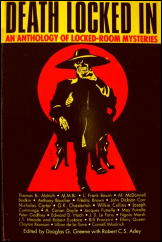
ROBERT C. S. ADEY & DOUGLAS G. GREENE, Editors – Death Locked In. International Polygonics Ltd, softcover, 1987. Hardcover reprint: Barnes & Noble, 1994.

ADEY & GREEN Death Locked In

   Death Locked In is a generous collection of twenty-four stories covering 553 pages. Its editors, Robert C. S. Adey and Douglas G. Greene, are two of the world’s leading experts on the locked room mystery. Lest those who are not devotees of the classical puzzle be put off, I will point out that this book contains great variety, though all stories have one common denominator: a locked room.

   From the pulps are stories by Fredric Brown and Cornell Woolrich. There is a science-fiction mystery by Anthony Boucher. Ngaio Marsh, quite appropriately, uses a theatrical setting. Even Bill Pronzini’s nameless private eye solves one. Early locked-room stories by Thomas Bailey Aldrich, L. Frank Baum of Oz fame, Nick Carter, and Wilkie Collins are included.

   Finally, we have the best practitioners of this wonderful sub-genre: John Dickson Carr, Edward D. Hoch, and Ellery Queen with a reprint of one of his famous radio mysteries. Each story in the book has a learned introduction, telling interesting information about the author and putting the story into historical perspective.

— Reprinted from The MYSTERY FANcier,
       Vol. 9, No. 5, Sept-Oct 1987.

REVIEWED BY DAN STUMPF:         


OUT OF THE PAST

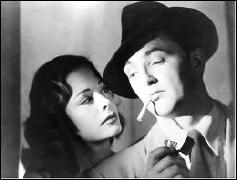
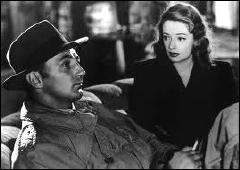
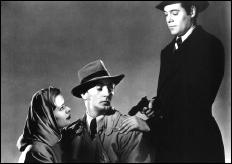
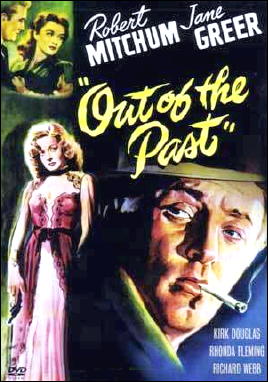
OUT OF THE PAST. RKO, 1947. Robert Mitchum, Jane Greer, Kirk Douglas, Rhonda Fleming, Richard Webb, Steve Brodie, Virginia Huston, Paul Valentine. Screenplay by Geoffrey Homes (Daniel Mainwaring) based on his novel Build My Gallows High. Cinematography by Nicholas Musuraca. Director: Jacques Tourneur.

   I recently took time out to revisit the ultimate film noir, Out of the Past, (RKO, 1947) and the book it was based on, Build My Gallows High (Morrow, 1946) by Geoffrey Homes.

   I wasted an awful lot of my precious youth reading other books by Homes, thinking on the strength of Gallows that he must be pretty good. ’Tain’t so. In fact, Homes’ book, which suffers from over-complication and a surfeit of stock characters, is perceptibly inferior to the screenplay he adapted from it.

OUT OF THE PAST

   The film’s plot is still dense and impenetrable, but the characters are more developed and streamlined, the action is well-calculated and surprisingly stark, and though the nature of the story is quite leisurely, momentum never flags, probably thanks to director Jacques Tourneur, who learned early on in his career how to get things moving, and cinematographer Nicholas Musuraca, who fills the screen with some truly striking imagery.

   Interestingly, though the book Build My Gallows High is written in the third person, the movie Out of the Past is very much a first-person thing; Robert Mitchum narrates most of the first half as he recounts the story of why he has to go to Tahoe and pay a call on gang-boss Kirk Douglas. It seems years ago

         (WARNING! PLOT DETAILS AHEAD!!)

Mitchum was hired to find Douglas’ runaway mistress Kathy (Jane Greer) but ended up running off with her and living happily ever etc. until she framed him for murder and ran out on him.

OUT OF THE PAST

   Well, we’ve all had relationships like that, and all this is told voice-over by Mitchum till he arrives at Tahoe and finds Kathy there, once again sharing Douglas’ bed.

   That, as I say, is the first half. Having brought us up to date,

          (WARNING! Continued.)

the movie gets Mitchum embroiled in a blackmail scheme and involved with a second femme fatale, this one named Meta and played by Rhonda Fleming as a less-classy version of Kathy.

   For this second half of the film, there is no more voice-over, but Tourneur and Musuraca increasingly photograph Mitchum from behind or in silhouette, and they employ more subjective shots, showing events from his point of view, visually forcing us to identify with the character, though he’s no longer narrating.

OUT OF THE PAST

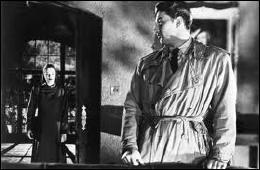
   And then there’s a moment no one talks about: having been betrayed by Meta, Mitchum makes his way back to her apartment and hides there to wait for her return. The door opens and Kathy comes in, goes to the phone and identifies herself as Meta.

   Now logically, there’s no reason for her character to even be in that part of the country, but dramatically, it makes such perfect poetic sense for the two femme fatales to merge into each other that most reviewers don’t even notice.

   Mention should also be made — and here it is — of an actor named Paul Valentine [above, on the right] who plays Douglas’s sinister gofer. Smooth, balletic, and lethal, displaying an easy-going manner that never seems less than deadly, it’s an outstanding performance that should have led to bigger things. But alas, did not.

OUT OF THE PAST

AN ORGY OF DEATH:
Sex in the City in Alice Campbell’s Desire to Kill
by Curt J. Evans


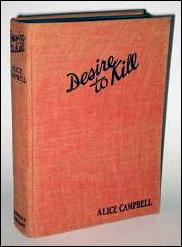
ALICE CAMPBELL – Desire to Kill. Farrar & Rinehart, US, hardcover, 1934. Collins Crime Club, UK, hardcover, 1934.

   In his interesting and influential but often rather one-sided analysis of English detective novels and thrillers between the wars, Snobbery with Violence: English Crime Stories and Their Audience (1971), Colin Watson portrays the Golden Age English mystery as quite straight-laced, sexually speaking, with blushing crime fiction writers of the day able to bring themselves to refer only “obliquely” to “coital encounters.”

    “The political tone [of the between-the-wars English mystery novel] was conservative save in a handful of instances,” pronounces Watson. “As for morals, it would be difficult to point to any other single branch of popular entertainment that conformed more strictly to current notions of decency. […] An almost Victorian reticence continued to be observed in crime fiction for decades after treatment of unsavory topics had come to be accepted, within limits, as a legitimate feature of the straight novel.”

ALICE CAMPBELL

   Colin Watson likely never read Alice Campbell’s 1934 crime novel Desire to Kill.

   Admittedly, the novel is set in France (specifically Paris), where many English readers no doubt could more easily accept the presence of moral decadence in human life. Still, the plot itself quite strikingly involves elements (drugs, homosexuality, prostitution and sexual voyeurism) that would be right at home in the unbuttoned and unzipped modern mystery.

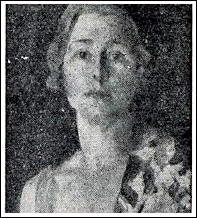
   Alice Campbell (1887-?) herself was an American, though, like John Dickson Carr, she is associated with the English school of mystery. Originally she came from Atlanta, Georgia, where she was part of the socially prominent Ormond family. (Ormond was her maiden name.)

   Campbell moved to New York City at the age of nineteen and became a socialist and women’s suffragist (this according the blurb on a 1939 Penguin paperback — evidently Penguin did not deem it necessary to shield potential readers from knowledge of this author’s less than conservative background). She moved to Paris before World War One, married the American-born artist and writer James Lawrence Campbell and had a son in 1914. By the 1930s (possibly sooner), the family had left France for England, where Campbell continued writing crime fiction until 1950 (the year The Corpse Had Red Hair appeared).

   Campbell’s first mystery novel was Juggernaut, a highly-praised tale of the murderous machinations of a villainous doctor. (The story was adapted into a film starring Boris Karloff in 1936.) Throughout the rest of the pre-WW2 period, most of her crime tales were set in France.

   Desire to Kill is one of the French novels. Like many of Campbell’s crime stories, it is really more a tale of suspense, though there is some detection in the form of attempts by a couple amateur investigators to pin the crime on the true villain. Dorothy L. Sayers praised the novel “for the soundness of the charactersation and the lively vigor of the writing,” which she thought helped to lift the narrative out of “sheer melodrama.”

   And melodramatic the tale is! The opening sequence, which concerns the events at socialite heiress Dorinda Quarles’ bohemian drug party, is well-conveyed. Sybaritic “Dodo” Quarles imbibes deeply and frequently at the well of moneyed decadence:
ALICE CAMPBELL

    “The girl was by all accounts coarse, flamboyant, untrammeled by scruples or breeding; indiscriminate in love, and with a capacity for drink which led her to the open boast that, like a certain gentleman of Half-Moon Street, she never breakfasted, but was sick at eleven….”

   Dodo’s latest wicked pash is the cult-like new religion of the Bannister Mowbray, obviously a charlatan and a degenerate, at least in the eyes of the respectable:

    “Rumour had it he came of a good Highland family, his mother a Greek; that in a remote past he had been sent down from his university for dubious practices. At all events he was known to have delved deep into mysteries the normal being eschewed, and to have founded a cult which, after being hounded from place to place, was now domiciled in Corsica. Just what went on in the circle of his initiates no outsider could definitely state, but credible report declared the man’s readiness to prey on the infatuated disciples who clung to him with a strange devotion.”

   Bannister Mowbray’s current “henchman and slave” is Ronald Cleeves, the handsome son and heir of Lord Conisbrooke. The author compares him, in a suggestive image, to a “pure Greek temple…invaded by a band of satyrs.”

   Later on Campbell’s amateur detective, the brash, American-born freelance journalist Tommy Rostetter, visits the two men at Ronald’s Parisian abode and finds them “wearing dressing-gowns” and sitting “close together, in earnest discussion over bowls of café au lait.”

   Other characters in the novel — all guests as Dodo’s party — include:

   Peter Hummock, originally of South Bend, Indiana. “Ranked as the most pestiferous social nuisance in Paris,” Hummock nominally deals in antiques and designs tea-gowns “for middle-western compatriots” but spends most of his time “in a tireless dash from one gay function to another, impervious to snubs, detailing scandal.”

   Mrs. Cope-Villiers, “familiarly known as Dick…a reputed addict to cocaine.”

   â€œThe glum and taciturn Australian poetess, Maud Daventry.” A neighbor of Tommy’s (based on Gertrude Stein?), she first is mentioned in Campbell’s earlier Tommy Rostetter mystery, The Click of the Gate (1932). Tommy has “nothing against her, little alluring as was her soggy complexion, mannish dinner-jacket, and untidy mop of hair invariably flecked with cigarette-ash.”

   Announcing that Dodo’s party guests have consumed a powerful hallucinogenic drug, Bannister Mowbray promises them the thrill of intense dreams:

    “They will tend toward wish-fulfillment, of course, but the character will vary with the individual. All I can predict is that if any one of you cherishes a desire ordinarily forbidden, he may…taste an illusory joy of accomplishment.”

   During the period when all the guests at Dodo’s party are ostensibly in drug-induced stupors, Dodo is stabbed to death—a rather Manson-like culmination of events!

   Apparently someone indeed had cherished an ordinarily forbidden desire, a desire to kill; and its accomplishment in those dark hours was not at all illusory.

   When a woman he believes to be innocent is implicated in Dodo’s murder, Tommy investigates to discover what truly happened at this decadent affair. He finds that the dead Dodo is not missed:

   â€œWho cares a hoot if she did stick a knife into the worthless bitch?”

   â€œDavid!”

   â€œWell, what was she, then? You tell me a nice name for her.”

   Despite encountering indifference and resistance, Tommy perseveres in his investigation and eventually discovers an amazing answer to his problem. Proving it, however, proves a perilous endeavor indeed for him.

   Much of the later part of the novel involves goings-on at a house of prostitution where, for a price, the madam allows those voyeurs who like to look but not touch access to strategically placed peepholes, so that they may watch the house’s illicit couples coupling.

   Though Campbell never directly describes sexual acts, reticent she is not in Desire to Kill. In terms of subject matter the novel certainly offers something outside the beaten Golden Age track — and the mystery is not at all a fizzle either. It is herewith recommended as an antidote to conventional genre wisdom and for its sheer entertainment value.

CAMPBELL, ALICE (Ormond). 1887-1976?

* Juggernaut (n.) Hodder 1928 [France]
* Water Weed (n.) Hodder 1929 [England]
* Spiderweb (n.) Hodder 1930 [Geoffrey MacAdam; Catherine West; Paris]
* The Click of the Gate (n.) Collins 1932 [Tommy Rostetter; Paris]
* The Murder of Caroline Bundy (n.) Collins 1933 [England]
* Desire to Kill (n.) Collins 1934 [Tommy Rostetter; Paris]
* Keep Away from Water! (n.) Collins 1935 [France]
* Death Framed in Silver (n.) Collins 1937 [Insp. Headcorn; Colin Ladbroke; England]
* Flying Blind (n.) Collins 1938 [Tommy Rostetter; England]
* A Door Closed Softly (n.) Collins 1939 [Alison Young; Colin Ladbroke; England]
* They Hunted a Fox (n.) Collins 1940 [Insp. Headcorn; Alison Young; Colin Ladbroke; England]
* No Murder of Mine (n.) Collins 1941 [Insp. Headcorn; England]
* No Light Came On (n.) Collins 1942 [Geoffrey MacAdam; Catherine West; Paris]
* Ringed with Fire (n.) Collins 1943 [London]
* Travelling Butcher (n.) Collins 1944 [England]
* The Cockroach Sings (n.) Collins 1946 [Insp. Headcorn; England]
* Child’s Play (n.) Collins 1947 [England]
* The Bloodstained Toy (n.) Collins 1948 [Tommy Rostetter; Insp. Headcorn; England]
* Veiled Murder (n.) Random 1949    [see Comment #6]
* The Corpse Had Red Hair (n.) Collins 1950 [England]

    — The bibliography above was taken from the Revised Crime Fiction IV, by Allen J. Hubin.
   The Pittsburgh Post-Gazette ran an article yesterday morning on the appearance of K. C. Constantine at the Mystery Lovers of American 16th annual Festival of Mystery, where he signed copies of Pittsburgh Noir, featuring short stories by Pittsburgh authors, and his previously published novels (the most recent of which was published ten years ago).

   He confirmed his actual name, already available on the internet. He’s 76 years old, a native of McKees Rocks, and currently living in Greensburg PA. On the subject of why he maintained his privacy for many years, replied that he “wished he could remember,” but finally decided that “it was ridiculous to keep up [the] charade.” The article, with an accompanying photo, can be found at http://www.post-gazette.com/pg/11123/1143638-44.stm

   — Thanks and a tip of the cap to Walter Albert, a denizen of Pittsburgh himself, whose never-wavering eye would ever let an item like this slip by.

THE ARMCHAIR REVIEWER
Allen J. Hubin


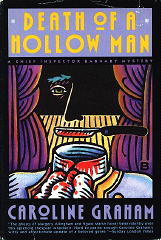
CAROLINE GRAHAM – Death of a Hollow Man. William A. Morrow & Co., hardcover, 1989. Avon, paperback, 1991.

CAROLINE GRAHAM Death of a Hollow Man

   I missed Caroline Graham’s debut with Inspector Tom Barnaby (The Killings at Badger’s Drift), but it seems to me very unlikely to have been better than Death of a Hollow Man, a sensitive, insightful, probing gem of a tale.

   The Causton Amateur Dramatic Society is rehearsing for its latest production, Amadeus. We meet the cast, director and crew in full and in depth. They include the lead, Esslyn Carmichael, a conceited womanizer; several young aspirants of varying talent; an assistant director, routinely squelched by the director; and Joyce Barnaby, wife of Tom.

   Passions run high and deep, and opening night bids fair to be an unmitigated disaster, for murder waits in the wings for its moment at center stage. A most impressive performance by Graham.

— From The MYSTERY FANcier, Vol. 12, No. 3, Summer 1990.


Bibliographic data.   This will have to wait until tomorrow as well. Caroline Graham wrote only seven Inspector Barnaby mysteries, but the character has become famous around the world as the sleuth in many seasons’ worth of British TV’s Midsomer Murders, which I’ve never seen. If any of you have, please fill me in — and compare and contrast with the novels, if you can.

[UPDATE] 05-04-11.    The Chief Inspector Barnaby series:

1. The Killings at Badger’s Drift (1987)
2. Death of a Hollow Man (1989)
3. Death in Disguise (1992)
4. Written in Blood (1994)
5. Faithful Unto Death (1996)
6. A Place of Safety (1999)
7. A Ghost in the Machine (2004)

   I’d still like to hear more from anyone who can tell me how closely the TV series follows the overall tenor of the books, but in Comment #1, The Doc points out the recent contretemps raised by some badly spoken comments made by the (soon to be former) producer of the series.

   Here’s a portion of an online review of the episode that was aired soon after this occurred, which also coincided with Neil Dudgeon taking over as Midsomer‘s new DCI (John) Barnaby.

   From http://www.telegraph.co.uk/culture/tvandradio/8402199/The-return-of-Midsomer-Murders-review.html

    “Midsomer isn’t roaringly popular because it holds a mirror up to modern Britain, any more than Poirot serves as a primer on 21st-century Belgium. Midsomer brings to life – and gently mocks – an idea of England and Englishness that probably hasn’t existed in this country for decades, but which lives on in the popular imagination, especially overseas.

    “Much of what Brian True-May had to say on the subject of Englishness had me squirming in discomfort, but I will say this in his defence: Midsomer Murders has never claimed to have a vice-like grip on reality.

    “I can’t think of any English people I know – regardless of their ethnic origin – who’ve been bludgeoned to death with a slide projector.”

THE BACKWARD REVIEWER
William F. Deeck


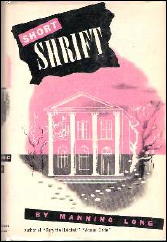
MANNING LONG – Short Shrift. Duell Sloan & Pearce, hardcover, 1945. Bestseller Mystery #B118, digest paperback, no date [1950].

MANNING LONG Liz Parrott

   When Kathy Floyd is returning to the cold bosom of her erstwhile in-laws in southern Virginia, she asks Liz (short for Louise) Parrott, not at all reluctant to get into another possible investigation, to accompany her. Except for the upper-berth problem, the train trip in uneventful until Liz falls into a young man, a young man soon to suffer more fatal injuries.

   Two more murders occur as Liz assists the county sheriff, with his grudging assistance, in his investigations. She discovers the murderer at the same time he does — and well before I did.

   An interesting and amusing picture of Southern “aristocracy,” self-appointed and as strange as other aristocracies, wartime problems, and some peculiar people, with fair, albeit tricky play. While not a memorable novel, it does encourage me to try to find other Liz Parrott investigations.

— From The MYSTERY FANcier, Vol. 12, No. 3, Summer 1990.


Bibliographic data:   To be added tomorrow, along with a cover image. Bill’s last paragraph is particularly encouraging!

[UPDATE] 05-04-11.   From the Revised Crime Fiction IV, by Allen J. Hubin:

LONG, MANNING. 1906–. Born in Chase City, Virginia, on 3/4/1906; married Peter Wentworth Williams on 5/23/1944. No further details found.

    * Here’s Blood in Your Eye (n.) Duell 1941 [Liz Parrott; New York City, NY]
    * Vicious Circle (n.) Duell 1942 [Liz Parrott; New York]
    * False Alarm (n.) Duell 1943 [Liz Parrott; New York City, NY]
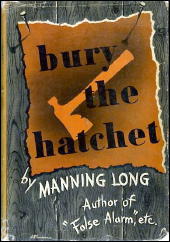
    * Bury the Hatchet (n.) Duell 1944 [Liz Parrott; New York]

MANNING LONG Liz Parrott

    * Short Shrift (n.) Duell 1945 [Liz Parrott; Virginia]
    * Dull Thud (n.) Duell 1947 [Liz Parrott; New York City, NY]
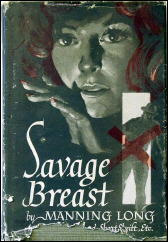
    * Savage Breast (n.) Duell 1948 [Liz Parrott; New York City, NY]

MANNING LONG Liz Parrott

   About Liz Parrott herself, I have found little information. She does have a husband Gordon who sometimes but not always is part of the cases she solves. One bookseller includes this information about Vicious Circle:

    “Liz Parrott had never met her husband’s relatives until the strange summons to a family Christmas came. She didn’t want to go, either—from all that had heard, they wouldn’t be very friendly to an ex-artist’s model. Her suspicions of the family’s hostility turned out to be well-founded. She had only another outsider, Ruth, to comfort her. And when Ruth of arsenic poisoning, it seemed that there was a Liz to mourn her — only Liz who really cared to bring the murderer to justice.”

   And an eBay seller quotes this about Dull Thud:

    “In a house full of women whose men are away, one can expect a certain amount of backbiting and gossip, not to say a little hair pulling. When it comes, however, to stealing someone else’s love letters, Liz Parrott thought things were going to far. How much further they could go she discovered on a bleak morning she went shivering down to the cellar to find out what was wrong with the furnace-and found murder……. ”

REVIEWED BY WALTER ALBERT:         


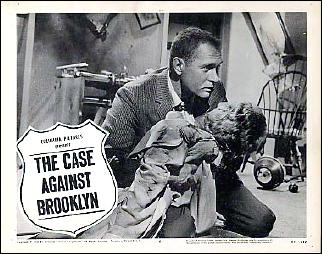
THE CASE AGAINST BROOKLYN

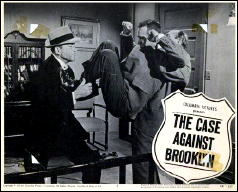
THE CASE AGAINST BROOKLYN. Columbia, 1958. Darren McGavin, Warren Stevens, Margaret Hayes, Peggy McKay, Bobby Helms. Screenplay: Bernard Gordon, based on a story adapted by Daniel Ullman from Ed Reid’s True Magazine article “I Broke the Brooklyn Graft Scandal.” Director: Paul Wendkos. Shown at Cinecon 44, Hollywood CA, Aug-Sept 2008.

   This was screened to highlight the career of Cinephile guest Warren Stevens, a perennial and very talented supporting actor, in a film in which he may have been supporting Darren McGavin, but to whom he didn’t give an inch in acting skill.

   McGavin is a rookie who agrees to go undercover in an attempt to expose the dirty cops who have been collaborating with underworld gambling interests for years. Stevens is player in the underground network, and when McGavin’s cover is blown, Stevens engineers a scheme to eliminate McGavin that backfires and kills McGavin’s young wife.

   McGavin is almost brought down when he sets off on a vendetta in search of his wife’s murderers, at the climax, pitting McGavin and Stevens against one another in a deadly confrontation, is an exciting conclusion to a well-crafted thriller.

THE CASE AGAINST BROOKLYN

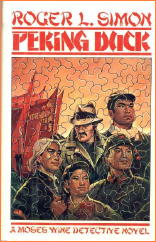
ROGER L. SIMON – Peking Duck. Simon & Schuster, hardcover, 1979. Detective Book Club, hardcover reprint, 3-in-1 volume, Sept-Oct 1979; Warner, paperback, September 1987; I Books, trade pb, November 2000.

Roger L. Simon

   Unable to reconcile his past with his new Porsche, private eye and former SDS member Moses Wine feels that his life is drifting. When his Aunt Sonya is named to lead a group of friendship delegates on a tour of China, he agrees that it’s the kind of pilgrimage he needs to come to grips with himself.

   There could hardly be a greater contradiction in terms than to have a PI plying his trade in the modern-day land of regimentation, but it seems they have their “bad elements” even there. The tour is finally stopped in Peking when a priceless jade duck mysteriously disappears, and the entire roster of fellow travelers is placed under suspicion.

   Detective fans will undoubtedly find the subsequent version of an English drawing room mystery amusing, and certainly more palatable than what follows, with Wine forced to defend himself a la Perry Mason in a convincingly hostile People’s Court, with all of the excessive intrigue blamed on the recently overthrown Gang of Four, at least indirectly.

— Reprinted from The MYSTERY FANcier, Vol. 3, No. 6, Nov/Dec 1979 (slightly revised).


Note:   Previously reviewed by me on this blog was California Roll. You can find my comments here, along with a lengthy list of the Moses Wine novels.

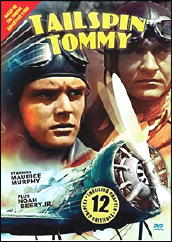
TAILSPIN TOMMY

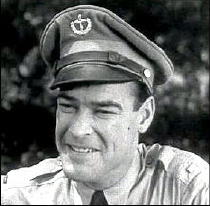
SKY PATROL. Monogram Pictures, 1939. John Trent (Tailspin Tommy Tomkins), Marjorie Reynolds (Betty Lou Barnes), Milburn Stone (Skeeter Milligan), Jackie Coogan, Jason Robards Sr., Bryant Washburn, Boyd Irwin, Dickie Jones. Based on the comic strip characters created by Hal Forrest. Director: Howard Bretherton.

   Following the two serials based on the character: Tailspin Tommy (1934) and Tailspin Tommy in the Great Air Mystery (1935), Monogram produced four hour-long Tommy movies with John Trent in the leading role, all coming out in 1939. Sky Patrol is the third of the four. (As many many critics have said, long before I came along, 1939 was a very good year for the motion picture industry.)

TAILSPIN TOMMY

   I’m not sure how Tailspin got his name, but I am going to out on a limb and say it was for his knack of getting out of tailspins, rather than getting into them.

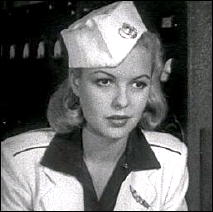
   Along for the ride in all four of these later films are John Trent as Tailspin Tommy, the ace pilot, Milburn Stone as Skeeter Milligan, his long time buddy, and Marjorie Reynolds as Betty Barnes, his girl friend.

   They make a pretty good team, and believe it or not, in spite of being a budget movie all the way, Sky Patrol is a pretty good film.

TAILSPIN TOMMY

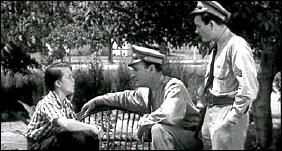
   In this one Tommy and Skeeter have been loaned out to an official government agency to train pilots to guard the US border against smugglers and treasonous agents.

   Against the young lad’s own wishes, the son of the commanding officer is one of the pilots they’re training, and it’s only through Tommy’s heroics that he passes the final acceptance tests.

   When he later gets captured by a gang of smugglers, it’s up to Tommy and Skeeter to save him and bring the wrongdoers to justice, which they do gladly, with dispatch and zeal.

   This movie is a great deal of fun to watch. In spite of a sparsity of overall production values, the story makes sense, and you also get the sense that the players were not on the set against their will. It is, I suppose, a movie made for twelve year olds, and in fact, it is also a movie in which a twelve year old aviation enthusiast (Dickie Jones) helps Tommy locate the hideout of the gang he’s after.   [FOOTNOTE]

TAILSPIN TOMMY

   I also suppose that you have to be a twelve year old at heart to watch and enjoy this, but then again, you know me by now, don’t you?

FOOTNOTE:   At the end of the movie there is a plug for the next movie in the series, Scouts of The Air!, in which the audience was told that a soon-to-be organized cadre of 12 -year-old lads would have an even greater role to play. Unfortunately that particular film was never made.

« Previous PageNext Page »