REVIEWED BY TINA KARELSON:         


PHILIP PULLMAN The Ruby in the Smoke

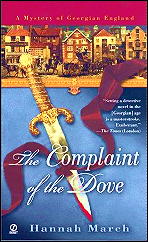
PHILIP PULLMAN – The Ruby in the Smoke: A Sally Lockhart Mystery. Oxford University Press, hardcover, 1985. Reprinted many times, in both hardcover and soft. TV movie: BBC, 2006 (with Billie Piper as Sally).

   First published in the U.K. in 1985, this was published in the U.S. in 2008, after the success of Pullman’s “His Dark Materials” trilogy. It’s more of an adventure story taking place in London, 1852, than a mystery, in the vein of the penny dreadfuls that the character Jim devours.

   In this first book in the series, 16-year-old Sally receives a mysterious note related to the death of her father, a shipping agent who drowned in the South China Sea. As she begins to investigate the note, Sally tumbles headlong into a mystery involving opium, pirates, Chinese secret societies, the seamiest areas of Victorian London, a legendary ruby and the truth about her own identity.

   It’s a quick read, awash in Pullman’s wonderful writing. Here’s the sailor Bedwell describing how the sea looked the night Sally’s father died:

PHILIP PULLMAN The Ruby in the Smoke

    “Our wake and our bowwave were great swirling tracks made up of billions of spots of white light, and all the sea on both sides was full of deep glowing movements — fishes darting through the depths, great shimmering clouds and veils of shadowy color, little surges and whirlpools of light far below — once or twice in your life you get a night like that, and it’s a sight to leave you breathless.”

   Recommended for craft and atmosphere.

    Bibliographic Data:

       The Sally Lockhart series —

    1. The Ruby in the Smoke (1985)
    2. The Shadow in the Plate (1986) aka The Shadow in the North (US)
    3. The Tiger in the Well (1990)
    4. The Tin Princess (1994)

REVIEWED BY GEOFF BRADLEY:         


BLUE MURDER. ITV, UK. Season Five: 7 September to 12 October 2009. Paul Loughran, Nicholas Murchie, Caroline Quentin, Ian Kelsey, Ceallach Spellman, Eden Garrity.

BLUE MURDER

   This series, with Caroline Quentin as D. C. I. Janine Lewis juggling her job and the needs of her children, usually to the detriment of the latter, has combined the occasional good plot with a lot of uninteresting family squabbles.

   This new series (6 one-hour parts, less adverts) was a big improvement with Lewis concentrating on her work and her team, whose deficiencies were previously well to the fore, actually seemed efficient.

   The series dipped a little with a two-part finale when Lewis’s family problems cropped up again and the team took so many liberties with police procedure (or what is shown as police procedure on other programmes) that disbelief had to be firmly suspended.

   Nevertheless this was a series I enjoyed.

ROUGH COUNTRY “MAN ON THE RUN” THRILLERS
A Top Twenty List by David L. Vineyard


   Using the rural or what I like to call the Rough Country definition of “Man on the Run” thrillers, here’s a stab at a top twenty. This comes with the caveat that I’m limiting it to one by each author or it could end up a list of no one but Buchan and Household.

   I’ll start with Buchan since he invented the modern variation on the theme. Of course this is going to be even more subjective than usual. I’m leaving off The Riddle of the Sands by Erskine Childers since it fits all of the qualifications but the hunted man, and Oppenheim’s The Great Impersonation because much of it takes place in an urban setting. First a quick list of books predating the genre that greatly influenced it:

   1. Kidnapped by Robert Louis Stevenson
   2. Kim by Rudyard Kipling
   3. King Solomon’s Mines by H. Rider Haggard
   4. The Four Feathers by A. E. W. Mason
   5. The Prisoner of Zenda by Anthony Hope

    An asterisk represents a film version — in some cases multiple films:

   1. The 39 Steps by John Buchan (not his best or his first, but the best known book of the type and the model for all that followed) *
   2. Brown on Resolution by C. S. Forester *
   3. Storm Music by Dornford Yates
   4. The Man With the Clubfoot by Valentine Williams
   5. The Nine Waxed Faces by Francis Beeding
   6. Without Armor by James Hilton (a British agent deep undercover in Revolutionary Russia escapes with a beautiful aristocrat) *
   7. Background to Danger by Eric Ambler (the closest of Ambler’s early novels to the classic man on the run theme) *
   8. The Journeying Boy by Michael Innes
   9. Rogue Male by Geoffrey Household *
   10. Horizon by Helen MacInnes
   11. Desperate Moment by Martha Albrand *
   12. Panther’s Moon by Victor Canning (an early example by a fine writer that also has the added pleasure of the hero being hunted while he hunts two escaped leopards in the Balkans with microfilm in their collars) *
   13. The Killer Mine by Hammond Innes (an early example in the classic form)
   14. The Most Dangerous Game by Gavin Lyall
   15. Night Without End by Alistair Maclean
   16. Act of Mercy by Francis Clifford *
   17. A Twist of Sand by Geoffrey Jenkins *
   18. The Rose of Tibet by Lionel Davidson
   19. The High Citadel by Desmond Bagley
   20. A Clear Road to Archangel by Geoffrey Rose

    and for #21 a classic send up of the genre that is also a first class example of the form

   21. Royal Flash by George Macdonald Fraser *

   These aren’t always the best books by these writers, but those that are most representative of the man on the run theme by the particular writer.

   Fairly recently, Sparling Lawrence’s Montenegro is an excellent example of the form.

Editorial Comment: This comes, of course, as a followup to the long previous listing of all “Man on the Run” adventure thrillers posted here a couple of days ago, supplemented by several who suggested additional authors and titles in the comments. It also comes as a reply to “D” who posed the original query, who then wondered which were the best among those which take place in rural or wilderness settings.

   Many thanks once again to David for coming up with this list in a very short amount of time!

GARRITY – Kiss Off the Dead. Gold Medal #948, pb original, 1960.

   To get the unappealing taste of Brad Latham’s Hook book out of my head, I went to my collection of prime Gold Medal stock and more or less picked this one out at random.

GARRITY David J.

   I’ve read enough of these early paperback novels to be convinced that the booze-babes-and-bullets approach to detective/mystery fiction does not automatically have to mean that it’s a book that I found as disappointing as I did The Gilded Canary.

   To tell you the truth, I was a little worried. Could it be that I was wrong, that my memory had gone bad? After reading this, though, my doubts were gone. I was completely reassured. They just don’t write ’em the way they used to, that’s all there is to it.

   This is the story of Max Carey, an ex-cop who’s gone bad, on the trail of a woman — his wife, as it happens — who’s to blame. She’s a tramp, although he refuses to admit it, even to himself. Just as he finds her — in a smoke-filled bar on the way to Florida — she disappears again, and the very next day (naturally!) her body turns up in the ocean.

   Small-town police officers being what they are, Carey is blamed, and he spends the rest of the book one step ahead of the law — and the mob– desperately trying to find the killer before either one of them finds him. A hat-check girl named Sherry is the only person who’s on his side.

   Not a terrifically original plot, I have to admit, but Garrity’s roughly-hewed writing style saves the day, even to the point of being nearly poetically effective in papering over the cliches. The non-stop action includes the prerequisite bedroom scene, but here at least the camera pulls away before the X-rated warning lights go flashing on.

   The book is filled with as much action as the Warner book, if not more, but what Garrity does that Latham doesn’t is to make you feel it — as nearly a participant as reading a book can do, not as a voyeur.

– From The MYSTERY FANcier, Vol. 6, No. 2, March/April 1982
        (considerably revised)


[UPDATE] 03-10-10. The revisions I just mentioned were designed to make the review stand more on its own, though I think it’s fairly clear that you might want to read the preceding review anyway, just to make the context clearer. I’ve made no changes in what you read now from what my opinion was then.

Bibliographic Data:  [Taken from the Revised Crime Fiction IV, by Allen J. Hubin.]

   GARRITY.   Pseudonym of David J. Gerrity, 1923-1984.

        Kiss Off the Dead (n.) Gold Medal 1960
        Cry Me a Killer (n.) Gold Medal 1961

GARRITY David J.

        Dragon Hunt (n.) Signet 1967, as by Dave J. Garrity.   (PI Peter Braid)
        The Hot Mods (n.) Signet 1969, as by Dave J. Garrity.

   GERRITY, DAVID J(ames).   Series character: Mafia hit man Frank Cardolini in all.

        The Never Contract (n.) Signet 1975

GARRITY David J.

        The Plastic Man (n.) Signet 1976
        The Numbers Man (n.) Signet 1977

NOTE: Some of Garrity/Gerrity’s books were either dedicated to Mickey Spillane or had a blurb by the latter on the cover (“I wish I had written it!”). They were friends, I believe, or Spillane acted in some way as a sponsor or mentor, but I haven’t tracked down any more specific information than this.

IT’S ABOUT CRIME
by Marvin Lachman

I WAKE UP SCREAMING

STEVE FISHER – I Wake Up Screaming. Dodd Mead & Co., hardcover, 1941. Paperback reprints: Handi-Book #27, 1944. Popular Library #129, no date stated [1947-48]. Bestseller Mystery B204, digest-sized, 1957. Bantam Books A2145, 1960. Black Lizard, 1988. Vintage, 1991. Film: 20th Century-Fox, 1941.

   Prior to this book, Fisher had written six mystery novels, under three different names, without any great success. For income he depended primarily upon being one of the best and most prolific pulp writers, one willing to write for almost every type of magazine, including Westerns, love stories, adventure, and war.

   After Screaming became a popular film noir from Twentieth Century Fox, despite the unusual casting of Betty Grable, along with Victor Mature and Laird Cregar, Fisher was able to pursue a career as a successful screen and television writer. He wrote dozens of films, including Lady in the Lake and Dead Reckoning. He also wrote hundreds of television scripts, including shows such as McMillan and Wife and Barnaby Jones.

I WAKE UP SCREAMING

   Fisher’s book is a Southern California mystery about a promoter suspected of murdering a starlet. Fisher’s friend and fellow mystery writer, Frank Gruber, once said of him, “Steve was never afraid to put his heart on a printed page,” and that is true of I Wake Up Screaming as he makes us identify with a protagonist on the run from a monomaniacal police detective who is determined to pin the murder on him.

   (Mike Nevins has claimed that the detective, named Cornell, was based in part on Woolrich, who had been a fellow pulp writer with whom Fisher and Gruber were acquainted when all lived and struggled in New York.)

   We get plenty of evidence here that Fisher had learned his pulp lessons well and was able to write crisp, fast-moving prose. We also get glimpses of the love affair Fisher had with Hollywood, one which, fortunately for him, the town’s major industry reciprocated.

— Reprinted from The MYSTERY FANcier, Vol. 10, No. 4, Fall 1988
         (slightly revised).


Editorial Comment:   This book was revised and updated several times over the years. See this earlier post and the comments that follow for some of the details.

I WAKE UP SCREAMING

REVIEWED BY WALTER ALBERT:         

UNDERWORLD George Bancroft

UNDERWORLD. Paramount Pictures, 1927. George Bancroft, Evelyn Brent, Clive Brook, Fred Kohler, Helen Lynch, Larry Semon, Jerry Mandy. Based on a story by Ben Hecht, adapted by Charles Furthmann. Director: Josef von Sternberg, who replaced the fired and uncredited Arthur Rosson.

   The relevation of Cinevent 1979 for me was the silent film classic, Underworld. George Bancroft plays a self-confident gangster lord with a beautiful mistress (Evelyn Brent) and an educated, alcoholic friend (Clive Brook) who try to smooth his rough edges and find themselves drawn to one another in the process.

   The action is blunt and swift, but the genius of this film is in the direction of the actors (“My God, but they had faces then!”) and the superb playing of this unlikely trio, the kind of ensemble performance that also contributed greatly to the success of The Glass Key and all those other melodramas we doted on before television pulped the genre.

   There’s a final shoot-out that makes similar scenes in 1930’s gangster films look like well-laundered exercises in politesse, and the old melodramatic device of the secret passage is revitalized and made a necessary and believable part of the action.

UNDERWORLD George Bancroft

   The camera work is remarkable (Sternberg was making great films long before he began to exploit Dietrich), with details that come from an older theatrical tradition that makes most recent melodramas look like uneducated exercises in bumbling.

   The film was meant to be shown with blue and yellow filters (for night and interior scenes), but this obscured the. photographic detail to such an extent that the projectionist abandoned the attempt after about twenty minutes.

   And anyone who thinks that silent films were primitive should be tied to a chair and forced to watch this and any number of other equally accomplished productions until he admits defeat.

– This review first appeared in The MYSTERY FANcier,
      Vol. 6, No. 2, March/April 1982.

Dear Steve,

Greetings from a total stranger. I wonder if you can spare me a few minutes of your time and some of your expertise.

I am a keen reader of the “man on the run” type of thriller novel. As you know, this is a sub genre where a person, usually male, finds himself pursued by a deadly enemy for most of the book. He has to elude his opponent in clever and creative ways before finally confronting him/ it/ them. I particularly like wilderness or countryside settings for these pursuits rather than urban ones.

I have read the few classic examples that I know of: Household’s Rogue Male, Watcher in the Shadows and Dance of the Dwarfs, and Buchan’s The Thirty-Nine Steps come to mind.

Now comes the inevitable question: do you know of any bibliographies or reading lists for this kind of thriller, or can you suggest some more authors and titles I should seek out?

Thank you in anticipation,     — D.

***

I passed the question on to David Vineyard, who quickly responded with the list that follows.     — Steve

***

   As a lover of the man on the run thriller myself, I’m glad to say there is quite a bit on it to be found at various sources.

   To begin with, look up a book called The World of the Thriller, by Ralph Harper. Harper was a British minister (religious kind, not political) and his book is mostly dedicated to the man on the run style thriller. There is also a good article on the subject in Dilys Winn’s Mystery Ink. The subject comes up in some of the books on the spy novel, too, since it is closely related. .

   Below I’ve done a sort of annotated list that deal with the subject in general. Generally it’s a British thing, but a few Americans, South Africans, and Canadians have contributed too.

   The first use of the man on the run theme was William Godwin’s (Mary Shelly’s father) Caleb Williams, the story of a man framed by his employer who ends up befriended by outlaws before clearing his name, though you could easily say the genre began with Homer and The Odyssey. Odysseus the man pursued by fate and the gods.

   Before Buchan came along, the model was established by Robert Louis Stevenson with Kidnapped, Catriona (sequel to Kidnapped), St. Ives (the story of an escaped Napoleonic soldier in England), and the novella “Pavillion on the Links.”

   Conrad also touches on it in his novel, The Rover, about a Frenchman who has to sink a British blockade ship during the Napoleonic wars. Elements of it figure in books like The Prisoner of Zenda, A.E.W. Mason’s The Four Feathers, and of course Victor Hugo’s Les Miserables.

   The Power House by John Buchan (1910) generally considered the first of the form and called by Graham Greene the first modern spy novel. Most of the pursuit is in London, but historically important.

   Prester John — a young man in Africa falls in with a hypnotic African leader who plots a bloody uprising.

   Mr. Standfast/Greenmantle/The Three Hostages/Island of Sheep — the adventures of Richard Hannay — all featuring the man on the run theme to one extent or the other.

   A Prince of the Captivity — stand alone novel by Buchan about a British agent who sets out to find a man he believes can save society from the dangers of fascism. Good details of his actions in WWI as an undercover agent, a rescue in the arctic, and a chase across the Alps pursued by Storm Troopers.

   Also by Buchan and touching the theme, The Dancing Floor, John McNab, Huntingtower, Castle Gay, House of the Four Winds and the historical novels Salute to Adventurers, Blanket of the Dark, and The Free Fishers.

    Also:

Riddle of the Sands by Erskine Childers — prophetic novel of two men who uncover a German plot to invade England prior to WWI.

Brown on Resolution by C.S. Forester — a British sailor with a rifle holds a German raider at bay on a desert island while the crew hunts him. Also a film as Sailor of the King.

The Great Impersonation by E. Phillips Oppenheim — a British nobleman in Africa is replaced by a German agent on the eve of WWI — or is he?

Francis Beeding — best known today for the book that became Hitchcock’s Spellbound, his series about Col. Alistair Granby are often of the man on the run variety. The Five Flamboys.

Valentine Williams — his novels featuring the German spy Clubfoot are often as not chase and pursuit novels with the British hero a hunted spy in Germany.

Household — virtually all of his books are on this theme — other than the ones you mention try The High Place, The Fifth Passenger (a humorous take), A Time to Die, A Rough Shoot, The Courtesy of Death, The Sending, and Red Anger.

Hammond Innes — the king of the British adventure story in the fifties — all of his novels are outdoor adventure with one man against the odds. The Wreck of the Mary Deare, Atlantic Fury, Blue Ice, White South, Campbell’s Kingdom, The Strode Venturer, Levkas Man.

Gavin Lyall — his early novels are much in the Innes mode with a touch of Eric Ambler — The Most Dangerous Game, Shooting Script, Venus With Pistol, Midnight Plus One. His later books are more often spy novels.

Desmond Bagley — South African writer in the Innes/Alistair MacLean mode — The Vivero Letter, High Citadel (a group of people stranded by a plane crash hunted by a South American army), Freedom Trap (filmed as MacIntosh Man), Running Blind, many more.

Wilbur Smith — several of his novels deal with the theme including A Time to Kill, Shout at the Devil, and The Diamond Hunters.

    Others:

Alistair MacLean — particularly the books Guns of Navarone, Night Without End, Fear is the Key, The Secret Ways, The Satan Bug, South By Java Head, When Eight Bells Toll, The Black Shrike

Duncan Kyle — Black Camelot, others

Anthony Trew — South African writer — variations on the theme

Mary Stewart — My Brother Michael, The Gabriel Hounds, Moonspinners, Wildfire at Midnight — romantic suspense, but with a strong Buchan/Hitchcock theme

Geoffrey Jenkins —South African writer — River of Diamonds, A Twist of Sand, A Grue of Ice, Hunter Killer

Douglas Orgill

Steve Frazee (Sky Block and Run Target)

Charles Williams (Man on the Run)

Q. Patrick (Man in the Net)

James Goldman (The Man From Greek and Roman)

Graham Greene (The Man Inside)

David Garth (most titles)

Edward Abbey (The Brave Cowboy — a modern cowboy in New Mexico flees across the Sangre de Cristos — filmed with Kirk Douglas and Walter Matthau as Lonely Are the Brave)

Gavin Black (the Paul Harris series)

Alan Furst (most of his novels feature protagonists who find themselves hunted by the Nazi’s)

Ethel Vance — Escape (an American has to save his German mother from the Nazi’s)

Helen MacInnes — the best woman writer of the genre — Above Suspicion, Assignment in Brittainy, Horizon, Pray for a Brave Heart, more

Martha Albrand — another woman with a taste for the man on the run theme

Dornford Yates — Storm Music, Cost Paid, She Fell Among Thieves — his heroes are usually on the run from the villains while hunting a treasure in some remote European location

Allan Caillou — actor and writer — many of his books are on the theme — Journey to Orassia, Rampage (a film with Robert Mitchum)

Ted Willis — Man Eater about a man hunting a man eating Tiger on the loose in rural England, Buckingham Palace Connection — a Brit in revolutionary Russia tries to save the Royal family

Victor Canning — one of the greats. Any of his books.

David Dodge — Plunder of the Sun, The Red Tassel, The Long Escape, To Catch a Thief, Angel Ransom

David Walker — Harry Black and the Tiger

John Masters — The Breaking Strain, Himalayan Concerto, Far Far the Mountain Peak, Lotus in the Wind — many of his novels feature the hero in classic chase and pursuit while others are more historical or adventure writers.

Berkely Mathers — The Achilles Affair, Without Prejudice (Mather co-wrote the screenplay of Dr.No) others.

Elleston Trevor — variations on the theme — also Adam Hall, many of the Quiller books have him on the run and alone — in fact most of them.

Nevil Shute — some of his novels follow the theme — So Disdained, Most Secret, Trustee in the Toolroom

Ernest Gann — variations on the theme particularly in Soldier of Fortune, Band of Brothers, The Aviator

Lawrence Durrell — White Eagles of Serbia a juvenile novel

Geoffrey Rose — A Clear Road to Archangel, No Road Home — outstanding and too little known in the US

Alan Williams — False Beards, Snake River, Holy of Holies.

Francis Clifford — Act of Mercy, The Naked Runner, more

Eric Ambler — Background to Danger, Epitaph for a Spy, Journey Into Fear, Cause for Alarm, The Schirmer Inheritance, A Kind of Anger, The Light of Day, Dr. Frigo

Jack Higgins — most of his books before The Eagle Has Landed fit the bill.

John Willard — The Action of the Tiger

Allan Dipper

Rupert Hart-Davis — The Heights of Rim Ring, Level 7

John Welcome — Run For Cover, Before Midnight good thrillers in the adventure vein

Archie Roy — Brit scientist whose books are often in the chase and pursuit vein of Buchan.

P.M. Hubbard — Kill Claudio — most of his books. Well worth finding. Similar to Household but not imitative.

Fred Hoyle — Buchanesque sf novel Ossian’s Ride.

L.P. Davies — some sf some thriller some mix the two. His heroes are frequently trying to find their identity while pursued by some threat

John Christopher— same mix

Desmond Cory — his hero Johnny Fedora often on the run from spies and the law

Michael Gilbert — some of his books fall into the genre such as The Etruscan Tomb, The Long Journey Home, The 92nd Tiger, Danger Route (based on his escape from an Italian POW camp in WW II).

Andrew Garve — some of his many novels fall into the category — Two if by Sea, Ascent of D-13, The Megstone Plot

Philip Loraine — Brit thriller writer and screenwriter — Dead Men on Sestos, Nightmare in Dublin, Break in the Circle.

Alan MacKinnon — hard to find but well worth it.

Donald Mackenzie — before his John Raven series his novels often featured small time crooks on the run from police and other crooks or spies.

Donald Hamilton — his non series novels, and even many of the Matt Helms fall into the general category.

Edward S. Aarons — Girl on the Run, chase for lost treasure in post war France

Frank Gruber — Bridge of Sand, Brothers of the Sword excellent Ambleresque adventures

Lionel Davidson — one of the best ever — Rose of Tibet, Night of Wenecslas, The Menorah Men, The Sun Chemist, Kolmsky Heights (read this one), Smith’s Gazelle

James Aldridge — The Statesmen’s Game, A Captive in the Land

George Macdonald Fraser — most of the Flashman novels feature Flashy hunted and pursued on all sides — very funny, and also the adventure novel done right.

Bernard Cornwell — several good modern thrillers and the Richard Sharpe series which often finds Sharpe and his friend Sgt. Harper hunted and on the run from Napoleon’s army and other enemies.

Mark Derby — hard to find, but good adventure thriller writer from the fifties and early sixties usually in the chase and pursuit vein.

Anthony Horowitz — his juvenile Alex Rider series often finds his young hero alone and on the run from his enemies — well written and not just for young readers.

Barry England — Figures in a Landscape — forget the awful movie — two men escape a brutal prison and flee across desert and mountains. A bit too literary, but well done.

Jon Manchip White — Nightclimber, Game of Troy — fine examples of the theme with almost Poe like touches.

Peter O’Donnell — you’d be surprised how often Modesty Blaise and Willie Garvin end up alone and hunted on all sides. Notably in Sabre-Tooth, A Taste for Death, The Impossible Virgin, The Last Day in Limbo, Night of Morning Star.

Norman Lewis — travel writer and adventure novelist. In real life escaped from an Italian POW camp in WW II with Michael Gilbert so he knows whereof he writes.

   Anyway, these will lead you to many others. Considering how simple the theme is, the variations are endless.

          David Vineyard

LYLE BRANDT – Justice Gun. Berkley, paperback original; 1st printing, August 2003.

LYLE BRANDT

   Lyle Brandt is another in a long line of pseudonyms for Michael Newton, author of over 170 novels, including many of the men’s adventure “Executioner” series, as by Don Pendleton. This is a western, though, and once you start reading it, it’s one you won’t put down right away.

   The first 60 pages are intense. Gunman Matt Price is found by a migrating black family after being left for dead; is nursed back to a semblance of health; and then becomes the savior in turn when the small wagon is accosted by a gang of redneck outlaws taking exception to the color of the Carver family’s skin.

   Refuge is found in the town of New Harmony, founded on the principles of equality for all. The doctor, who has her work cut out for her in saving Price’s skin again, is indeed a woman, which makes for two largely unlikely happenings (historically speaking) in one short amount of time.

   New Harmony is, as it turns out, under attack, and Matt Price may or may not be their protector and their champion. Unevenly told — the middle section sags somewhat — and rather linear in terms of plot, but the story’s ending has all the gunsmoke and action you could ever hope for.

— Reprinted from Durn Tootin’ #3, October 2003.

Bibliographic Data Justice Gun is the second in a series of western paperbacks labeled “The Gun Series.” Matt Price, I believe, is the leading character in all of them.

    The Gun (2002)

LYLE BRANDT

    Justice Gun (2003)
    Vengeance Gun (2004)

LYLE BRANDT

    Rebel Gun (2005)
    Bounty Gun (2006)

   Also by Newton as by Lyle Brandt are the books in his “Lawman” series, the lawman referred to being US Deputy Marshal Slade:

    The Lawman (2007)

LYLE BRANDT

    Slade’s Law (2008)
    Helltown (2008)

LYLE BRANDT

    Massacre Trail (2009)
    Hanging Judge (2009)
    Manhunt (2010)

A TV Review by MIKE TOONEY:


HITCHCOCK HOUR Black Curtain

“The Black Curtain.” An episode of The Alfred Hitchcock Hour (Season 1, Episode 9). First air date: 15 November 1962. Richard Basehart, Lola Albright, Harold J. Stone, Gail Kobe, James Farentino, Lee Philips, Celia Lovsky. Teleplay: Joel Murcott. Based on the novel The Black Curtain (1941) by Cornell Woolrich. Director: Sydney Pollack.

   During the course of getting mugged by some street punks, Phillip Townsend (Richard Basehart) gets conked on the noggin; when he comes to, he has an entirely different identity. What he’s forgotten is his criminal past, which soon catches up with him when a man tries to kill him in the park ….

   You can hardly go wrong with a Cornell Woolrich story; just about everything he wrote had cinematic potential. This particular narrative had already been dramatized on radio and even filmed as Street of Chance (1942) with Burgess Meredith and Claire Trevor, except a building had to fall on the protagonist to induce his personality change.

   Richard Basehart made quite a splash with his psycho cop killer in He Walked by Night (1948). He also appeared in Tension (1949), Fourteen Hours (1951), The House on Telegraph Hill (1951), The Intimate Stranger (1956), Portrait in Black (1960), The Paradine Case (1962, live TV), The Satan Bug (1965), 110 episodes of Voyage to the Bottom of the Sea (1964-68), and The Great Bank Hoax (1978).

   Lola Albright appeared in The Good Humor Man (1950), The Killer That Stalked New York (1950), five appearances on Burke’s Law, one episode each of McMillan & Wife and Columbo, and 81 episodes of Peter Gunn (1958-61) as Pete’s girlfriend Edie.

Hulu:   http://www.imdb.com/video/hulu/vi836239385/

REVIEWED BY DAN STUMPF:         


THE STRANGLER. Allied Artists, 1964. Victor Buono, David McLean, Diane Sayer, Davey Davison, Baynes Barron, Ellen Corby, Jeanne Bates. Screenplay: Bill S. Ballinger. Director: Burt Topper.

THE STRANGER Victor Buono

   Very much in the Zugsmith mold, but in fact directed by one Burt Topper, The Strangler is a wonderfully perverse and to-the-point bit of sickness put out when no one was looking.

   Victor Buono stars delightfully as an emotionally-constipated mama’s boy who gets off (and I mean that literally; the close-ups of his face leave no doubt about the sexual nature of his acts) strangling nurses and leaving broken dolls at the scene of his crimes.

   Nasty stuff, done with pleasing simplicity and not a bit of wasted time by a mostly-undistinguished director who seems here to have risen to the occasion. Credit must be shared with Bill S. Ballinger’s no-nonsense script, and art direction by Eugene Lourie, no less, but it’s primarily Victor Buono’s compelling performance that carries this thing off.

   Fauning over an arcade girl, fretting about his sick mama, or just flitting prissily amid the mid-60s decor of sterile hallways and plastic furniture, he commands our full attention, disgust and even a bit of sympathy, in a bit of great acting where no one looks to find it.

THE STRANGLER Victor Buono

« Previous PageNext Page »