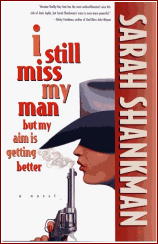
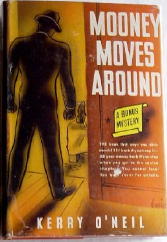
The artist for this nifty paperback cover isn’t identified, so I won’t hazard either a guess or an opinion, but if you believe you know, I’d surely like to hear from you.

   That the girl looks something like Betty Grable, for those of us old enough to remember her, is not too surprising, as she starred in the 1941 film version with Victor Mature, Carole Landis, and Laird Cregar. I don’t believe I’ve ever seen the film, and now I’m itching to.

STEVE FISHER I Wake Up Screaming

   Frank Loose sent me the following publication data for the book, supplemented by my own records:

Hardcover:

   Dodd, Mead & Co., 1941.
   Robert Hale, UK, 1943.

Paperback:

   Handi-Book #27, 1944.
   Popular Library #129. No date stated. Frank says 1948; Graham Holroyd says 1947. Dealers on ABE seem to be 50-50 either way.
   Bestseller Mystery B204, digest-sized, 1957.
   Bantam Books A2145, 1960.
   Black Lizard, 1988.
   Vintage, 1991.

   Frank also adds, “I have a copy of the Black Lizard, but I want to read the original. If I understand correctly, the revised version starts with the Bantam book in 1960. Everything before that date should be the original unedited, unrevised version.”

   I’m sure Frank is right about this. I’m not sure, but I believe the reason for the revision is that Fisher himself wanted to “modernize” the book. If so, it’s the same thing John D. MacDonald did toward the end of his career when he published two collections of short stories taken from the 1940s pulp magazines. He rewrote some of the stories to make them seem as though they were taking place in the 1980s.

   It was a really bad idea, as far as I was concerned — something like “colorizing” black-and-white movies.

   But I don’t know for sure if that’s what Fisher did, nor why Black Lizard didn’t go back to the original novel for their edition. Once again, if you have more information, I hope you’ll pass it along.
      From the back cover:

Once there was a girl named Vicky Lynn. She met Pegasus, a screen writer, and they fell in love. Then Pegasus and three friends pooled their resources to sponsor Vicky. They built her into a glamorous personality, and she won a screen contract. And the next day she was murdered.

For Pegasus, Vicky’s death was the end of the world, until he became aware of Vicky’s lovely sister Jill, who believed in him when everyone branded him killer.

To escape the police, Peg and Jill ran away, but their flight turned into a cycle of terror, of hiding and running from the ever-approaching shadow of a relentless, obsessed pursuer!

   What turned out to be unusual in this grouping of “A” authors taken from Part 23 of the online Addenda to the Revised Crime Fiction IV, is two incidental pairings of authors with the same name, two with the same year of birth.

ALFRED, WILLIAM. 1922-1999. Add as a new author entry. Longtime professor in medieval studies at Harvard University, specializing in early English literature.
      -Hogan’s Goat. New York City: French, 1965. [Play.] Setting: New York City, 1890. TV movie: PBS, 1971 (scw: William Alfred; dir: Glenn Jordan). “A play in blank verse about the bitter political maneuvering among Irish-Americans in Brooklyn in the late 19th century.”

Alfred: Hogan's Goat

ALLINGTON, MAYNARD. 1931- . Career US Air Force officer, 1951-76, when he became a writer. Author of three wartime thrillers included in the (Revised) Crime Fiction IV. See below.
      The Court of Blue Shadows. Washington: Brassey’s, hc, 1995. Updated setting: Europe, past. “A survivor of the Dachau concentration camp is haunted by his experiences […] as he searches for retribution.” [Reviewed in the New York Times.]

Allington: Court of Blue Shadows

      The Fox in the Field. Washington: Brassey’s, hc, 1994. Setting: India, World War II. “Derek Carr, a gambler and former arms smuggler blackmailed into working for British intelligence.”
      The Grey Wolf. Warner, pb, 1986. [Corrected date.] Setting: Russia, World War II. “A thrilling tale of a British agent and his involvement in a military coup against Stalin, based on actual events in the USSR in 1942.”

ANDERSON, DON. 1931- . Add as a new author entry. BBC national and international television news reporter; left to form his own media, communications and web company in the 1990s.
      Heatshield. Pan, UK, pb, 1990. Setting: Ireland, future. “On a secret mission in the Russian space shuttle, a cosmonaut is forced into a crash landing off the coast of Ireland.”

ANDERSON, DON. 1931- . [Note that though they share the same name and year of birth, this is not the same author as the one above.] Author of one novel included in the (Revised) Crime Fiction IV. See below.
      The Price We Pay… Washington: Ye Galleon Press, hc, 1998. [Corrected spelling of publisher.] Setting: Seattle WA.

ANDERSON, LINDA. 1949- . Add as a new author entry. Member of the English Department of The Open University as Reader in Creative Writing, previously at Lancaster University.
      -To Stay Alive. Bodley Head, UK, hc, 1984. Setting: Belfast, Northern Ireland. “Set in the bleak months before the 1979 Republican hunger strike in Long Kesh prison.” Short listed for the Higham and Sinclair Prizes.

Linda Anderson: To Stay Alive

ANDERSON, LINDA (née KIRCHMAN). [Noted here to distinguish her entry from that of the author above.] Add maiden name. Author of two romantic suspense novels included in the (Revised) Crime Fiction IV. See below.
      The Secrets of Sadie Maynard. Pocket, pb, 1999. Setting: West Virginia. [Photojournalist Memphis Maynard returns to her West Virginia hometown to solve the 1936 murder of her grandmother, Sadie Maynard.]

Linda Anderson: Sadie Maynard

      When Night Falls. Pocket, pb, 2000. Setting: North Carolina. [Former prosecutor Lannie Sullivan in reclusion is stalked by a rapist recently released from jail.]

Mystery House logo.   The latest batch of covers uploaded to Bill Deeck’s Murder at 3 Cents a Day website are those for the Mystery House. The page is still under construction, but it’s been a long time since I’ve been able to make an announcement like this, even premature as it is. The years 1940 to 1943 are done, with three covers so far to begin 1944.

   Here’s the introduction to the page containing the publisher’s line of mystery titles:

The Corpse with the Listening Ear    From the August 31, 1940, issue of Publisher’s Weekly: “Arcadia House, Inc., has announced the establishment of two new imprints, one for the publication of detective fiction and one for religious books. Detective novels will be published under the imprint of Mystery House, with Sally Frances as editor in charge. The following titles inaugurate the series: Clue in Two Flats, by R.L.F. McCombs, August 26th; The Corpse with the Listening Ear, by Laurence Dwight Smith, September 20th; Death in the Wheelbarrow, by Jan Gordon, October 10th; Abandon Hope, by Isabel Garland, October 22nd; Homicide Johnny, by Stephen Gould, November 12th. Each book is priced at $2.00.”

   Things didn’t go as planned. Not all of the books came out as scheduled, as you will be able to see for yourself, and I hope you will. Follow the link above.

LES SAVAGE, JR. – The Shadow in Renegade Basin. Leisure Books; paperback reprint, July 2001. Hardcover edition: Five Star, March 2000.

   For those of you who may have come in late, yes, I do do reviews of westerns on this blog. I know I don’t have to explain myself, but it has been a while since one has appeared here, so what I’m going to do is to repeat the following paragraph from the last one I did, which was of Edge of the Desert by Matt Stuart (L. P. Holmes):

    “… and whether or not they’re included in Al Hubin’s Crime Fiction IV – Al generally says no unless there’s a leading character who’s actually a detective and involved in solving a case – I have no compunction about reviewing them [westerns] here. Almost every western has a crime component of some kind, and if they don’t, I probably don’t read them. Rustling, gunfighting, horse thievery, burning out homesteaders, it’s all against the law, and therefore – when written up in book form – crime fiction.”

LES SAVAGE The Shadow in Renegade Basin

   But no more self-indulgent justification! Let me begin by giving you the titles of the three short novels (or long novelettes) included in this particular group of western tales, and the issues of the pulp magazines they first appeared in:

       “Plunder Trail.” Frontier Stories, Summer 1944. Savage’s original title: “Oregon Traitor Trail.”
       “Brand of Penasco.” Action Stories, Winter 1945, as “Brand of the Gallows Ghost.”
       “The Shadow in Renegade Basin.” Frontier Stories, Summer 1950, as “Tombstones for Gringos.”

   Savage had a short but prolific career as a western writer. He died in 1958 only 35 years old, but in the short time he had to live, he wrote 25 novels, the last one, Gun Shy, finished by Dudley Dean McGaughey after his death. This does not include a long list of short stories which Jon Tuska has been packaging into collections like this. (Savage’s first published short story was written when he was a mere 17.)

   Enough facts. If I’ve read anything by Savage besides this one, it would have been over 50 years ago, and opinions when one is 15 old, plus or minus a couple of years, simply do not count. Which assumes that I’d remember, which I don’t, but I’m sure I did – read one, that is.

   Let’s take the two earliest ones first. I appreciate the fact the three stories were published in chronological order. It does help in putting a writer’s career in perspective. Of the first two, I’d say that at time, when Savage would have been in his early 20s, he was absolutely terrific in describing western landscapes and capturing moods, but only so-so in connecting with connecting with his characters and convincing them to come to life.

   Something else he was very good at was writing action scenes, the parts of the stories where violence kicks in, delineated blow by blow, and….

    … in “Plunder Trail,” that is exactly where the story stops dead in its tracks, at least it did for me. It’s the story of a gambler at loose ends who finds himself part of a wagon train full of homesteaders headed west. Ed Manton also finds himself getting caught up in their hopes and new lives. And when Georges Arvada and his gang strike, as is totally anticipated, it is Manton whose abilities as a leader and with a gun are needed the most.

   The last 15 pages need only be skimmed. The fight seems to go on forever, and the last page, in which Manton and Leah are finally reunited, comes both as a relief and as no surprise at all.

   Story number two, “Brand of Penasco,” is one of seven short novels Les Savage wrote about Elgera Douglas, familiarly known as Senorita Scorpion, one of the most popular characters to appear in Action Stories, says Jon Tuska in his introduction.

Senorita Scorpion

   Elgera is blonde and quite a pistol-packing lady, just the right combination to win the hearts of every adolescent boy and young man who might have read the magazine back in 1945. More of her background than this, however, is not given in the story itself.

   Truth in advertising. The cover shown to the right is from the Winter 1949 issue, not the one in which the story in this book appeared. Nor is the lady masked in this tale, as she is in most (if not all) of the covers she was featured on. (I just happen to think that she’s shown to her best advantage on this one.)

   I think a mistake has been made in terms of not putting all of her adventures into two volumes, say, instead of of scattering them around one at a time in other collections. The impact that she made would have been far greater, I’m sure, with her exploits being able to be read in the order they occurred, as well as the romances she had.

   It’s still a good story, but after her friend Chisos is shot and left for dead, the story seems to sag a little, caught up in too much action without enough motivation. The capture of a fellow named Penasco, an outlaw known to have been hanged many years ago but rumored to still be alive and on the loose again, is the primary focus, but the tale, populated by people named Tequila, Bighead and El Cojo, seems to go off in too many directions from there.

   It is the title story, “The Shadow in Renegade Basin,” that Jon Tuska, in his introduction to it, seems the proudest of to present. He compares it to Greek tragedy, and describes it as filled with “fratricide and incest.” No kidding. The story had to be rewritten considerably before it could be published in a pulp magazine in 1950. The restored text is supplied.

   Unfortunately I do not relate to Greek drama very well, a failure that no teacher of great literature was able to cure. The shadow in the title is that which is supplied by a sinister-looking mountain called El Renegado, and the legends that are told about it. In the rich, fertile valley at its foot, there are no farms, no ranches, no people, until the arrival of two brothers and their mother, hoping there to settle down and prosper.

   Enter Christina Velasco, who is beautiful, of course, lives alone somewhere in the area, and equally of course both brothers fall in love with her. There is also a Mexican peddler of rare birds named Pajarero and an hombre named Nacho, both of whom are also, in their differing ways, under Christina’s spell.

   As was mentioned earlier, it is no surprise that the ending was changed. And as it was originally written, the story is filled with tantalizing wisps of beautifully described countryside and fragmentary glimpses of fascinating characters who seem to have no control over the events they are in.

   It is like no pulp story I have read before, and I have no way of explaining exactly why, other than I’ve done so far.

   I also apologize for allowing this review to go on so long. Paraphrasing what I remember someone else much more famous than I having once said, I have not taken the time to make it shorter.

THE BIG COMBO. Allied Artists, 1955. Cornel Wilde, Richard Conte, Brian Donlevy, Jean Wallace, Lee Van Cleef, Earl Holliman, Helen Walker, Helene Stanton. Director: Joseph H. Lewis. Original music by David Raksin.

   This one’s the real deal. In the last week or so I’ve been telling you about bits and pieces of various movies that were noirish in nature, but by 1955 directors and cinematographers (John Alton, in this case, of Raw Deal and I, the Jury fame) who worked with noir films knew exactly what they were doing, and they did it well.

   Mike Grost has done a superbly in-depth online analysis of the films of Joseph H. Lewis (no relation), and you should go read it. The Big Combo is one of his films that comes in for a lot of attention, including a good many things that didn’t register for me on my first time through. (Mike admits that he has watched many of Lewis’s films more than once.)

The Big Combo

   I’ll not repeat any of Mike’s thoughts and facts about the film. I don’t mind repeating myself by saying that you should go read it for yourself. I’ll be content to relay to you my impressions and not rely on any of his.

   And impression number one is the reason I included David Raksin’s musical score in the credits. The loud jazzy opening scene, with a good-looking blonde running frantically from two thugs in the shadowy depths of a boxing arena is one of the finest in recent memory. Made me think the movie was about a jazz band (The Big Combo), in fact, but no, not so.

   No, the Big Combo is essentially Mr. Big’s gang, Mr. Big being Mr. Brown (Richard Conte); the girl on the run is his girl (Susan Lowell, played by Jean Wallace); and the job the two thugs are doing (Fante and Mingo, aka Lee Van Cleef and Earl Holliman) is to make sure she doesn’t get away from him.

   Cornel Wilde as Lt. Diamond is the detective obsessed with bringing Mr. Brown to justice. That he is also obsessed with Susan Lowell, and in fact in love with her from afar — she does not even know of his existence — is getting him in trouble with the people who pay the bills. He has gone far beyond his department’s allotment of funds, and so far to no avail.

   (That Jean Wallace was also Mrs. Cornel Wilde I did not know while watching the film. She is worthy of obsessing over, and so she fits the role perfectly, but her acting is only slightly above the ability of usual female model who goes to Hollywood.)

The Big Combo

   Better, I thought, was Helene Stanton as Rita, a showgirl of Diamond’s long acquaintance to whom he turns for solace when things begin to look their darkest. It is hinted at that perhaps she is more than a showgirl, for the place where she works is not the most upscale of joints.

   This movie also hints at several other things, including the relationship between Fante and Mungo, which could be debated, as hints are all you are going to get.

   Taunted by Mr. Brown into a fury, Diamond aches to find some hold or some charge he can get him on. That he makes only $96.50 a week only adds to the resentment. Mr. Brown does not hesitate to rub it in. The name “Alicia” means something to Mr. Brown, however, and it takes a nice bit of detective work to track down who she is and what she means to him.

   I have not mentioned Brian Donlevy, who plays Joe McClure, a broken-down and not too intelligent assistant to Mr. Brown, outwardly always in his place, but inwardly frustrated at having been passed over when the position at the top of the gang became available. He wears a hearing aid, a fact ordinarily not worth mentioning, but in this case it is, and twice, both in scenes crucial to the story.

The Big Combo

   I did not care for the ending as much as most reviewers seem to have. Mr. Brown’s fall came too quickly to suit me, although it certainly came as no surprise that it happened, and that there was a way out that he didn’t take advantage of — well, it was a disappointment to me.

   A minor quibble, perhaps. Otherwise, as I said at the beginning, this is the real thing. Fine acting, fine directing, and fine movie-making, all on a low B-movie budget. I dare not ask for more, nor should you.

   It’s been a while since I’ve done one of these “maps in mysteries” posts, since last October, as a matter of fact, unless my records are off. British mystery fan and bookseller Jamie Sturgeon has been saving these for me, patiently waiting till I did something useful. Like get them online, as I’m finally doing now.

   The first comes from an author I’d frankly never heard of until now. I imagine that his books are scarce, too, but Jamie had one for sale last November:

Laurence Geogeghan

LAURENCE GEOGHEGAN The Brackenbridge Enigma. Methuen, UK, 1929.


   The next two are from books by Herbert Adams, a writer best known for his golfing mysteries:

Herbert Adams

HERBERT ADAMS The Nineteenth Hole Mystery. Collins, UK, 1939. [Roger Bennion]


Herbert Adams

HERBERT ADAMS The Body in the Bunker. Collins, UK, 1935. Lippincott, US, 1935. [The map is from the Collins edition, but it may have also appeared in the Lippincott.]


— Bibliographic information taken from Crime Fiction IV, by Allen J. Hubin.


PORT OF NEW YORK. Samba Films, 1949. Scott Brady, Robert Rober, K. T. Stevens, Yul Brynner, Arthur Blake, Lynne Carter; narrated by Chet Huntley. Director: László Benedek.

Port of New York

   Filmed as a semi-documentary on behalf of US Customs and the Treasury Department, with narration throughout by (uncredited) Chet Huntley, there’s enough solid drama stuck in between the various drop-in chunks of stock footage — suitable for PTA meetings and 4H clubs, not that there’s anything wrong with that — to make this a rather respectable (and enjoyable) crime thriller.

   Unlike the film Dangerous Lady, which I reviewed here not so very long ago, Port of New York takes its crime seriously. When a load of dangerous narcotics is smuggled into New York City from the sea, an entire contingent of federal men are summoned to work on the case, led by Jimmy Flannery (Richard Rober) as a treasury agent, assisted by “Mickey” Waters (Scott Brady) on customs detail. (Unless of course I have their job assignments switched around. In the context of the movie, it didn’t seem to matter.)

Port of New York

   Their roles pale in comparison with that of the villain of the piece, though, a suave but nasty piece of work named Paul Vicola (Yul Brynner, in his film debut, and with hair, as I think every retro-reviewer of this movie is going to say, so why shouldn’t I?). When his girl friend Toni Cardell (lovely brunette K. T. Stevens) discovers that murder is involved, she begins to have second thoughts.

   Her fate is sealed from that point on. It will not take much experience as a crime movie buff to know exactly what I mean: Says Yul Brynner’s character: “You are most ungrateful, Toni.” [See Footnote.]

   Arthur Blake’s role is small but hardly insignificant. As a weak, somewhat effeminate nightclub entertainer named Dolly Carney (specializing in imitations of Charles Laughton) who is nabbed as go-between in the dope-peddling business, he’s caught between the cops and big guys and with no way out.

Port of New York

   Some other impressions: The film was shot in Manhattan, along the port, in the harbor, and on the streets Even if filmed in only black and white, the city makes a impressive setting. Of course it is that the movie is filmed in black-and-white, with the dark contrasting shadows at night and in the interrogation room, that makes this film a noir, lessened of course by the story itself, with its naturally positive ending. (I probably shouldn’t give this away — that this movie has a happy ending, that is — and in fact, for some of the players, rest assured that it is simply just not true.)

   And oh, one more thing, without trying to go political. I was wholly on the side of the federal guys, but their tactics were at times — to use a new word I just looked up — rather cringeworthy. As the single most egregious example, breaking and entering one of the bad guys’ offices at night might have helped break the case, but there was no mention of warrants, and the evidence itself was worthless.

   Take my advice anyway. If you’re a fan of black-and-white crime movies with more than a touch of noir, you could a lot worse than watching this minor but still suspenseful and well-plotted example. You could do worse, without even trying.

FOOTNOTE. Thanks to a commenter on IMDB for providing the exact phrasing, which I think is pitch-perfect in every way.

   I don’t suppose many of the authors in this blog entry are going to be familiar to many of you. They certainly weren’t to me, and there wasn’t much I was able to add by searching the Internet. These came from the top end of Part 24 of the online Addenda to the Revised Crime Fiction IV, speaking alphabetically again, all in the A’s, except where pen names came into play.

   A number of the entries in Part 24 are for authors whose works were published by Major Books, a rather minor paperback company that started up in the late 1970s. They published a wide array of books, though, including fiction in all genres. Of interest to us is their crime fiction, of course, including a number of gothics. Most of their books are rather hard to find today. Getting their wares into sales venues was more than likely their greatest problem.

   The added settings for the Major Books were sent to Al Hubin by Ken Johnson. Dan Roberts provided me with the cover images. Thanks to both!

ADDLEMAN, D. R.
      A Contract on Stone. Major, pb, 1977. Add setting: Los Angeles. “He’d been set up, trained, and programmed; John didn’t know he was also the target!”

Addleman: A Contract on Stone


ALEXANDER, MARSHA. Pseudonym of Marsha Bourns, 1940- , q.v. Under this pen name, the author of romantic fiction, including four gothic or occult paperbacks cited in the (Revised) Crime Fiction IV. See below.
      Birthmark of Fear. Major, pb, 1976. “There was something evil about the house on Scorpion Crest, but Thea tried to ignore it … until the ‘accidents’ began!”

Marsha Alexander: Major Books

      The Curtis Wives. Major, pb, 1979.
      House of Shadows. Major, pb, 1977.
      Whispers in the Wind. Major, pb, 1977. Add setting: California. “What was the strange horror that gripped the house when the baby was born…?”

AMES, EDNA. Pseudonym of Andrew J. Collins, q. v. Under this pen name, the author of one gothic romantic suspense novel included in the (Revised) Crime Fiction IV. See below.
      The House of Secrets. Major, pb, 1976. Add setting: California. “Her brother’s mysterious death brought her back to the lonely beach house … back to the edge of terror!”

Edna Ames, The House of Secrets


ANONYMOUS.
      The Orphan Seamstress: A Narrative of Innocence, Guilt, Mystery, and Crime. New York: Burgess, hc, 72pp, 1850. Setting: New York, New Jersey, 1840s. Add: also contains ss: The Step-Mother [also no author stated]. The book is referred to several times in a doctoral thesis by Paul Joseph Erickson entitled Welcome to Sodom: The Cultural Work of City-Mystery Fiction in Antebellum America. Note: Shown below is a later edition published by Dick & Fitzgerald, no date given, but circa 1860s.

The Orphan Seamstress


ANTHONY, JED. Pseudonym of Theodore D. Irwin, 1907-1999, q.v.
      _Divorce Racket Girls. Design Publishing, pb, 1951. (Intimate Novels #6.) Previously published as Collusion (Godwin, 1932) as by Theodore D. Irwin. “A bombshell of a true story which blows the lid off a whole foul world and explosively discloses the debauches and treacheries of the divorce racket.”

BOURNS, MARSHA. 1940- . Pseudonym: Marsha Alexander, q.v.

COLLINS, ANDREW J. Pseudonym: Edna Ames, q.v.

IRWIN, THEODORE D. 1907-1999. Add pseudonym: Jed Anthony, q.v. Author of one work of fiction included in the (Revised) Crime Fiction IV, possibly true crime in novelized form. See below. This now constitutes the author’s complete entry.
      Collusion. Godwin, hc, 1932. Add: also published (abridged) as: Divorce Racket Girls (Designs, 1951), as by Jed Anthony. Setting: New York City. Film: Majestic, 1934, as Unknown Blonde (scw: Leonard Field, David Silverstein; dir: Hobart Henley). Delete reference to film previously cited: Age of Indiscretion (MGM, 1935). The lurid cover below is of the Hillman paperback reprint, #18, 1949.

Theodore Irwin: Collusion

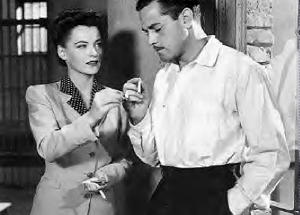
DANGEROUS LADY. PRC, 1941. Neil Hamilton, June Storey, Douglas Fowley, Evelyn Brent, Jimmy Aubrey. Directed by Bernard B. Ray. Based on a story by Leslie T. White.

Dangerous Lady

   With bargain basement movies like this one, you get what you pay for, which is – unless you’re not particularly careful with your wallet – almost nothing. Most of the online reviews for this movie, out on DVD, include the line “Neil Hamilton and June Storey play the married sleuths with a bemused and breezy ease in this clever Thin Man-style mystery thriller.”

   Bemused, maybe, wondering why on earth they’re in this film. Breezy, yes, with a plot having holes in it wider than the cheesiest Swiss you’ve ever seen. Thriller, not at all. In the first ten minutes what passes for witty repartee between husband (private eye Duke Martindel, played by Neil Hamilton) and wife Phyllis (a hot shot lawyer lady played by June Storey) as they prepare for bed (and quite noticeably, separate beds) will get you to sleep even more quickly than they do.

Dangerous Lady

   It is difficult to say who should bear the brunt of the blame. All of the players have long careers in the movies, but they’re as a group awfully wooden in this one. Neil Hamilton lasted long enough to become Commissioner Gordon in the Batman TV series; by that time his gray hair made him look distinguished.

   June Storey was in maybe ten of Gene Autry’s western movies – but this photo of her below with William Henry was probably taken from a 1941 musical drama starring Carole Landis entitled Dance Hall – and Jimmy Aubrey’s comedic efforts were on display in over 400 films.

Dangerous Lady

   Leslie T. White wrote a long list of tales for the pulp magazines, but they must have run out of both film and shooting time to fill the gaps in what passes for a story line in this one. Nor was this director Bernard B. Ray’s only chance at directing a film. Also known as Raymond K. Johnson, he did over 60 of them.

   The music in the background was stolen from an early 1930s comedy, though of course in Dangerous Lady, some of the action was intended for laughs, as most mystery and detective movies were obliged to do before noir came along, not that they called it noir back then. Looking back at the first paragraph of this review, I suppose this was what was meant as “breezy.”

   You will have noticed that I have said nothing about the story itself. You’re right. I haven’t.

   I’ve been too long away from working on the online Addenda to the Revised Crime Fiction IV, and it felt good to get back. This afternoon I tackled the further end of Part 24, alphabetically speaking. Nothing seems to be known about James Yardley, the second of these two authors. I’ll report back later if more digging turns anything up.

WOLFERT, IRA. 1908-1997. Noted journalist and war correspondent during World War II; received the Pulitizer Prize for The Battle of the Solomons, published in 1943. Author of one novel included in the (Revised) Crime Fiction IV. The following is now the author’s complete entry.
      Tucker’s People. L. B. Fischer, hc, 1943. Add: Victor Gollancz, UK, hc, 1944. Also published as The Underworld (Bantam, 1950). Add setting: New York City. Film: MGM, 1948, as Force of Evil (scw: Abraham Polonsky, Ira Wolfert; dir: Polonsky). “Based loosely on the rise and fall of Dutch Schultz, the book presented a vivid picture of life among the poor and restless in New York City.” [The movie, starring John Garfield as a crooked lawyer, is considered by many a classic film noir.]

Ira Wolfert: Tucker's People.

      _The Underworld. Bantam, pb, 1950. See Tucker’s People.

Ira Wolfert: The Underworld

YARDLEY, JAMES. Author of two spy novels included in the (Revised) Crime Fiction IV. See below. The leading character in each is Kiss Darling, the “chick with the computer brain and the venus body.”
      A Kiss a Day Keeps the Corpses Away. Michael Joseph, UK, hc, 1971. Signet, US, pb, 1971. Add setting: England. “A madman millionaire […] holds the fate of mankind in a handful of pills.”

Yardley: Kiss a Day

      Kiss the Boys and Make Them Die. Michael Joseph, UK, hc, 1970. Signet, US, pb, 1970. “As the rising waters of the Nile build up behind the Aswan Dam, the entrance to a 3000 year old temple of Rameses II is dramatically exposed.”

Kiss the Boys

« Previous PageNext Page »