Authors


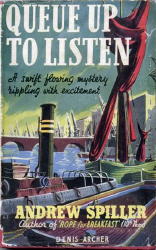
   A short while ago I posted a blog entry about a group of authors whose deaths had recently been noted. One of those authors was Andrew Spiller, about whom I knew nothing at the time, except for the list of mystery fiction he wrote, which you’ll find by following the link.
Queue

   To learn more, I first emailed John Herrington:

 John

   I tried a Google search for Spiller and/or Inspector Mallard, and found … nothing. Another author like Brian Flynn, perhaps, popular only because he wrote a lot of books and for very little other reason?

Best

      Steve

  Hi Steve,

   I wouldn’t disagree. I have managed to borrow a couple of his books though inter library loans and they are nothing special.

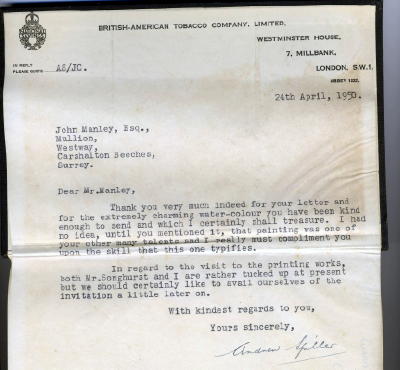
   Have discovered that he was working for the British-American Tobacco Company in 1950. He is like a lot of writers of the 1940s and 1950s, who stopped writing by the end of the 1950s. A lot of the smaller publishing companies were disappearing (or being bought up) and perhaps he realised that there was no longer a market for his books. This happened to the likes of ‘Ernest Dudley’ who stopped writing crime around the same time because there was no money in it.

Regards

      John

   Then arrived a welcome email from Jamie Sturgeon:

  Steve,

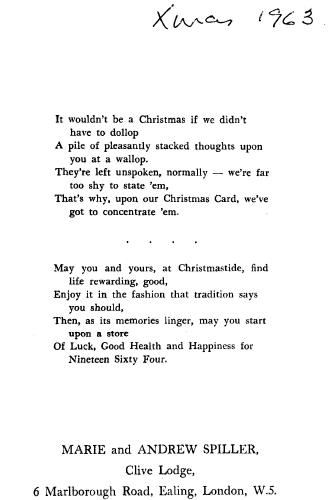
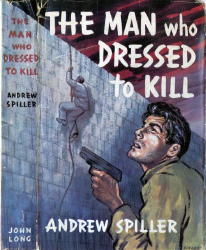
   Did John mention that Andrew Spiller worked for British American Tobacco and his wife’s name was Marie? Please see attached scans, including two more covers in DJ.

Cheers,

   Jamie

Letter

Xmas


   Then from Victor Berch, who has managed to delve deeply into Andrew Spiller’s traveling days:

  Steve

   Remember my mentioning that database which contained information on aliens and citizens entering the US? Well, I decided to poke in Andrew Spiller’s name and to my surprise two hits came up. I wasn’t too sure I had the right Andrew Spiller, but when I spotted his birthplace of Bridport, I knew I had the right person. So, here are some of the details from those records that I gathered from the ships’ manifests:

   On his first trip to the US, Andrew Spiller came aboard the SS Olympic which left Southampton, Eng on Feb. 25, 1925 and arrived in New York March 4, 1925. From this manifest, it stated that he was in transit to visit his cousin, C. James, in New Zealand. He was listed as an advertising agent for the British American Tobacco Co, Ltd (which, by the way is still in operation). His age at the time was given as 35 years old. He was 5’9 1/2″ with brown hair and grey eyes.

   On his second trip, he came aboard the SS Aquitania, which left Southampton, Eng on April 28, 1928 and arrived in New York May 4, 1928. Spiller was still listed as advertising manager for the British American Tobacco Co., Ltd and was going to stay in the US for 60 days.

   On this record he was required to give the name and address of his nearest kin, which was Mrs. A. Spiller, 26 Heathfield Rd., Acton, W. 3 , London. These records seem to predate his writing period.

Best,

      Victor


Dressed

   And so there you are. Bits and pieces of a life of a mystery writer who’s become obscure and all but forgotten now, but who was very prolific in his time.

   For a gallery of even more covers, provided by Jamie Sturgeon, I’ve set up a separate website here.
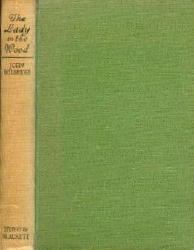
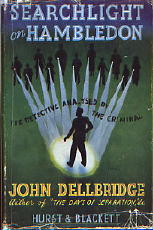
JOHN DELLBRIDGE – The Lady in the Wood

Hurst & Blackett Ltd., hardcover; no date stated [1950]. No US publication.

   As readers of this blog will know full well, it has recently been discovered that “John Dellbridge” was the pen name of Frederick Joseph De Verteuil (1887-1963). A native of Trinidad, he became a barrister and practiced law in India and England before becoming a novelist.

    I’ll forego the usual bibliography, as the previous entry already includes one, as well as a small amount of other information that has been learned about the author. There are six mysteries to his credit in all, however, the last three having as their lead character one Rupert Hambledon, about whom more in a minute. The Lady in the Wood is the last of the three, which were published in a short span between 1947 and 1950. Dellbridge’s earlier crime-writing career spanned a much earlier 1927 to 1929.

Lady

    The story is told in quasi-documentary style, in the beginning as if in the form of local Inspector Kemsing’s report to some superior officer, starting with Chapter One, page 7:

   At 6:30 p.m. yesterday, Friday, and August, Mrs. Martineau of Sharpes Cottage, Checksworth, reported by telephone that she and her husband had found the naked body of Lady Charlotte Barnet in a larch plantation in Checksam Park. There seemed to be a bullet wound in the head. Her husband was standing by the body. She described the exact spot. I telephoned the police surgeon and the St. John Ambulance and at once proceeded to the scene by car with Sergeant Streeter and Constables Neve, Avis and Ayling, with a camera. Mrs. Martineau was waiting for us at the junction of a bridle path and the Diddlehurst-Midworth road: Sharpes Cottage is about fifty yards East of the junction of the path and road and invisible from the path as the road bends there.

   The dead woman had been a heroine in World War II, having parachuted into France and done great deeds undercover with the Resistance. Some Vichy French and some members of the Gestapo are immediately suspected. On the other hand, this is England, and the world is in the process of becoming civilized again. Lady Barnet had come down from London to be one of the guests at nearby Schlatts Hall, the home of Mr. and Mrs. Arthur Bonteve.

   So a manor house mystery is what this is, no more and no less, replete with constant and subsequent misbehavior and strange actions on the part of the many participants, many clues, another death – that of a maid who perhaps knew too much and who turned to blackmail as a result? – and endless timetabling, more than I can remember in any mystery I’ve read in many years.

   Sir Rupert Hambledon is called in early on by one of the suspects. That he has a title means that he travels in the same circles as the class of people who live in or are guests at manor homes. He is not from Scotland Yard, however, but a very expensive inquiry agent. (One hesitates in referring to him as a mere private detective.) Being the “best known detective in England” and “the smartest” (page 111), in no time at all he is in charge of the case, Inspector Kemsing more than willing to defer to him.

   One of Sir Rupert’s other traits is that “he commits irregularities that no official policeman would dare to try” and “these irregularities get results.” (Also page 111.) By the way, the inspector does not narrate the entire book. He alternates telling the story of the investigation with Mr. Perceval Hadlow-Down, a solicitor of one of the guests, who often plays Watson to Sir Rupert. Says Hadlow-Down early in his own narrative, when it is his turn;

   I am a thriller ‘fan’. Many of them are very good, though they have lost some of the savour since Lord Peter Wimsey went out of business and Dr. Fortune was replaced by a colleague of mine called Clunk who should have been struck off years ago.

Sir Rupert may outdo either of those two gentlemen by stating on page 70:

    “I’ve known who the murderer was since this morning,” he asserted with a stort of Olympian impatience.

   Of course there is not a shred of legal evidence at this point, and if the murderer were to be charged, the inspector would be “laughed out of court.”

Lady

   Does Sir Rupert indeed know? In the end, after the killer is indeed caught and charged, there are indications that he did, but to my mind, the strongest point in his final summary of the case was based on an flimsy (and even erroneous) insight into human nature. He was exaggerating, were you to ask me. It was a good guess, perhaps more, but that it took the remaining two-thirds of the book to name the killer for keeps strongly suggests that a good guess is all that it was.

   The purpose of the alternating narration – not too common in detective novels? – serves the author in this case well. That is to say, it keeps the reader off-balance, preventing her or him of being aware of what each narrator knew and when while the story was being told by the other.

   In short, however, if you are the kind of mystery reader who likes lots of clues, time tables, and exhaustive interrogations of the parties involved, you will find a lot to like, if not love, in this book. If not, then most definitely not.

— February 2007

  Hallo Steve!

   Yes, Donald Hamilton died in Visby (Gothland) Sweden on 20th of November last year. Unfortunately I didn’t know about his death until an English friend of mine, Jeremy Dund living in Stockholm, e-mailed me about it.

   I knew him well through my correspondence with him, and also because my wife and I visited him and his wife in their home in Santa Fe, many years ago. We were invited to stay a full week there, and we had a lot of nice hours together.

   He also visited me in my home when I lived alone in Sweden (1983). He and his wife Kathleen had dinner with me in my home at that time.

   He was a very nice and generous man, and he knew that his books were very popular all over the world.

   When I visited him last year in August in Visby – in fact my hometown when I was 15 years old till I was 23 and moved to Uppsala (where Donald was born) – he was in a home for the elderly, but he was in very good condition although his memory was not 100%. But he remembered me and the visit in Santa Fe, and we talked for a full hour about that and his books etc.

Photo
Iwan and Donald Hamilton

   His son Gordon then came and I talked to him and his wife. They had decided to take care of Donald for the rest of his life. The home he was staying at was excellent, and the service was the absolutely best you can get.

   I’ll be driving to Sweden this summer, and hopefully I’ll be in Visby for a week or so and will get in touch with the Hamilton sons then.

   Nice to hear from you, and if I can be of some help just let me know.

               Your friend Iwan

>>   For a longer account of the friendship between Iwan and Donald Hamilton, their visit in the assisted living home, and more photos, go here.   — Steve

   — One of the activities that keeps my spare time occupied is adding images, links and miscellaneous information to the online Addenda to Allen J. Hubin’s Revised Crime Fiction IV. Here are some of the latest:


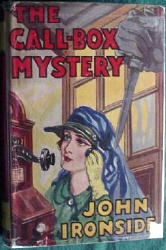
IRONSIDE, JOHN. Pseudonym of Euphemia Margaret Tait, 1866- , q.v. [Add definite year of birth.] Born in Liverpool; educated privately; journalist and novelist. Under this name, the author of eight novels included in the (Revised) Crime Fiction IV, one with marginal crime content, published between 1911 and 1945. Series character Inspector Freeman appears in two of them, but not the one illustrated below:

Ironside

IRVING, CLIFFORD
      The Spring. TV movie: NBC, 2000 (scw: J. B. White, David S. Jackson, Kathleen Rowell; dir: Jackson)

JAHN, MIKE
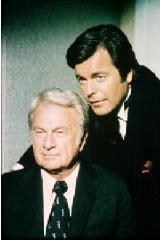
      Switch. TV movie [series pilot]: Universal, 1975 (scw: Alan Godfrey, Glen A. Larson; dir: Allen Baron, Robert Day). SC: Pete Ryan (Robert Wagner) & Frank McBride (Eddie Albert).

Switch

JAQUES, EDWARD TYRRELL. 1859-1919. Pseudonym: Christian Tearle. q.v. Add year of birth.

JAY, EDITH KATHARINE SPENCER. ca. 1847-1901. Pseudonym: E. Livingston Prescott, q.v. Add approximate year of birth.

JOHNSTON, WILLIAM This author of many movie and TV tie-in’s is not William W. Johnstone, writer of many tough crime and western novels.
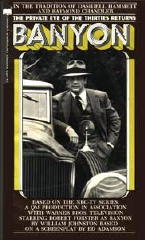
      Banyon. TV movie [pilot for series]: Warner, 1971 (scw: Ed Adamson; dir: Robert Day). Leading character: 1930s PI Miles Banyon (Robert Forster).

Banyon

JONES, JANE GILLIS. 1942-2002. Lifetime resident of Metro New Orleans; retired high school teacher. Author of one book previously listed in the (Revised) Crime Fiction IV; see below. The author was working on a second book in the series at the time of her death, Murder in Metairie Cemetery. Add middle name, years of birth and death.
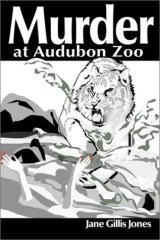
      Murder at Audubon Zoo (iUniverse, 2000, pb) [New Orleans, LA] Leading character: retired English teacher Elizabeth Young.

Jones

KATHRENS, (WILLIAM HAROLD) VAUGHAN. Intelligence Officer in WWII; assisted in arrest of Admiral Doenitz at the end of the war. The link will lead to his daughter’s account of some his activities; this link leads to more. Author of four hardcover crime thrillers published in the UK by Melrose between 1950 and 1953. Add first and second names, in parentheses.

KEELER, HARRY STEPHEN
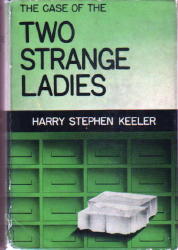
      The Case of the Two Strange Ladies. Add setting: Southern US. Leading character: Tommy Skirmont, reporter on the Southern City Democrat.

Keeler

K    There are events in the real world that you, I am sure, would find hard to believe if someone would take them simply as they happened and write them up as part of a work of fiction. Noted comic book writer Arnold Drake died in mid-March at the age of 83. Spy fiction author Leslie Waller died on March 29th, four days before his 84th birthday.
   The connection? In 1950 as “Drake Waller” the two men collaborated as the author of It Rhymes with Lust, considered to be the first graphic novel, a digest-sized work in comic book form. Of marginal interest as a crime novel, it nonetheless was recently added as a marginal entry to Crime Fiction IV, by Allen J. Hubin. See the online Addenda, Part 12.

   Two men, born within a year of each other, worked on one key book together in their 20s, went their own professional ways, and then died within weeks of each other. Destiny sometimes moves in mysterious ways.

Diana

   Not all of Mr. Waller’s bibliography consists of crime-related fiction, but a large portion of it is, with espionage, crooked bankers and Mafia elements predominant.

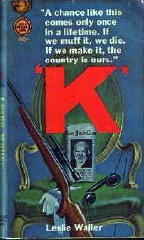
   He was in fact a Gold Medal writer, as a book simply titled “K” (Gold Medal, 1963) was a plot to assassinate Khrushchev during a visit to the US.

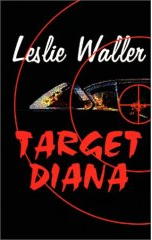
   His final work of fiction was Target Diana, a trade paperback with low distribution in which Princess Diana was murdered by a rogue agent, with the secret approval of the Royal Family.

   Excluding It Rhymes with Lust, but expanded to included Target Diana, Leslie Waller’s output as recorded in CFIV looks like this:

WALLER, LESLIE (1923-2007); see pseudonyms C. S. Cody & Patrick Mann.
      * “K” (n.) Gold Medal, pbo, 1963 [Chicago, IL]
      * A Change in the Wind (n.) Geis 1969
      * The American (n.) Putnam 1970 [Europe]
      * The Coast of Fear (n.) Doubleday 1974 [Italy; WWII]
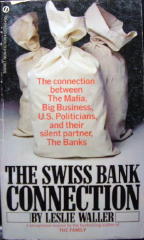
      * The Swiss Account (n.) Doubleday 1976 [Switzerland]

Leslie Waller

      * Trocadero (n.) Delacorte 1978 [Paris]
      * Gameplan (n.) Bantam 1984
      * Embassy (n.) McGraw 1987 [London]
      * Amazing Faith (n.) McGraw 1988 [Europe]
      * Deadly Sins (n.) Heinemann. UK, 1992
      * Mafia Wars (n.) Onyx 1993
      * Tango Havana (n.) Heinemann, UK, 1993 [Havana, Cuba]
      * Manhattan Transfer (n.) Heinemann. UK, 1994 [New York City, NY]
      * Eden (n.) Severn, UK, 1997
      * Target Diana (n.) Transatlantic Publishers, pb, 2001.

CODY, C(harles) S.; pseudonym of Leslie Waller.
      * The Witching Night (n.) World 1952 [Indiana]
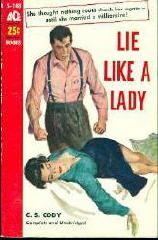
      * Lie Like a Lady (n.) Ace, pbo, 1955 [Chicago, IL]

Cody

MANN, PATRICK; pseudonym of Leslie Waller.
      * Dog Day Afternoon (n.) Delacorte 1973 [New York City, NY]
      * -The Vacancy (n.) Putnam 1973
      * Steal Big (n.) St. Martin’s 1981 [England]

   I haven’t happened to have found a cover image for Tango Havana (1993), but I did come across a description of the plot. Hoping to provide an idea of the kind of stories Mr. Waller wrote, I’ll include it here:

    “Cuba in the days when Meyer Lansky called the shots and General Batista ruled. An island where no man was what he seemed. A Mafia boss, a missile crisis, and a mess that went all the way to the White House. But while history turns on its axis, a conspiracy threatens to blow the Caribbean apart. It takes two to tango. Victor Sanchez and Midge Boardman just have to decide who leads.”

   And taken from the same book, here’s a short “About the Author” biography:

    “Born in Chicago, IL, Waller attended the University of Chicago and earned his M.A. from Columbia University. A crime reporter, he joined the United States Army Air Force intelligence in World War II. He published his first novel [Three Day Pass] in 1944, followed by some 50 more over the years.

    “From his first marriage he has two daughters and four granddaughters. He married Patricia Mahen in 1967, moving to Italy and eventually England. After 15 years abroad they now live in Naples, Florida where he writes, lectures and contributes to Florida’s leading cultural magazine, the Naples Review.”

Falcon

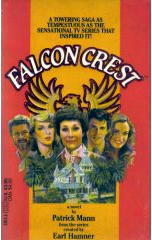
   Although some sources say Mr. Waller wrote several screenplays, IMDB mentions only his work as a writer for the TV show Falcon Crest, and that a non-fiction book he wrote, Hide in Plain Sight was made into a 1980 film starring James Caan. Not stated on IMDB, as Patrick Mann he also wrote the book which novelized the film Dog Day Afternoon. Either of these may be where the confusion arises.

   Even though it’s not included in CFIV, some of the behavior displayed on Falcon Crest was definitely criminous in behavior. Below you’ll find a image of the cover of the book, a novelization of the TV series written by Patrick Mann, a.k.a. Leslie Waller, once again the man behind the pen name.

[UPDATE] 12-02-08.   Based on a suggestion included in an email I received from Dan Bara today, Al Hubin agrees that the following two titles by Leslie Waller are crime-related and should appear in CFIV. The brief descriptions of each were found by me and helped Al make the call:

At 01:44 AM 12/2/2008, you wrote:

 Mr Lewis,

   I believe books that have crime/mystery tones that are not listed in your blog post are: The Banker (1963) and The Family (1968).

   Hope that helps!

        Good Day, Dan


Descriptions from various sources:

K

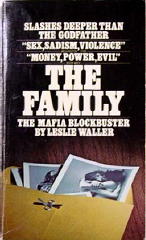
The Family.

FROM THE FRONT COVER: Slashes deeper than the Godfather, “sex, sadism, violence, money, power, evil.”

“An explosive story that bares the link between the big-time bankers and big-time crime.”

The Banker.

The money man: He owned villas in France, Italy, Switzerland, England, Germany & the Caribbean–each outfitted with emperor-sized round beds …. He was a juggler of power & people, keeping an uneasy balance between the broads he bought, the men he bled, the Swiss bankers & mafia musclemen he did business with. He was one step ahead of the SEC, the IRS, & the Justice Department. He was the wheeler-dealer king of international finance.

Woods Palmer moves into the field of intrigue and counter-intrigue in the big business world of banking in America.

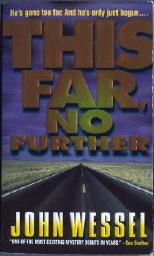
JOHN WESSEL – This Far, No Further

Island/Dell; paperback reprint, November 1997. Hardcover, first edition: Simon & Schuster, October 1996.

    Here’s an even better example of what I was rambling on about just before this when I was reviewing Dreamboat, the Jack Flippo PI novel by Doug J. Swanson, although I don’t think this first book by John Wessel, also a private eye novel, caught anyone’s eye for an Edgar nomination.

   Wessel’s detective is named Harding, an unlicensed PI working in the Chicago area. Both he and the author seem to have had a three-novel run, and that was all that it appears there will ever be:

         This Far, No Further. Simon & Schuster, 1996; Island/Dell, 1997
         Pretty Ballerina. Simon & Schuster, June 1998. No US paperback edition.
         Kiss It Goodbye. Simon & Schuster, January 2001. No US paperback edition.

   The fact that only the first one came out in paperback certainly says something, but of course it is never easy to interpret these things correctly. One obvious explanation is that for the last ten years (or more?) private eye novels no longer rule the roost as they did, once upon a time. Either Wessel’s writing never caught on, starting with his very first book, or perhaps even more likely, Island/Dell didn’t give him (or the books) the chance they needed.

   And there are not too many series with continuing characters which beat the odds and succeed in hardcover only. Without the paperback reprint coming out a year later, just about the time the next one in hardcover shows up, a series almost always seems to lose steam, then is forced to pack up and leave, never to be seen again.

   Should the Harding books have succeeded? Were they wrongly done in? I have mixed feelings about this. There is a lot to like in This Far, No Further, and there is a lot, well, let’s say that I had problems with, and maybe other readers did too.

Wessel

   First to like: Harding tells his own story, first person (uh-oh) present tense. Present tense? I can live with that, even though it fought me a little. The telling is spirited and enthusiastic, even though Harding has been badly wronged in his life, so far, and the less-travelled (grittier) paths and neighborhoods in Chicago are described with the panache and style of a long-time inhabitant.

   Second to like: Harding’s lady friend Allison, a commercial photographer and (evidently) one-time girl friend who assists him on this case. The banter between them is relaxed, pointed, trenchant and (all at the same time) far more cutting than Spenser ever has had with Susan, as enjoyable as the Robert B. Parker books are and always have been. Nor has much of the past between Alison and Harding been made clear by the end of the book. Allison, who is also very good at the martial arts, seems as well to have close lady friends of her own.

   Not to like very much: The utter sleaziness of the dead girl’s death in a rundown motel outside of Chicago, the victim of what appears to have been a sex tryst that went way too far. Harding was following the male in the party, a noted plastic surgeon whose wife hired the lawyer who hired Harding. Much is made later of videotapes and other paraphernalia.

    Not to like even more: The plot itself eventually becomes verbal sludge and next to impossible to follow. You may take this as an overstatement born out of frustration, and you would be right, but nonetheless, it is true. Harding’s own past – the reason behind the loss of his license – eventually becomes entangled with the doc and his problems, and Harding’s attraction to his wife (and his client, twice removed), and I confess that by that time, I was only skimming the pages.

   As fast as I could. Was I about to about to quit? No.

   Absolutely not. Did I go online and buy the next two books in the series? Yes.

   Can there be more to be said than that? Probably, but I hope I don’t need to.

— November 2006

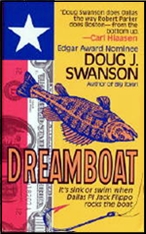
DOUG J. SWANSON – Dreamboat. Jack Flippo #2. HarperCollins, hardcover, February 1995. Harper, paperback, January 1996.

   The mystery shelves of used bookstores are filled with any number of series of detective fiction that appeared out of nowhere, flamed brightly for a short while, then just as suddenly disappeared. If there were still used bookstores, that is. They are, alas, an endangered species, are they not?

   I’m not going to digress off in that direction, though. Not this time. I’m going to stay focused and on track, even if I have to force myself. Private eye novels, which this one is, or cozies, which this one isn’t, it makes no difference. If they don’t catch on, in spite of critical acclaim, they gone, they’re history, and how many of the Jack Flippo PI novels can you name? Do you know what major city he worked out of? Had you heard of Jack Flippo before you began reading this review?

   One of the reasons I began this review the way that I did is that on the front cover Doug J. Swanson is described as an “Edgar Award Nominee.” Given all of the questions I just asked you, this is a fact I did not know myself — but it’s why my mind went poetic on me, re the fire “that flamed briefly brightly” and all, and I hope you’ll forgive me.

    Here’s the list of all of Swanson’s mystery fiction. The detective in each of them is Jack Flippo.

       Big Town. Harpercollins, hc, February 1994.
         Harper, pb, February 1995
      Dreamboat. Harpercollins, hc, February 1995
         Harper, pb, January 1996.
      96 Tears. Harpercollins, November 1996.
         No paperback edition.
      Umbrella Man. Putnam, hc, July 1999.
         Berkley, pb, May 2000.
      House of Corrections. Putnam, hc, August 2000.
         Berkley, pb, May 2001.

   That’s it. That’s all there were. Viewing it from the outside, and given the three year gap around then, it looks very much as though Flippo’s career was all but over after the first three. The Edgar nomination came in 1995 for Big Town in the category of Best First Novel of the Year. (It did not win. The award went to The Caveman’s Valentine by George Dawes Green, as I am sure you will recall.)

   Swanson himself was a long-time reporter for the Dallas Morning News, or so I’ve discovered, and at the age of only 53, there’s a good chance he still is. Luckily he’s had a day job to fall back upon. But what this also means is that he knows the Dallas area, and the people that live there, all kinds of them: the small-town hicks, the semi-slimy big-city entrepreneurs, the ladies of the evening, high and low, good folk and bad. He also has a sense of humor about his approach to mystery fiction (and probably life as well) that tickles my funny bone, and who knows, maybe yours as well.

   Jack Flippo used to be an Assistant D.A. in Dallas. At the beginning of this book, he’s a non-practicing lawyer, a newly licensed investigator, and he’s in jail for simple assault. The victim: his ex-wife’s boyfriend. (This turns out to be important.)

   The case he’s asked to work on, by the insurance exec who bails him out, is to look into the death by drowning of a gent with a half-million dollar policy on him Off he goes, therefore, to a small town called Baggett, somewhere in East Texas, where he meets a small town justice of the peace and an even smaller (five foot six) hick sheriff by the name of Loyce Slapp. You can bet that Flippo doesn’t get anywhere, and fast, even if he suspects foul play, and you would win.

   He also meets a girl named Sally, good-looking, of course, and who works for the dead man’s partner in an exotic-type night club in Dallas. This is important, too, since a friend of hers named Bobby has gone missing, and she’s starting to get worried. Apparently he is (or was) in on whatever business went on in Baggett, and is in hiding (or worse). Thieves do fall out, and in Texas everything does grow taller, including tales like this one.

   While Jack is quick with the quip and talks with a basket full of confidence, I have to say (reluctantly) that it would be nice if he had a small modicum of competence to go with the confidence. Things do not always go smoothly for Mr. Flippo, in other words. Spenser he is not, not to mention that he does not have a Hawk for a back-up. Nor even back-up plans for every contingency, for that matter either. On the other hand, not all of his various problems and ill-times mini-disasters are entirely his fault, exactly.

   So a somewhat warped sense of humor (like mine) is what you need as a reader, and if that is what you have, you will have a rattling good time. On the other hand, and you may be certain that there is one, the story also goes off into some dark and dangerous directions now and then as well. It isn’t all funny-named characters who are in over their head in matters criminous. Some of the bad guys are rather competent, as a matter of fact. The ending — if I may now at this juncture skip over some of the story lines which you are better off reading yourself anyway — is better than average, even in comparison with PI novels which take themselves a lot more seriously.

    I would imagine that the five Jack Flippo novels are all there are going to be. If you were ever to spot one in a used bookshop shelf someday, may I suggest that you don’t pass it by. If the description of this one hasn’t sent you running in the other direction already, which of course I realize that it very well may, do yourself a favor and give it a new home. You’ll thank me, I?m sure, and maybe as early as the very same evening.
   

— September 2006

   After the news of Donald Hamilton’s death late last year was confirmed two days ago, the world of mystery fiction has been rocked a second time this week. Michael Dibdin, creator of the deeply idiosyncratic Venetian police detective Aurelio Zen, passed away last Friday, March 30th, only eight days after his 60th birthday.

   Rather than duplicate the effort, I strongly recommend you visit The Rap Sheet, where J. Kingston Pierce has done his usual excellent job of putting together a series of links and quotes about Mr. Dibdin, who certainly left us far too young.

Holmes

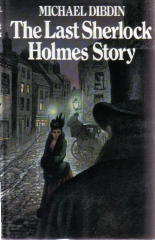
   While his first book was a well-regarded Sherlock Holmes pastiche, one in which the master detective confronted Jack the Ripper, Aurelio Zen is the character Mr. Dibdin’s career has been centered around ever since. And from what critics around the world have said, his reputation, were it to depend on only this one creation, is secure for a long time to come. I’ll quote only one section of the obituary in the Telegraph, as posted by Jeff at The Rap Sheet:

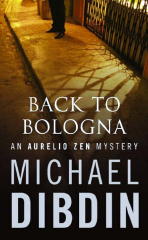
    “Aurelio Zen’s initials offered a clue to his creator’s methods and motives; in the course of the series, Dibdin pieced together an A to Z of contemporary Italy, a composite of finely-drawn observations about the country and its people. The picture he painted, however, was no rose-tinted idyll: his tenth Zen mystery, Back to Bologna (2005), opened with a football club tycoon slumped dead over the wheel of his Audi, a bullet in his brain and a Parmesan cheese knife rammed through his chest.”

Bologna

   Michael Dibdin was born in England but lived in the Seattle area in the US since his marriage in 1995 to fellow mystery writer K. K. Beck. The following bibliography of his crime fiction, as expanded from Crime Fiction IV, by Allen J. Hubin, lists only the British editions:

      # The Last Sherlock Holmes Story (n.) Cape 1978 [Sherlock Holmes; London; 1888]
      # A Rich Full Death (n.) Cape 1986 [Florence; 1855]
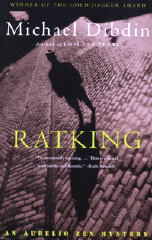
      # Ratking (n.) Faber 1988 [Insp. Aurelio Zen; Italy]

Ratking

      # The Tryst (n.) Faber 1989 [England]
      # Vendetta (n.) Faber 1990 [Insp. Aurelio Zen; Italy]
      # Dirty Tricks (n.) Faber 1991 [Oxford; Academia]
      # Cabal (n.) Faber 1992 [Insp. Aurelio Zen; Rome]
      # The Dying of the Light (n.) Faber 1993 [England]
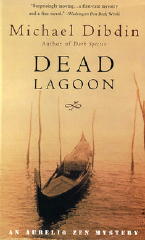
      # Dead Lagoon (n.) Faber 1994 [Insp. Aurelio Zen; Venice]

Lagoon

      # Dark Spectre (n.) Faber 1995 [U.S. Northwest]
      # Cosi Fan Tutti (n.) Faber 1996 [Insp. Aurelio Zen; Naples]
      # A Long Finish (n.) Faber 1998 [Insp. Aurelio Zen; Italy]
      # Blood Rain (n.) Faber 1999 [Insp. Aurelio Zen; Sicily]
      # Thanksgiving (n.) Faber 2000 [Nevada]
      # Medusa (n.) Faber 2003 [Insp. Aurelio Zen; Italian Alps]
      # Back to Bologna (n.) Faber 2005 [Insp. Aurelio Zen; Bologna]

   Again according to the Telegraph: “Back to Bologna was Dibdin’s most recent title, but he has an 11th (and probably last) Zen novel, End Games, due out in the UK in July and in the States in November.”

   A day or so after Bill Pronzini’s short article on Elliott Chaze appeared on this blog, Ed Gorman posted the following over on his site. It is reprinted here with his permission:


   Chaze is known in pulp circles for his flawless novel Black Wings Has My Angel, which many people feel is the single best novel Gold Medal published during its heyday. As Bill details, Chaze also wrote several other novels, a few of which are also fine books.

   As I was reading the Chaze piece last night, I started remembering the two or thre phone calls I had with him. At that time the original Black Lizard Publishing Company seemed to be flourishing. Both Barry Gifford, the line’s editor, and I wanted to get Angel back into print. I agreed that I’d try and track Chaze down. Took a while but I finally got a phone number.

   He seemed almost amused that anybody remembered Angel with such respect and interest. He talked first about a few of his other books. My interpretation – and I may be wrong here – is that he felt hardbacks published by major houses should be of more interest than a paperback original.

   But as we talked, I kept bringing up scenes from Angel. And finally he began speaking enthusiastically about it. That is, until I told him what we could pay him for it. He then went into a low key but bitter story about how “New York” screwed writers at every turn. They didn’t pay much, they didn’t promote, they cheated you on royalties. While these were all standard writer complaints, he delivered them with singular ferocity.

   He assured me several times that he liked me, that he just might have to look up one of my books, that he’d appreciate seeing some Black Lizard novels to look over. He obviously didn’t want to end on a bitter note. He even invited me to call him again, which I did. The next call we mostly talked books and movies we liked. And toward the end about his career as a journalist in the South during the most turbulent decades since the Civil War.

   He was a bright, gifted man. We never did reprint Angel because the line was sold suddenly. But I sure wish we had. I can see it with one of those great Kerwan covers on that shiny stock the Lizards used. Chaze would have been right at home with the other hardboiled greats, Fredric Brown, Peter Rabe, Jim Thompson, Charles Willeford and many others – Barry had developed, for my taste, the best reprint line of American hardboiled fiction ever offered anywhere.

>>  Bill Pronzini’s reply:   I envy Ed’s contact with Chaze, who was clearly a writer after my own heart. I’d have enjoyed knowing him, I’m sure. His experiences with and feelings toward publishers and publishing pretty much mirror mine.

   Before breaking up part of it a few years ago, Walker Martin had one of the largest collections of pulp magazines in the world. It’s still large, and he’s in the process of building some of it back up again. Two of his favorite pulp magazines have always been Black Mask and Dime Detective. After he commented on my recent review of the Charlie Chan movie, The Scarlet Clue, I asked him if he’d seen the blog entries on Morton Wolson, aka Peter Paige:


  Hi Steve –

   Yes I read the Morton Wolson post but somehow missed the letter from his son. I think I mentioned to you a couple years ago how I had tracked Morton Wolson down and visited him in his furniture store in Manhattan.

   It was in the 1980’s and my wife was with me. We spent a couple hours talking about his pulp career, Ken White, who was the editor of Dime Detective, and Joe Shaw. I got the impression he was the owner of the store, which was quite large but empty of any customers while I was there.

   Wolson was amazed that anyone was interested in talking about the pulp days. He said he was paid quite well for the Peter Paige novelettes, most of which starred Cash Wale and his sidekick Sailor Duffy. He received around $500 per novelette which in the 1940’s was a big sum of money. His agent was Joe Shaw (which he referred to as Cap Shaw) and when the pulps died off in the early 50’s, an attempt was made to break into the paperback market but nothing came of it.

   He remembered all the Dime Detective and Black Mask authors and had nothing but good things to say about his pulp days. When nothing came of his attempts to write mainstream literature, he somehow got into the furniture business and was successful.

   I asked him about the other pulps that Popular Publications published but he said he had no interest in them because except for Black Mask, Dime Detective, Detective Tales, New Detective, Adventure, the other pulp titles were slanted for the teenage boy market. Adults did not really read the hero pulps like Spider, G-8, Operator 5, etc.

   This is an interesting comment that I have heard from other old timers that actually bought the pulps off the newsstand. Harry Noble, who I was friends with for almost 40 years, used to laugh to see the adult collectors of today making such a fuss over The Shadow, Doc Savage, etc. When these hero pulps were on the newstands, the main audience was kids, teenagers, mainly boys. The girls were interested in the love pulps.

   My wife’s father who died recently at age 93, often told me that he and the other blue collar working men bought the adult pulps like Blue Book, Adventure, Black Mask, Western Story, etc. It never crossed his mind to save the issues. They were read to pass the time and then thrown away.

   Anyway these were the things that Morton Wolson talked about. We kept in touch for a while, and then I guess he retired and eventually I mislaid his new address. One funny thing, a year or so later I came across some cancelled checks from the files of Popular Publications. I still have some showing payment of several hundred dollars to Morton Wolson for the Peter Paige novelettes. I sent Morton some copies of these checks and he was astonished to see such things still in existence.

   I’m sorry to learn he is no longer with us. I always enjoyed the Cash Wale stories.

« Previous PageNext Page »