Reviews


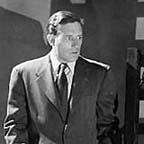
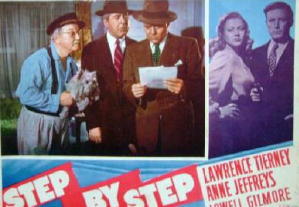
STEP BY STEP. RKO Radio Pictures, 1946. Lawrence Tierney, Anne Jeffreys, Jason Robards Sr., George Cleveland. Screenwriter: Stuart Palmer. Director: Phil Rosen.

   I don’t know his career all that well, but I know enough to make it awfully hard to imagine that the tough-looking Lawrence Tierney had many leading roles in which he wasn’t the villain. Nonetheless, here he is in this low budget postwar mystery movie, pairing up with a deliciously blonde Anne Jeffreys to help nab a gang of Nazi spies somewhere along the sunny California coast.

Jeffries

   Fresh out of the Marines, Johnny Christopher (Tierney) spots Evelyn Smith (Jeffreys) while she’s swimming in the ocean, and in a two-piece bathing suit yet. Not easily taking a friendly no for an answer, he follows her to the house where she’s working as a Senator’s secretary, but another Miss Smith seems to have taken her place. Johnny’s Miss Smith is nowhere in sight.

   Bringing the police in does not help, and in fact makes things worse. When the bodies start to pile up, he’s immediately been tagged as being a semi-delusional if not cracked-up war veteran, and his Miss Smith, when found, quickly becomes his partner on the lam.

Poster

   Although I admit that the plot is ridden with as many holes as that legendary slice of Swiss cheese, it still tickled my fancy to see fate conspire against the pair of fugitives, with every step they take getting them more and more deeply into trouble. George Cleveland, playing a cranky but lovable old motel owner, is the only one who believes in them.

   Since I watched a print that omitted the opening credits, I didn’t recognize Anne Jeffreys until I looked it up after the movie was over, but with her long blonde hair curled up slightly at the ends, I didn’t take my eyes off her very often. Even as a misunderstood hero, Lawrence Tierney played his part as if he were an old-fashioned pocket watch that has been wound up too tightly and is ready to burst into a flying display of gears, cogs and pieces of broken springs at the slightest provocation.

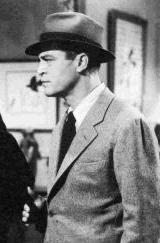
Tierney

   And on two occasions, he does, in a couple of high-flying, hard-punching fist-fights in which he nearly bounces off the walls in the bargain. A good film that the critics didn’t care for (*), but on the other hand, five out of six IMDB viewers so far have thought it was as much fun to watch as I did.

   —

   (*) Here, for example, are some of Bosley Crowther’s contemporaneous comments as they appeared in The New York Times: “Even two murders don’t relieve the tedium of this incredible tale about an ex-Marine and a chance feminine acquaintance who stumble into a Nazi espionage plot in sunny California and get quite a pushing around before their innocence is established and the spies are apprehended. As the principals Lawrence Tierney and Anne Jeffreys move through the film like two bewildered innocents in search of a director.”

DANA CHAMBERS – Rope for an Ape

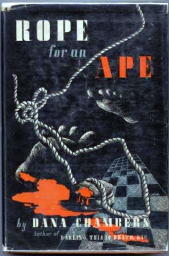
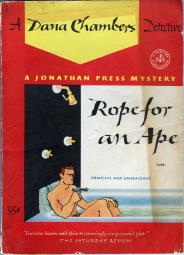
Jonathan Press Mystery J63; digest-sized paperback; no date stated, but circa 1951. Hardcover edition: The Dial Press, 1947. Previous paperback edition: Bestseller Mystery B-103; abridged; no date stated, but circa 1948.

   Jonathan Press and Bestseller Mysteries were each published by the same company, which was essentially Mercury Press, with Lawrence E. Spivak the actual publisher. Back in the 1940s Mercury Press also published Ellery Queen’s Mystery Magazine, to set a frame of reference, perhaps. I have no idea why this particular book by Dana Chambers was so popular that they did it twice. The books they reprinted are not considered very collectible, since more often than not, many of them were abridged. In this case I read the uncondensed version, and I’m sure I’m far better off for having done so.

Ape-HC

   Since Dana Chambers is all but a brand new author for me, you’ll have to indulge me. Let me check in with Al Hubin’s Crime Fiction IV to see what other mysteries he might have written:

CHAMBERS, DANA; pseudonym of Albert Leffingwell, (1895-1966); other pseudonym Giles Jackson

* Some Day I’ll Kill You (n.) Dial 1939 [Jim Steele; Connecticut]
* Too Like the Lightning (n.) Dial 1939 [Jim Steele; New York City, NY]
* She’ll Be Dead by Morning (n.) Dial 1940 [Jim Steele; New York City, NY]
* The Blonde Died First (n.) Dial 1941 [Jim Steele; Ship]
* The Frightened Man (n.) Dial 1942 [Jim Steele; New York City, NY]
* The Last Secret (n.) Dial 1943 [Jim Steele; New York City, NY]
* Darling, This Is Death (n.) Dial 1945 [Miami, FL]
* The Case of Caroline Animus (n.) Dial 1946 [Jim Steele; Miami, FL]
* Death Against Venus (n.) Dial 1946 [New York]
* Rope for an Ape (n.) Dial 1947 [New York]

** Dear, Dead Woman (n.) Jonathan Press 1948; See: The Case of Caroline Animus (Dial 1946).
** Too Like the Dead (n.) Bestseller 1951; See: Too Like the Lightning (Dial 1939).
** Blood on the Blonde (n.) Jonathan Press 1952; See: Witch’s Moon (Dial 1941), as by Giles Jackson.

LEFFINGWELL, ALBERT (1895-1946); see pseudonyms Dana Chambers & Giles Jackson

* Nine Against New York (n.) Holt 1941 [New York City, NY]

JACKSON, GILES; pseudonym of Albert Leffingwell, (1895-1946); other pseudonym Dana Chambers

* Witch’s Moon (n.) Dial 1941 [Nile Boyd; Connecticut]
* Court of Shadows (n.) Dial 1943 [Nile Boyd; New York City, NY]

   There’s a year of death discrepancy there, I see, but I suspect that 1966 is the one that’s wrong, and that it was really 1946 when he died. If so, that would mean both that Leffingwell died young and that the book in hand was published posthumously. If and when I learn more, I’ll let you know.

   While I have some of the books listed above, I’m almost positive that Rope for an Ape is the first one of them I’ve read. As for who Jim Steele was, I admit I have to cheat and tell you what Bill Crider had to say about him on his blog, where he recently reviewed The Blonde Died First:

   You don’t hear much about Dana Chambers these days. In fact, you don’t hear anything at all, and Chambers isn’t mentioned in any of the reference books I have handy. But in the 1940s, Chambers was a prolific and well-reviewed writer of medium-boiled mysteries. The Blonde Died First is narrated in the first person by Jim Steele, who’s supposedly a successful script writer for radio, though we just have to take his word for it. There’s nothing in the novel to prove it.

   Steele is a series character, and this isn’t his first appearance. I gather that he was a pretty successful spy at one time since he has the Medal of Honor. But in this one, he’s just a guy trying to solve a couple of murders, including that of the blonde of the title. (The title, by the way, is a clue.) Most of the book takes place on a cruise ship, and there’s quite a bit of action, a complicated plot, and Steele’s smooth narration to carry you along. Things get really kinky by the end of the book, surprisingly so, I thought, for a novel published in the 40s, but maybe I’m just naive. I have a couple of other books by Dana Chambers, and I guess it’s time I read them.
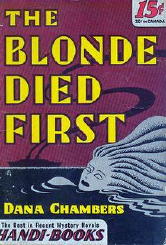
Blonde

   So Jim Steele is a radio writer, is he? Then what’s he doing being listed on Kevin Burton Smith’s master list of private detectives on his Thrilling Detective website? Acting like a PI in all his stories, as a wild and probably not-so-far-off-the-mark guess.

   Jim Steele’s not in this one. Suffice it to say for now that the detective of record is a fellow named Nile Boyd, he has a girl friend named Anna Warriner, and I’ll say more about both of them more in a minute. First, though, what caught my eye was a short sentence on page 65 of this edition to the effect that he and Anne were involved in a case very much like this one “up in Connecticut a while back.” Aha! Here’s a series character appearance that Al Hubin didn’t know about before – see the pair of books written by Chambers as by Giles Jackson listed up there not too long ago.

   Boyd works for the New York Clarion, and now that the war has ended, he’s back from overseas as a war correspondent. Anne, who works for the same newspaper, is nearly twenty years younger than he, and since he’s now on the East Coast and she’s in California visiting her mother, and maybe having a good time out there as well, he’s beginning to worry about how strong the attraction he has on her may actually be.

   He needn’t worry too much, only just a little, as it turns out. As far as the detective puzzle is concerned, the one that Boyd soon finds himself in the middle of, this is one of those wealthy “upper crust affairs” that are the equivalent of the British manor house mysteries that were so common back in the 1920s, 30s and 40s. A well-to-do family is hosting a slew of guests over a long weekend, the only problem being that some of them starting to turn up dead.

Ape-PB

   The chief suspect, and a huge negative as far as I was concerned, is a giant ape who has recently escaped from a circus train which derailed nearby. Forget that. I’ve heard too many bad radio shows and watched too many equally bad B-movies that’ve been based on this same old plot gimmick, which was tired and worn out even the first time.

   But the killer is all too human, as it turns out, and it takes all of Nile Boyd’s ingenuity to nab him. And all the while he’s doing so, with Anne’s assistance eventually, there is plenty of witty upscale dialogue to keep the reader amused on a fulltime basis – at least this one was – and as usual in novels like this, particularly in the beginning, everyone is drunk, was drunk or is about to get drunk. Well, yes, perhaps I am exaggerating, but maybe that’s because I am getting a little high on the fumes myself. (Never touch the stuff otherwise.)

   The case eventually turns to the tough, though, what with guns and blows to the head (Boyd’s) and a small amount of generally restrained violence such as that. After the second murder, it begins to dawn on everyone that they’re not playing fun and games any more. Nonetheless, this is a fairly-clued detective puzzle, with a long explanation at the end, with all of usual trappings.

   Something for everyone, you might say. An unusual mix, and maybe the book suffers a little for it, but if you ever come across a used copy and want my advice, I think you might take at least a second scan through it before saying Yay or Nay.

— February 2007


[UPDATE] 04-18-07.    S. B. has asked me about the cover of the paperback edition. “Is that what I think I see?”   Yes, indeed. If you think you see a man sitting in a bathtub with a gun in his hand, that it is exactly what it is. Is the scene in the book?   Yes, indeed again. What you see is what you get.

[UPDATE] Later on 04-18-07. I’ve just received a pair of email messages from Victor Berch, who says in the first one:

  Steve:

   Just read your piece on Leffingwell. His middle name was Fear, which was his mother’s maiden name. He was born in Cambridge, MA, so I could check the Mass. Vital Statistics. On his draft card,the transcribers have transcribed his middle name as Fern, but looking at the actual handwriting, it is definitely Fear that is handwritten.

               Victor

    The second is a copy of Leffingwell’s obituary notice taken from The New York Times for August 15, 1946, so the year of death stated for him as Dana Chambers is the one that’s wrong, as suspected. Leffingwell, aged 51, was a former advertising executive who lived in Scarsdale NY at the time of his death, which occurred after a few months’ illness. He founded his own advertising agency, Olmstead, Perrin & Leffinwell, in 1925, the Times goes on to say, before turning to writing. It isn’t clear from the obituary whether he was ever a writer on a full-time basis or not.

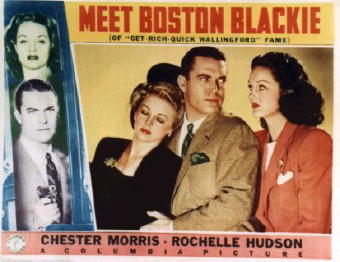
MEET BOSTON BLACKIE. Columbia, 1941. Chester Morris, Rochelle Hudson, Richard Lane, Charles Wagenheim, Constance Worth. Screenplay: Jay Dratler; based on a character created by Jack Boyle. Director: Robert Florey.

   I was warned by Vince Keenan that in spite of their popularity at the time — there were 14 of these Boston Blackie films with Chester Morris in all — they (um) weren’t very good, or certainly not as good as he’d expected. He taped a few of them last month from TCM, just as I did, only he got around to watching some of them before I did.

Poster

   This is the first one, as you might have guessed from the title — the series lasting until 1949 — and even before I started watching it, I was convinced that Vince was wrong. And for the first 10 or 15 minutes or so, I was even more convinced. After that, well, I’ll get back to it, but Vince — crossing my fingers where you cannot see them as I say this — I’ll never doubt you again.

   In this movie, it isn’t made clear whether Blackie is a reformed jewel thief or a very tricky one whom the persistent Inspector Faraday (Richard Lane) simply hasn’t been able to catch yet. They are on friendly enough terms, but Faraday has this obsession about finally outwitting his (much) more quick-witted nemesis, and he can’t quite do it.

   A body found in Blackie’s cabin on a ship returning from Europe gets the chase started, and to clear himself, Blackie has to nab a gang of foreign agents hanging around a Coney Island carnival. The black-and-white atmospherics are nicely done, and then done again, until finally overdone. Another location would have been welcome, but it’s not difficult to figure out that a lot of money, time and effort had already been spent on this one.

Morris

   Chased by the aforementioned gang, Blackie commandeers a roadster driven by a dark-haired beauty named Cecelia Bradley (Rochelle Hudson), whose charms Blackie doesn’t seem to recognize as quickly as the audience does — speaking only for myself, of course — but charms nonetheless.

   Running the car up into a freight train to escape doesn’t work as well as planned, but after a desperate automobile chase and dodging a few bullets, the pair finally manage to get away. Miss Bradley, no weak-kneed spinster lady she, discovers that she has had the time of her life, and signs herself up with Blackie to solve the case together. While her company is certainly welcome, in my heart of hearts, I am not entirely persuaded.

Hudson

   I see that I am on the verge of revealing more of the plot than I should, and I had better watch what I say from here on out, except to say that the story line goes drastically downhill from here.

   The light-hearted approach is a little too light-hearted. The funny lines are tired, worn and generally not very funny, even (I would have thought) for 1941 audiences. The gang of agents couldn’t smuggle their way out of wet paper bags. And for most of their time together, Blackie seems to connect with Miss Bradley on a buddy-buddy basis more than he does on a man-to-woman basis

   On the other hand, Miss Bradley is definitely smitten, but as for the hint at movie’s end that she’d be coming back to appear in Blackie’s next exploit, well, it never happened. Too bad. While I’m sure Blackie will find plenty of women to pair up with through the course of his follow-up adventures, too bad indeed.

   Screenwriter Jay Dratler was later nominated for an Oscar (for the movie Laura) and won a Edgar in 1949 as one of the people responsible for Call Northside 777. He was still in the minor leagues, though, when he was assigned this one to work on.

[UPDATE] 04-17-07. Looking at this blog entry this evening, checking for errors and tweaking the prose a little, neither of which I actually did, it occurred to me that none of the images I’ve posted actually came from this particular movie, not even the one in the poster. The two women in the film never met, not once.

   And as long as I’m doing this update and to remain fair and balanced in my presentation, why don’t I give equal time to someone who liked the movie? Leonard Maltin gives it three stars (***) and goes on to say, “… a slick and fast-paced mystery comedy … Franz Planer’s stylish cinematography enhances this solid programmer.”

RICHARD BURKE – The Frightened Pigeon

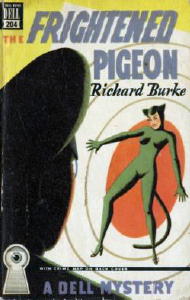
Unicorn Mystery Book Club; hardcover reprint, June 1946. First Edition: G. P. Putnam’s Sons, 1944. Paperback reprint: Dell 204, mapback edition, 1947.

   When Victor Berch, Bill Pronzini and I did our annotated bibliography of the Ziff Davis line of Fingerprint Mysteries , we included a short profile of Richard Burke, which of course you should go read. Many of his books, we said, involved a Broadway private detective named Quinny Hite, but as it happens, this is not one of them. In fact The Frightened Pigeon takes the reader to another part of the world and (one imagines) another kind of mystery altogether.

Pigeon-Front

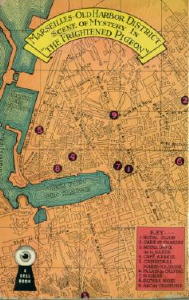
   But first a word on the cover that’s shown, though, before getting down to details. This is, of course, the Dell mapback edition that’s mentioned above, and in case you can’t make out the details, the map on the back below is that of the city of Marseilles, which is where the last eighty percent of the story takes place.

   The setting of the first fifty pages is Paris, 1942, with the Germans solidly in control of the city. An American dancer named Valerie Bright is still there, however — the pigeon of the title –- and very determined to stay non-political. From page 8, of the Unicorn edition:

   Of course after the Axis had decided to include the United States in the war, she had regarded them as enemies, but there wasn’t anything personal about her feeling.

   Her close male friend, Charles John Dillon, nicknamed “Ching,” is working closely with the French underground, however, and events, beginning with a stolen German diary, bound to be embarrassing if it falls into the wrong hands — as, for example, into Ching’s hands — soon make the light-hearted Val realize how dirty — and dangerous — war really is, not knowing what will happen next nor whom your friends really are. By page 40, she is one frightened pigeon indeed, as off to Marseilles they and a small group of displaced others go, hoping to find a way out of France and its closed borders.

Pigeon-Mapback

   The diary appears and disappears with amazing regularity. It is, in fact, amazing, how much mileage an author (Burke) can make of one small important object. Otherwise here is a novel one can learn a large amount from — supposing, that is, that one has never been in a place controlled by Nazi-like enemies one is trying his or her best to avoid — both in term of locale (well-described) and people, especially those like Valerie, whose mind is soon brought down to earth in satisfying (but not very surprising) fashion, but also the large number of others who find themselves caught up in events far beyond their say.

   Don’t get me wrong. This is by no means a major work. It’s no more than ordinary at best, in the overall scheme of things, but what it does have is atmosphere, and plenty of it.

— September 2006

PRAIRIE LAW. RKO Radio Pictures, 1940. George O’Brien, Virginia Vale, Slim Whitaker, Paul Everton, Cy Kendall. Directed by David Howard.

   Generally speaking, I didn’t intend to include reviews of B-western movies here on the M*F blog, but since there’s more than the usual amount of criminous activities going on in this film’s 60 minutes, I decided to break my own rule, and who better?

   A crooked land promoter, Judge Ben Curry (Paul Everton), is taking money from farmers hand over fist, without telling them two things: One, that the former ghost town of Olympia City, where his headquarters are, has no water, and two, that the land he is selling them belongs to cattleman Brill Austin (George O’Brien).

O'Brien

   Yes, in this movie it is the cattlemen who are the good guys and not the usual other way around. Among the settlers is the daughter of one of the farmers, Priscilla Brambull (Virginia Vale) – and no, I didn’t think of that until right now, and no, it’s not that kind of movie. Among other legal misbehavior committed by Judge Curry is his blatant attempt to call for an election without proper notice, stuffing the ballot box, and declaring Olympia City the county seat so that the killer of the sheriff, Brill Austin’s Uncle Jim, can be set free.

   Later on in the movie while a valid trial is being held in Prairie Rose, the jury does double duty: while deliberating on the verdict, they’re also dodging bullets by the judge’s henchmen. All this in sixty minutes, I remind you, which also includes a song sung by the uncredited Ray Whitley and his band.

   There’s nothing here to be taken too seriously, as the players certainly don’t, but other than that, it’s a rather pleasurable experience. As for George O’Brien, a former silent film star who went into non-series westerns like this one when talkies came in, this was close to the end of his steady movie career.

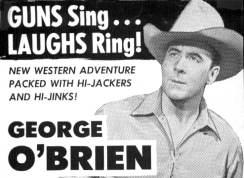
    [Truth in advertising: The photo of O’Brien comes from another film of the same vintage and not this one — but it could have been.]

  Dear Steve,

   Someone sent me your review of my long lost book Dreamboat. I write to say that you are correct that the Flippo series is packed up and put away, and that I remain at the Dallas Morning News as a reporter and editor. You were too kind to Dreamboat, I thought. I wrote it in a tremendous hurry, and never liked it. But thanks, anyway.

   Writing crime novels started out as a hobby, then became a part-time job, then a burden. The books weren’t making enough money for me to quit my newspaper gig, and after number five all the pleasure had drained away. So I stopped writing for a few years.

   About a year ago I started writing again, but once again as a leisure-time activity. The new book is a one-off suspense that bears little resemblance to the previous five. Don’t know if I’ll ever finish it..

   It was a fun ride for a while, but you’re right: it didn’t last long. Long enough, though. I had a good time while it lasted.

Best wishes,

      Doug Swanson


>>   Thanks for writing, Doug, and best wishes in return on getting that new novel finished!    — Steve

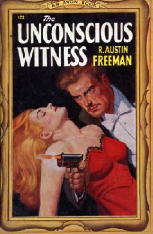
R. AUSTIN FREEMAN – The Jacob Street Mystery.

Hodder & Stoughton, 1942. US title: The Unconscious Witness; Dodd Mead, 1942. US paperback: Avon #122, 1947.

   As Tom Pedley is painting in Gravel Pit Woods, concealed by shrubbery from the casual glance, he observes a woman whose odd behaviour shows she is eavesdropping on a pair of men who have just walked past. One man returns and is furtively followed by the woman, and the intrigued Pedley checks the other end of the path but sees no sign of the second man.

   A week later, the artist, who has no wireless and does not read the papers, learns a murder by forcible administration of poison was committed in the wood during the very time he was painting the sylvan scene, and from a description circulated in print and on the airwaves he is obviously the man being sought for interview by the police.

Witness

   Around this time Pedley makes the acquaintance of brassy Mrs Schiller, a modernist artist separated from her husband and now living next door to Pedley. There is also Mr William Vanderpuye, who meets Mrs Schiller when he visits Pedley’s studio to arrange for a portrait sitting. The pair strike up a close friendship and Mr Vanderpuye is the last person seen with her before her disappearance. For while a dead woman is found locked in Mrs Schiller’s room with the key on the inside, she is not its tenant.

   We now leap forward a couple of years. Mrs Schiller is still missing, and Freeman’s most frequently used detective character Dr Thorndyke and his assistant Dr Jervis become involved in the case due to a large bequest which would be hers if she was still alive. A presumption of death has been requested but the solicitor feels uneasy under the odd circumstances. Is she still living, and if she is, why has she not been found despite sterling efforts by the authorities and a vast amount of publicity in the press? Who was the woman found dead in her room and what is the connection between them?

   My verdict: Readers will learn yet another way to open a door locked from the inside. The method in this case needs a particular type of key, common at the time, so fair enough, and its use helps point up the fact that, despite appearances, the dead woman found in Mrs Schiller’s room was not a suicide.

   There are sufficient and fair clues, and the investigations are described in lively fashion. It turns out to be a more complicated case than it seems at first glance. I guessed part of the solution but not the whole. All in all I found this, the final mystery novel Freeman wrote before his death in 1943, one of the better Thorndyke outings.

            Mary R
http://home.epix.net/~maywrite/


   Etext: http://gutenberg.net.au/ebooks05/0500481.txt


[UPDATE]   Later the same evening, excerpted from an email from Mary, after she’d seen her review online:

  Dear Steve

   It looks very good. The cover is certainly eye-catching!

   I suspect the illustrator’s artistic license had been recently renewed and was operating at its highest level! A pistol shot is mentioned at one point but there is no gunplay of the kind depicted on this cover.

   The woman looks as if she has fainted but it may be a clever bit of word play since we can take it she is intended to represent the dead woman. This is because the latter could be said to have acted as an unconscious (in the sense of unknowing) posthumous witness to her own murder due to certain evidence her remains provide.

   On the other hand, the publisher may have simply got the cover details mixed up…

As ever

      Mary R

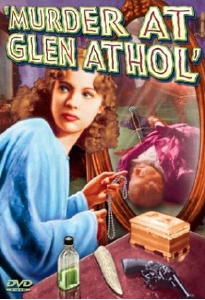
MURDER AT GLEN ATHOL. Invincible/Chesterfield, 1936. John Miljan, Irene Ware, Iris Adrian, Noel Madison, James Burtis. Based on the Doubleday Crime Club novel by Norman Lippincott. Director: Frank R. Stayer.

   The date of the movie as given on the DVD case is 1932, but that’s in error. The book of the same title that the film is based on is 1935, a one-shot detective novel by Norman Lippincott, about whom very little is known. The book itself is scarce, with no copies being offered for sale by anyone on the Internet at the present time.

DVD

   I happen to have a copy myself, but of course it’s inaccessible, along with most of my collection of Crime Club mysteries, shelved away in the far end of the basement, which I do intend to get to one day. Really soon now. So any impression of the mystery that Mr. Lippincott wrote is going to have to come from this filmed version instead, and I must say that I was impressed.

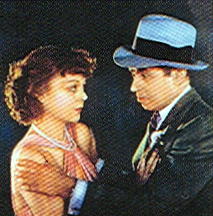
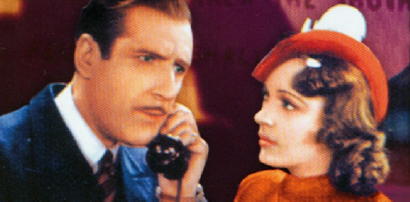
   Within the 64 minutes that it takes to watch this tightly directed detective movie are all of the standard ingredients of the Golden Age mystery yarns of the time: A detective, Bill Holt, on holiday, played rather stiffly by John Miljan; his trusted and slightly comic assistant, Jeff (James Burtis) who looks like an ex-prizefighter; a brash and sexy vamp who lives next door, Muriel Randel (Iris Adrian), who’s not afraid of a little blackmail on the side, even if one of her victims is local gangster Gus Colletti (Noel Madison). See below.

Scene 2

   Visiting next door, where Holt is invited to a dinner party one evening is Jane Maxwell (Irene Ware), who in this movie is merely wholesomely pretty, not beautiful. Holt’s eye lights up as soon as he sees her; Muriel’s overt charms mean nothing in comparison. Jane Maxwell has her own secrets, but no one this wholesomely pretty could be guilty.

   And Muriel is one of three people who are murdered later that same evening. I haven’t mentioned the other two, but suffice it to say that one of them is assumed to have killed both Muriel and the other victim, which suits the local police just fine. They’re wrong, of course, and the job Bill Holt takes upon himself is to prove it, and it isn’t easy, what with all of the red herrings, lies and false trails he’s forced to dodge and make his way down before doubling back.

Scene 1

   Movies like this are often played for laughs as well as for the detective aspects, but thankfully such small hilarities are kept to a minimum. It’s only a guess, but I’d have to say that the movie stuck fairly well to the novel it was based on. Whether that’s so or not, and low budget or not, this is detective movie that’s both worthy of the name and the just over sixty minutes that’s needed to take it all in.

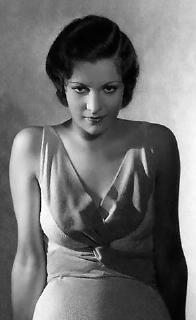
PostScript: Here are the two leading ladies of this film, neither of whom are dressed as they are in this movie, but as if this blog weren’t classy enough, they do add a little something to the overall ambience, don’t they?

Iris Adrian
Iris Adrian


Irene Ware
Irene Ware

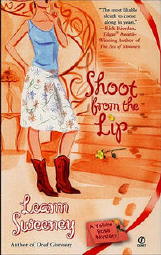
LEANN SWEENEY – Shoot from the Lip

Signet, paperback original, January 2007.

   There are a few private detectives in the world of crime fiction that Kevin Burton Smith doesn’t (yet) know about, he of the Thrilling Detective website, which attempts to list ALL of them, and in all honesty, he pretty well succeeds. Case in point, though: He’s missing Houston-based Abby Rose, who’s in this book, her fourth case overall, the previous three being:

   Pick Your Poison. Signet, pbo, May 2004. Abby inherits her late father’s home and computer business along with her twin sister, Kate. When she investigates the murder of their gardener, she learns some truths about their true birth parents.

   A Wedding to Die For. Signet, pbo, January 2005. Independently wealthy, Abby has started her own business as a private investigator finding birth parents for adoptees. Her client is a bride-to-be who hires Abby to find her biological mother so she can be at her wedding, but a murder occurs at the reception instead.

   Dead Giveaway. Signet, pbo, November 2005. After Abby is hired by a 19 year old basketball star looking for his birth family, the woman who found him on her doorstep as an infant is murdered.

Cover

    In spite of all of the murders and the fact that Abby is a fully licensed PI, these are all “cozy” type mysteries, and so is the book in hand, Shoot from the Lip. Yellow Rose Investigations is the name on her business card. Her twin sister Kate, a psychiatrist, does the psychological assessments on any prospective clients, and with money in the bank, she can easily afford to turn down clients whose cases she doesn’t wish to take.

   Her client this time around is young Emmy Lopez, who’s been responsible for her three younger siblings ever since their mother died. An upcoming appearance on a TV reality show brings out the possibility that there was a fourth child Emmy never knew about and who may have been put up for adoption, either legally or (more likely) illegally.

   The story’s told in raw-boned but light-hearted Texas style, with lots of details of the two sisters’ various romances with their steady (and not so steady) boy friends, along with Abby’s continual references to her daddy, now gone but far from forgotten.

    Murders do occur in this book, which I have just realized that I have forgotten to mention, but unfortunately the detection involved is slim to none. Not only are Abby and her circle of family and friends relatively slow on the uptake when dangerous things begin to happen, but the killer makes the fatal flaw of simply hanging around too long. He or she is caught only by doing one evil deed after another, until eventually going too far, when at last the truth is revealed.

   Don’t get me completely wrong. For fans of low-keyed murder investigations, enhanced and enlivened by a crew of friendly folk who seem to come back book after book, they could do far worse than stay with Abby Rose, wherever her adventures may take her.

— February 2007

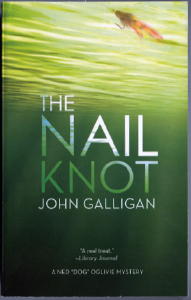
JOHN GALLIGAN – The Nail Knot

Worldwide; paperback reprint, October 2006. Trade paperback: Bleak House, May 2005.

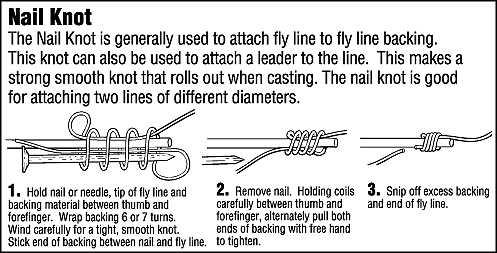
   A “nail knot” is one of those clever devices that are used most often by fly fishermen, and as such it is something I knew nothing about before reading this book. (The last time I went fishing was with my grandfather when I was ten or so, when all we did was to drop our lines into water off a long pier jutting out into Lake Michigan. No casting abilities of any kind required. Nor did we catch anything, but why do I still remember the day, now well over fifty years ago?)

Knot

   The primary protagonist of The Nail Knot, a laid back sort of fellow who calls himself the Dog, is a fly fisherman, however, and I’ll get back to him in a minute.

   In the meantime, here is a short list of other mystery novels or series which I’ve just come up with in which fly fishing is a substantial component, in no particular order.

  Firehole River Murder, by Raymond Kieft, first book in the “Yellowstone Fly-Fishing Mystery Series.” Series character: name not known.
  Blood Atonement, by Jim Tenuto. Series character [SC]: fly-fishing guide Dahlgren Wallace.
  Bitch Creek, by William Tapply. SC: Stoney Calhoun, amnesiac worker in a bait and tackle shop in rural Maine.
  Pale Morning Done, by Jeff Hull. SC: Montana fly-fishing guide Marshall Tate.
  Dead Boogie: A Loon Lake Fishing Mystery, by Victoria Houston. SC: Chief Ferris, Doc Osborne and Ray Pradt. [There are several in this series.]

   There are probably others that I am not thinking of now. Please add others, if you can. This is the first of at least three books in John Galligan’s “Dog” series, but some research shows that he wais the author of one earlier mystery novel, Red Sky, Red Dragonfly, also published by Bleak House (in 2001), in which a hockey player from Wisconsin travels to Japan to teach English for a year and ends up being implicated in his predecessor’s disappearance.

   Subsequent and/or reportedly forthcoming follow-ups in John Galligan’s fly fishing series are:

  The Blood Knot. Bleak House, hardcover, October 2005. [UPDATE: Bleak House, trade paperback, March 2007.]
  The Clinch Knot. Bleak House. Spring, 2007. [UPDATE: Unpublished as of April 2007.]
  The Surgeon’s Knot.
  The Wind Knot.
  The Hex.

   This is a long-range projection, and I suspect that some of these titles may turn out to be totally hypothetical. But assuming that you’re still with me, let’s take a look at the book in hand. As mentioned above, “the Dog” is how the leading character refers to himself — he tells the story, and on a strictly personal basis, it’s quite a story that has to tell.

   The Dog’s real name is Ned Oglivie, and he is what you might call a dropout from the human race, wandering across the country and checking out fishing spots as he goes. A nomadic fly fisherman without parallel, you might say. Until he reaches Black Earth, Wisconsin, that is, where it is that he finds a body along the edge of the creek that leading into (or out of) local Lake Bud. (You can see that even though it may be an important plot point, it didn’t make much of an impression on me.)

Cover

    He also finds The Woman, but not until she removes from the crime scene all of the evidence that (Dog later learns) points to her semi-senile father. But let the Dog describe the lady, from page 13:

    … and it was impossible for me to take my eyes off her.

    You expect me, I suppose, to tell you that she was a gorgeous creature, or lay out for you some other such cunning nonsense. But it wasn’t like that. The last thing the Dog wanted in those days was attraction to a woman. Plus that was far from the mood, and this woman was anything but gorgeous. She was more like confusing. She had already shown me the clod-hopping ability of a teen-aged boy. She was dressed like that too — dirty jeans and work boots, a t-short that had once been white, a dirty-green John Deere cap with a pair of cheap sunglasses up on the brim. Her thighs and arms and shoulders were thick, and her posture atop the stream mud was on the dark side of dainty. But there was a frazzled spark of red-blond ponytail sticking out the back of the cap. There were breasts strapped down by a sports bra beneath the t-shirt. There were tears in her eyes. Earth to Dog: woman.

   You can tell at once that the Dog is hooked. Her name is Melvina Racheletta O’Malley, or Junior for short, and the Dog discovers to his dismay that he cannot walk away when she asks him to help her in what she insists is a frame-up of her father, Mel.

    The dead man has only lately been a local, which first of all is not a good thing in rural Wisconsin, and secondly he had been an activist in trying to revive and save the fish in Lake Bud, which is also definitely not a good thing — activism, that is.

   The solution to the mystery depends greatly on who was able to tie a nail knot, and at what time. It wouldn’t have been a terribly difficult case to solve, if one had a protagonist who was a little more, shall we say, pro-active on the case — you soon get the feeling that if the Dog were any more low key than he is, he wouldn’t be able to get up in the morning — but then again meeting all of the local folk, some more local and inbred than others, and some not, would have been not nearly so much fun as this.

— October 2006


UPDATE. Quite coincidentally there has been a discussion of fly-fishing mysteries on DorothyL this past week (early November), in relation to a slightly different topic of “male cozies.” Here are a couple more mystery series that have been pointed out as belonging to the category, still small but obviously growing:

  Fly Fishing Can Be Fatal, by David Leitz. SC: Max Addams, owner of a northern Vermont fishing lodge. [There are several other books in this series.]
  Catch and Keep, by Ronald Weber. SC: Northern Michigan conservation officer Mercy Virdon and her boyfriend, newspaperman Donald Fitzgerald. [There is at least one other book in this series.]
  Death on a Cold, Wild River, by Bartholomew Gill. SC: Dublin police Chief Superintendent Peter McGarr, who is the detective in several other books by Gill. In this one, though, it’s the victim who is the fly fisherman, along with at least one of the suspects.

« Previous PageNext Page »