Horror movies


REVIEWED BY DAN STUMPF:


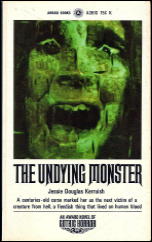
JESSIE DOUGLAS KERRUISH – The Undying Monster. Heath Cranton, UK, hardcover, 1922. Macmillan, US, hardcover, 1936. Reprinted in Famous Fantastic Mysteries, June 1946. Award A351S, paperback, 1968. Lulu Press, POD softcover, 2013.
THE UNDYING MONSTER

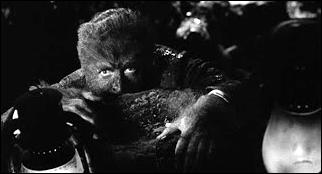
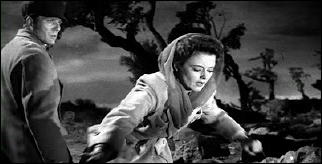
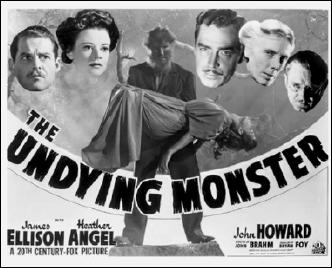
THE UNDYING MONSTER. 20th Century Fox, 1942. James Ellison, Heather Angel, John Howard, Bramwell Fletcher, Heather Thatcher, Aubrey Mather. Director: John Brahm.

   The Undying Monster by Jessie Douglas Kerruish was first published in England in 1922 and is considered by some a classic tale of lycanthropy. I considered it a wanton squandering of my precious youth, but there you are. Thinking back, there were probably some inventive bits in the tale, but for me they were ruined by…. But I can’t yet tell you why. Read on:

   Undying starts out promisingly with a family curse, murder in the moonlight and all sorts of delicious Victorian nastiness. It seems that the Hammand family (local gentry with an imposing manor house and a coat of arms that goes back to the Flood) is periodically stalked from time to time by a horrendous but unseen thing that rips some of them limb from limb and scares others into gibbering madness.

   Good so far. But when Oliver Hammand, latest in line to inherit the family unpleasantness, encounters the thing in the dark, he gets off with a few bites and a case of amnesia while his companion is mauled to near death and his loyal dog is spread all over the countryside. Naturally concerned, Oliver’s sister calls in female paranormal investigator Luna Bartendale, and that’s when things get gummy.
THE UNDYING MONSTER

   Luna Bartendale is probably the most irritating character ever consigned to printed page. She hasn’t been on the case for more than a few paragraphs before she’s saying things like, “I have some theories but I won’t discuss them until….” and then “This confirms what I was thinking but before I say more I must…..” followed by “I know why, but I can’t reveal it to you yet,” and “There’s a very good reason why I can’t tell it to you.”

   Now I got nothing, against foreshadowing, but a man gets tired of that kind of talk all the time. No one likes the guy who says “I told you so,” but even worse is one who says “I could tell you so — if I felt like it,” and Luna Bartendale, for all her groundbreaking appearance as fiction’s first female paranormal detective, says very little else. By the time the plot reached the point where Good and Evil were locked in what should have been a horrific struggle, I was hoping merely that the superannuated boogeyman of the title would gobble her up but (SPOILER ALERT!) no such luck.

   All the sadder then that there are glimmerings of a good story here. So good in fact that 20th Century Fox made a movie of it in 1942 — kind of. Writer Lillie Hayward and Michael Jacoby replaced the annoying Ms Bartendale with cowboy star James Ellison playing a Scotland Yard investigator — and doing it surprisingly well.
THE UNDYING MONSTER

   He’s aided by Heather Thatcher as a plucky distaff-Watson, but his attentions are focused primarily on Heather Angel as the distraught sister of poor Oliver Hammond (They changed the spelling for reasons best known to themselves.) played by John Howard, who had already been paired with Miss Angel in the Bulldog Drummond series over at Paramount.

   Undying Monster is a stylish affair, thanks largely to director John Brahm, who brought similar gothic elegance to The Lodger (1944) and Hangover Square (1945) and cinematographer Lucien Ballard, who will be remembered for The Wild Bunch. Together they impart an atmosphere not unlike the Sherlock Holmes series over at Universal, with evocative fog, looming shadows, and a general sense of mystery — rudely dissipated when we finally see the rather unprepossessing monster.

   And I should add a bit of trivia beloved of bad-movie buffs: the opening shot of Undying Monster is repeated exactly in a later, cheaper Monogram film, Face of Marble (1946). Understandable, since Michael Jacoby, who toiled at or near Hollywood’s bottom rung for his whole career, worked on both films. But one wonders with what weary desperation poor Jacoby found himself re-typing his own work in such reduced circumstances.
THE UNDYING MONSTER

REVIEWED BY DAN STUMPF:


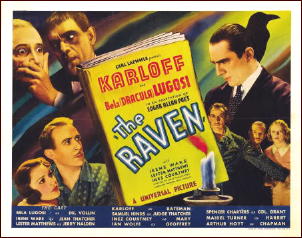
THE RAVEN. Universal, 1935. Boris Karloff, Bela Lugosi, Lester Matthews, Irene Ware, Samuel S. Hinds, Spencer Charters, Inez Courtney. Based on a poem by Edgar Allan Poe. Director: Lew Landers (as Louis Friedlander).

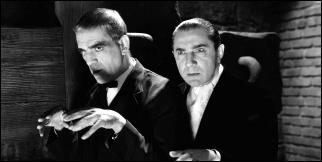
   William K. Everson described The Raven as “grand guignol.” He might also have added that it was probably the apex of Bela Lugosi’s career. Loud, lurid and fast-moving (only 62 minutes long) it’s got monsters, torture, bondage and obsession, and perhaps the Classic Mad Scientist of the Movies, definitively interpreted by Lugosi, whose magnetic screen presence and limited acting ability made him a tragic icon of the B movies.

   The Mad Doctor in The Raven is just about everything an evil medico should be: a megalomaniac plastic surgeon (a theme that would reappear in the classic Eyes Without a Face) obsessed with Poe, who keeps a torture chamber in his basement, falls in love with a woman he can’t have, and sets out to torment her and the rest of the cast, laughing maniacally between fits of sinister organ-playing. What more could you want from a Mad Scientist? Or for that matter, from a horror movie?

   Well for one thing The Raven also features Karloff as a sinister go-fer (the only time Boris ever played second-string to Bela in their careers) a disfigured and disgruntled killer clearly just aching for a chance to get back at his mad-doctor-boss.

   There’s also a giant, razor-edged pendulum, swinging mercilessly downward at its victims, perambulating rooms, a dark, stormy night, and a pervasive atmosphere of tasteful sadism, more quaint than kinky, closer to Fu-Manchu than Krafft-Ebbing. Plus Bela Lugosi gloating — a lot. As if Director Louis Friedlander immediately saw that gloating was his star’s forte and felt it best to give him his head. The result is a full-bodied performance in a juicy part that just begs for the kind of sonorous overacting only Lugosi could give. And a fun film all around.

THE RAVEN Bela Legosi

   Alas, though, things weren’t all that much fun for poor Bela. Almost immediately after The Raven, horror movies went out of style (possibly because of excesses in films like this and Island of Lost Souls) and were actually banned in Britain.

   And hence, one of the premier horror actors of his day found himself unemployed and unwanted. Monster movies came back in the late 30s and early 40s, but now the former star was mostly cast as sinister butlers or red herrings, his name featured prominently on the posters but himself seen little in the films.

   That was in the B-movies. In the grade-Z flicks from Monogram and PRC, Lugosi got meaty roles once again, with a string of mad scientists, deranged killers and lots of screen time, but the meat here was generally bland-tasting, as the films themselves were slow-moving, cheap and mostly devoid of thrills.

   Only once more did Lugosi get a really good lead in a B-movie, and that was Return of the Vampire (Columbia, 1944) a classy job once again directed by Friedlander, who was now calling himself simply Lew Landers. Return has been largely ignored by Horror fans, but it has s spooky atmosphere reminiscent of Roy William Neill’s Sherlock Holmes series over at Universal, even featuring some of the players from that series and set, like them, in an oddly gothic war-time England.

THE RAVEN Bela Legosi

   This was only the second time Lugosi played a Vampire in the movies (he’s named Armand Tesla, but with his cape, coffin and dinner clothes he is Dracula to all intents and purposes) and he takes the role in his teeth and runs with it, clearly relishing the chance to swirl his cape once more and stalk about the graveyard cloaked in fog.

   He’s even assisted by a rather unimpressive werewolf, played by Matt Willis in the best tradition of Dwight Frye, and he gets to gloat a lot once again, just like he did in the old days. Landers/Friedlander adds some fine touches, with the vampire’s presence presaged by dead leaves fluttering in through the french doors, and mist creeping all over the place, and again, when Lugosi’s being sinister, the camera’s right there in a well-lit close-up, while writer Griffin Jay, a veteran of the B-horrors at Universal and PRC, manages to polish up all the old clichés and provide a fast-moving story that seems enjoyably familiar.

   The rest of the 1940s were unkind to Lugosi, and the 50s even worse, but it’s nice to see him in Return of the Vampire, once again flashing his hammy fangs and biting the scenery as only he could.

THE RAVEN Bela Legosi

REVIEWED BY DAN STUMPF:


THE LAST MAN ON EARTH

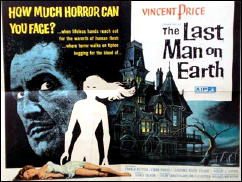
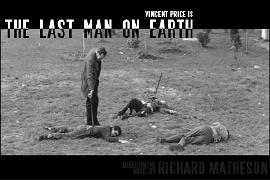
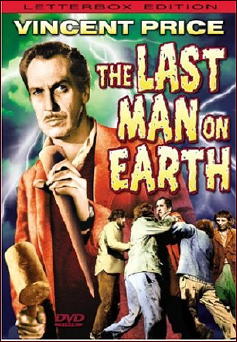
THE LAST MAN ON EARTH. American-International Pictures, 1964. Vincent Price, Franca Bettoia, Emma Danieli, Giacomo Rossi-Stuart, Umberto Rau, Christi Courtland. Screenplay: William F. Leicester & Richard Matheson (as Logan Swanson), based on the latter’s novel, I Am Legend. Directors: Ubaldo B. Ragona & Sidney Salkow.

   Speaking of Sublime Cheapies, The Last Man on Earth was on the other night, the first time it’s been aired around here — cable or otherwise — for almost twenty years.

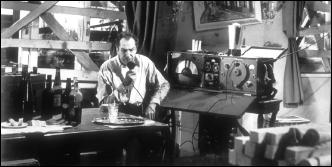
   It was worth waiting for. This film has real seat-of-the-pants tawdriness: a ragged, amateurish improvisational feel that is totally appropriate to the subject. As I watched the over/under-lighted camera-work, listened to the grainy soundtrack, and had my wits challenged by the jagged editing, I had the same eerie feeling I had two decades ago, that this film could have been made by, not about, the last surviving human.

THE LAST MAN ON EARTH

   Needless to say, TLMOE is light years beyond its big-budget remake, The Omega Man, of seven years later.

   In the latter film, we got heroic Charlton Heston living in sybaritic isolation amid mad horde of counterculture late-60s stereotypes, treating the theme with a banality all its own. The picture in The Last Man on Earth is of the ultimate Civilized Man, cooped up in the suburbs, getting by with a jerry-rigged generator and clunky old cars as he copes as best he can with the ultimate in Unreason: Crowds of his former neighbors now turned into zombies.

http://video.google.com/videoplay?docid=-51739690186335997

   The Last Man on Earth also has the distinction of being the most poignant Monster Movie I’ve ever seen.

THE LAST MAN ON EARTH

   In a movie this ragged, the few moments spared for Feeling take on a surprising importance: the torment of parents trying to ignore the cries of a sick child because they’re afraid to call a doctor; Vincent Price crying as he watches old Home Movies; and best of all, his pathetic joy at attracting a mangy, dying dog — all carry an emotional impact one rarely gets from even decently-made films, much less hand-to-mouth cheapies like this one.

   I should add that my esteem for this film is to General Critical Consensus as Perversion is to Love. For the last quarter-century, responsible reviewers have dismissed The Last Man on Earth as a cheap, miscast travesty of Richard Matheson’s I Am Legend. Perhaps, years from now, Fashion will catch up with it. But I doubt it.

— Reprinted from A Shropshire Sleuth #49, March 1991.


THE LAST MAN ON EARTH


Editorial Comment:   It’s now 20 years after Dan first wrote this review. No longer do you have to wait for the movie to be shown on TV. You can watch it in its entirety on your computer screen whenever you wish. (See above.)

   What’s the critical opinion today? The Last Man on Earth currently has a 6.9 rating out of 10 on IMDB, and there are links to 100 external reviews. Has that last doubt of Dan’s been proven wrong?

DAMSELS IN DISTRESS, PART THREE
by Walter Albert         


LEMORA, LADY DRACULA

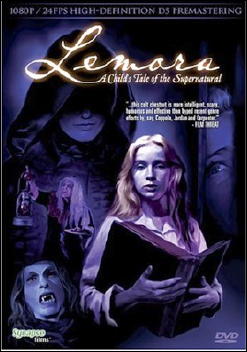
LEMORA, LADY DRACULA. Media Cinema Group, 1973. Originally released as Lemora: A Child’s Tale of the Supernatural. Lesley Gilb, Cheryl Smith, William Whitton, Hy Pyke, Maxine Ballantyne, Steve Johnson, Parker West. Director: Richard Blackburn, also co-screenwriter.

   Now that I have disposed of the romantic and realistic Damsels in Distress (DID) films, honesty obliges me to admit that there is one kind of DID film that I find not unappealing ­ the bizarre or the erotic.

LEMORA, LADY DRACULA

   A late-night film I saw recently qualifies, on both counts. Lemora, Lady Dracula is described in John Stanley’s Creature Features Movie Guide (privately printed, 1981) as an “offbeat, surrealistic vampire flick with heavy artistic overtones,” a fairly accurate, bite-sized summary.

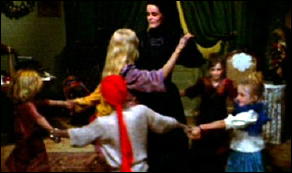
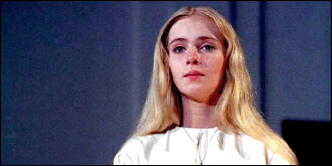
   The basic narrative concerns an adolescent girl who has been redeemed by a fundamentalist congregation from her worthless parents and trained as a singer to witness for the church. When she receives word that her father is dying and would like to see her, she runs away, traveling through a nightmare country inhabited by prostitutes and lascivious rustics until she is waylaid and carried off by monstrous, semi-human creatures looking like rejects from Dr. Moreau’s laboratory.

   Escaping from the stone prison they lock her into, she is “rescued” by a tall, beautiful woman dressed in black with thick white makeup and given a robe to put on for a mysterious ceremony. Both Lemora and the fey children who attend her are vampires, and the girl’s father has become one of the Moreau-like creatures who had kidnapped her. The rest of the film is taken up with the girl’s flight from Lemora and her cohorts and the vampire’s eventual victory.

   The film’s colors are predominantly black and red with glossy highlights, and there is a veneer of seductiveness and erotic titillation in almost every frame. (Even in the opening sequences in the church, the girl is dominated by a young, intense minister of whom we are immediately suspicious.)

LEMORA, LADY DRACULA

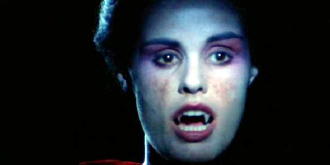
   The depiction of the vampire children is particularly effective, a ‘blend of the diabolic’ and the pathetic. Lemora, who seems to be an untrained actress and reads her lines stagily (she is better at leering than reading) is the Dark Lady of romantic legend and exudes a sensual quality that gives the film a rather lurid cast.

   There is increasingly less distinction between the present and past, fantasy and reality, and the girl’s flight from seduction becomes a sexual odyssey that is often quite disturbing.

   Although Lemora is clearly an exploitation film and sometimes borders on the ludicrous, its implicit content pre-dates the recent rash of summer-camp psycho films but, like them, charts adolescents’ ambivalent sexual feelings.

LEMORA, LADY DRACULA

   The most common situation is one in which young girls or women are pursued by murderous/sexually threatening men or women. The ambivalence of the spectator’s feelings toward the monster in the classic horror film (both admiration and fear) is exploited in a more troubling way.

   The classic film monster was often a tormented being with some impulse toward good; now, he ­ or she ­ is as threatening as the unspecified taboos and mysteries of sex, a disquieting visualization of the adolescents’ deepest fears and instincts.

   Another feature of these films is that very often the monster is not exorcised or destroyed. He lives again to spread havoc through one or more sequels. This was also true of the Universal Studio horror cycle, but there was usually some escape from the threat posed by the monster.

https://www.youtube.com/watch?v=yQNmu4Cw72s

   In this open-ended narrative one can see a reflection of the contemporary fondness for unresolved plots. Like the anti-detective novel, where the narrative gaps are left unresolved, the conventions of the horror film seem increasingly to function not to quiet anxieties but to intensify them and may reflect a fairly general feeling that there are no longer satisfactory solutions to any problems.

   It may be a symptom of the disappearance of some of the traditional distinctions between elitist and popular art that popular art can feed contemporary anxieties, but that phenomenon, in itself, may be as disquieting as the fears it no longer mediates but intensifies.

— Reprinted from The MYSTERY FANcier,
       Vol. 7, No. 2, March-April 1983 (slightly revised).


LEMORA, LADY DRACULA


BLACK MOON Fay Wray

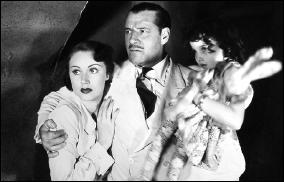
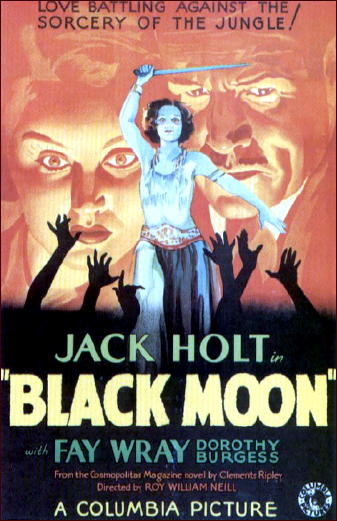
BLACK MOON. Columbia Pictures, 1934. Jack Holt, Fay Wray, Dorothy Burgess, Cora Sue Collins, Arnold Korff, Clarence Muse, Eleanor Wesselhoeft, Madame Sul-Te-Wan. Director: Roy William Neill.

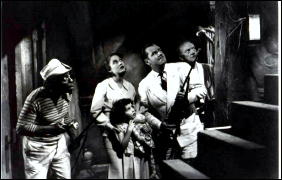
   This early voodoo movie is a little old-fashioned in its presentation — and you could even say out-and-out clunky and get away with it — but there some very some effective moments in Black Moon. Especially weird and strange are the scenes of native sacrifices, filmed against a backdrop of drums constantly beating on a fictional (though very Haiti-like) island in the Caribbean.

   It’s easy to call Black Moon old-fashioned today, but when you think about it, how ready would audiences have been for a movie like this in 1934?

BLACK MOON Fay Wray

   Isolated on the island is a small outpost of whites: a man; his young daughter; his secretary (secretly in love with him); his wife, who has been caught under the voodoo spell since she was child, even back in New York City; and her uncle, who owns a plantation on the island. (The young girl’s nanny barely counts, as she dies very early on.)

   By old-fashioned, though, I mean (for example) the story moves only in fits and starts, and one can easily wonder why everyone stays so calm (relatively speaking) when the deaths and the other strange and eerie events begin. (Some things have never changed in movies like this, not since day one.)

   Of the actors, Jack Holt does stolid well. Fay Wray as his secretary and the exotic Dorothy Burgess as his wife provide the beauty, and this they do very well, maybe even better.

BLACK MOON Fay Wray

REVIEWED BY DAN STUMPF:         


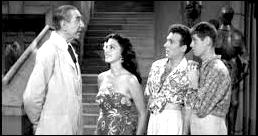
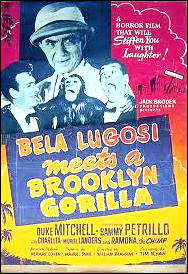
BELA LUGOSI MEETS A BROOKLYN GORILLA. Realart, 1952. Bela Lugosi, Duke Mitchell, Sammy Petrillo, Charlita, Muriel Landers, Al Kikume. Director: William Beaudine.

BELA LEGOSI MEETS A BROOKLYN GORILLA

   Now here is a film that single-mindedly redefines the Bad Movie Genre. Admirers of Bad Films talk glowingly of the ineptitudes of Ed Wood or the excesses of DeMille, but BLMABG is that rarity, a pure, ugly, abomination of a film, a high-concept atrocity that has few equals and no betters (or Worsers) in the ranks of Awful Cinema.

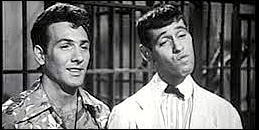
   Start with the basic premise of making a Dean Martin & Jerry Lewis Picture — a dubious notion in itself. Only instead of Martin and Lewis, substitute the team of Duke Mitchell and Sammy Petrillo, who spend the film doing godawful impressions of Dean and Jerry. And until you’ve seen a really bad impression of Jerry Lewis, you just haven’t lived.

BELA LEGOSI MEETS A BROOKLYN GORILLA

   Add to this the sight of poor, palsied, Bela Lugosi, clearly a sick man by this time, clinging to the bare shreds of his career.

   Throw in a comic-relief monkey, a few men in cheap Ape Suits, set the whole thing on a back-lot Tropical Island, then wrap it around a tired, tired plot of Shipwrecked Zanies and a Mad Scientist.

   And you still can’t picture how bad this movie is till you see it. Unlike the films of Ed Wood, BLMABG is suffused with a thin veneer of professionalism. The sets and photography have a nice look, and there are none of the Continuity Gaps so beloved by Wood aficionados.

   Somehow, though, it makes it even worse to realize that Actual Filmmakers spent there time on this.

   Needless to say, I loved it.

BELA LEGOSI MEETS A BROOKLYN GORILLA

REVIEWED BY DAN STUMPF:         


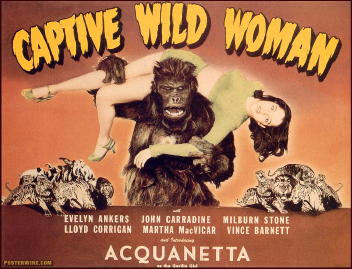
● CAPTIVE WILD WOMAN. Universal, 1943. Acquanetta, John Carradine, Evelyn Ankers, Milburn Stone, Lloyd Corrigan. Director: Edward Dmytryk.

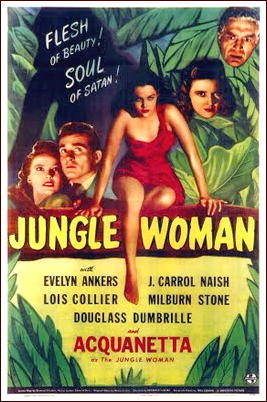
● JUNGLE WOMAN. Universal, 1944. Acquanetta, Evelyn Ankers, J. Carrol Naish, Samuel S. Hinds, Lois Collier, Milburn Stone, Douglass Dumbrille. Director: Reginald Le Borg.

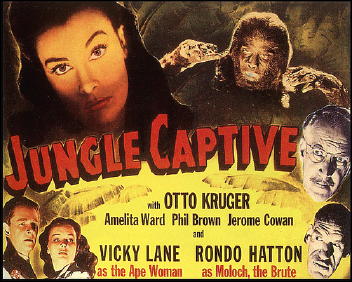
● JUNGLE CAPTIVE. Universal, 1945. Otto Kruger, Vicky Lane, Amelita Ward, Phil Brown, Jerome Cowan, Rondo Hatton. Story & screenplay: Dwight V. Babcock. Director: Harold Young.

   Among movie studios, Universal is fondly remembered for classic horror films like Frankenstein, Dracula, The Wolfman and the sequels they spawned, but the studio put out a good number of lesser efforts, and even a few second-string series, haunted by bush-league monsters who somehow never hit the big time.

PAULA THE APE WOMAN

   One recalls (not fondly) the Spider Woman and the Creeper, both spawned by the superior Sherlock Holmes series, and both duller than dishwater. But perhaps the most persistent of the minor monsters was Paula the Ape Woman.

   Captive Wild Woman (1943) initiated the series and it opens with a credit thanking Clyde Beatty for his “inimitable talent and contribution to this film.” Said contribution consists of stock footage from an old circus serial, and why they refer to Beatty as “inimitable” I don’t know, because Milburn Stone imits him all through the movie, as a lion tamer whose every foray into the cage becomes a long-shot of the back of Beatty in the earlier film.

   In defense of Milburn Stone, who became a respected character actor on Gunsmoke, I have to say that he puts in a very convincing performance when called on to play Beatty’s back, and it’s only when he goes through the tame leading-man motions that interest flags.

PAULA THE APE WOMAN

   Unfortunately, there’s rather much of this, as the plot of Captive Wild Woman meanders its way from a circus milieu to the den of a mad scientist (John Carradine) experimenting on the sister (Martha Vickers) of leading lady Evelyn Ankers, who put up with quite a lot of that in those days.

   Carradine extends his research so far as to steal a gorilla from the circus and turn it into a near-human woman (Acquanetta, “the Venezuelan Volcano”) using glandular injections from Vickers, whereupon the writers decide to get silly and have Carradine take Paula the Ape Woman back to the circus, where she promptly falls in love with Stone and becomes part of his act.

   But Stone is already engaged to Ankers, and when Paula gets jealous she morphs into a half-ape and must return to Carradine who is eager to extend his research even further, resulting in a four-sided triangle reminiscent of the lovers in Midsummer’s Night Dream, but without the class.

   All this is handled with some amount of style by Edward Dmytryk, a director going places (like Murder, My Sweet and The Caine Mutiny) who throws in the occasional camera angle or bit of moody lighting, but to little effect; Captive struts and frets its brief 60 minutes on the screen, signifying very little indeed.

       PAULA THE APE WOMAN

   But any movie with a title like that was bound to draw customers, and returns on Captive were strong enough for Universal execs to order a sequel. Thus Jungle Woman appeared the next year.

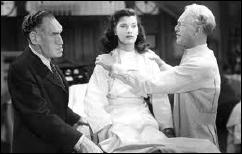
   This is a strange one, even by B-movie standards, as if, pressed for time, producer Ben Pivar decided to simply re-run the fist movie. About a third of Jungle Woman is lifted bodily from Captive Wild Woman, as stars Milburn Stone and Evelyn Ankers reprise their roles from the first film in a framing device centered around testimony at an inquest involving another mad scientist (J. Carroll Naish this time) and a dead ape-woman (Acquanetta again) found on the grounds of his sanitarium.

   Said framing takes up the whole first part of the Jungle Woman, with Ankers and Stone recalling events in flashback from the earlier film, which appear in no particular order, making this thing look like a Resnais film, as the past rises to feebly haunt the present with little coherence or cohesion.

   Finally, re-runs exhausted, a new cast appears, and they proceed to tell a story in flashback (did some of this anticipate film noir?) filling out the running time with an account of how Naish, visiting the circus sometime during the first film, was impressed enough to acquire the body of the ape woman, revive her, and start a movie of his own, leading to the unpleasantness that awaits those who dabble in things man wasn’t meant to etc, etc..

   Well, sixty minutes pass in this manner, leading to a wrap-up that would have been fairly shocking, had anyone been paying attention. As it is, the final scene gets tossed off like the rest of the movie, and I, for one, was left wondering what they must have been thinking of when they committed this crime against Cinema.

PAULA THE APE WOMAN

   Somehow, though, Universal thought the concept was worth another try, and the next year saw the release of Jungle Captive. This is marginally better than Jungle Woman, and if you look up the term “faint praise” in the Dictionary, you may find the words “marginally better than Jungle Woman.”

   Actually, Captive benefits from the appearance of Otto Kruger as this year’s Mad Scientist, who begins by electronically reviving dead rabbits and, with the reasoning of his ilk, decides the next logical step is to steal the body of the Ape Woman from the morgue and revive that.

PAULA THE APE WOMAN

   Kruger handles all this with commendable restraint, and somehow puts Real Feeling into lines like “I need your blood,” though things get a bit much when he decides his ape woman (played by Vicky Lane this time) needs a new brain and proceeds to check out his predecessor’s brain-transplant instructions (written on a 5×8 note card) and borrow a book titled Brain Surgery!

   Maybe because it eschews the flashbacks, Captive seems to move at a faster pace, with some creepy support from Rondo Hatton as “Moloch the Brute” and effective makeup for the ape woman.

   There’s also an appearance by Jerome Cowan (of whom more later) playing his usual clueless role as a detective, and Vicky Lane, though she gets no lines and has little to do, is a distinct improvement as the new Ape Woman: her strong features and large, expressive eyes remind one of the girls in drawings by Gene Bilbrew, and make me wonder what sort of career she might have made for herself with better luck than this.

       PAULA THE APE WOMAN

REVIEWED BY DAN STUMPF:         


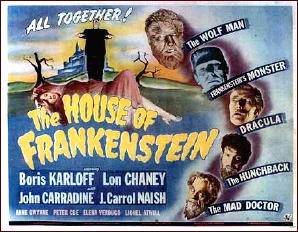
●   HOUSE OF FRANKENSTEIN. Universal, 1944. Boris Karloff, Lon Chaney, John Carradine, J. Carrol Naish, Elena Verdugo, Glenn Strange, Anne Gwynne, Peter Coe, Lionel Atwill, George Zucco, Sig Ruman. Screenplay by Edward T. Lowe, from a story by Curt Siodmak. Director: Erle C. Kenton.

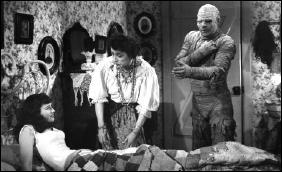
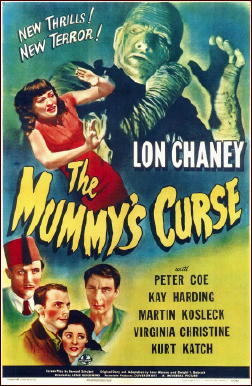
●   THE MUMMY’S CURSE. Universal, 1944. Lon Chaney, Peter Coe, Virginia Christine, Kay Harding, Dennis Moore, Martin Kosleck, Holmes Herbert. Director: Leslie Goodwins.

   House of Frankenstein [recently reviewed here by Walter Albert] and The Mummy’s Curse were originally released on a double bill back in 1944, so I recently watched them back-to-back to get the full event-effect the artists involved must have intended.

HOUSE OF FRANKENSTEIN

   House is generally dismissed as Utter Bosh, though lots of fun, with all the old monsters (mad scientist, hunchback, Dracula, Wolfman and Frankenstein’s monster) and all the old clichés, each trotted out to strut and fret its brief fifteen minutes or so on the screen and then make way for the next: there’s the naïve young couple, suspicious burgermeister, singing gypsies, lost love, obsession, frozen-in-ice and torch-wielding villagers, all played with commendable seriousness by Boris Karloff, Lon Chaney, John Carradine, J. Carol Naish and Lionel Atwill, served up with surprising stylishness by director Earle C. Kenton.

   House of Frankenstein was followed the next year by (wait for it…) House of Dracula (Universal, 1945) the sad swan song of the Monster Movie hey-day, offering the Frankenstein monster, Dracula and the Wolfman, with a Mad Scientist and distaff hunchback tossed in for good measure.

   These movies are two of my guilty pleasures; I know in my head they’re ridiculous, but it thrills my heart to see all the old clichés — and I mean all of them — treated respectfully one last time.

   But there’s something else lurking about House of Frankenstein, something oddly evocative about all the rapid-fire drama played out on moonlit nights: When you’re young, an October night can be a lifetime. You can make a life-long friend, get your heart broken, find God, decide on a career, and get into serious trouble, all of it terribly dramatic, because you’re young.

CURSE OF THE MUMMY

   And in some delirious way, House of Frankenstein captures this adolescent self-importance and conveys it in suitably lurid tones to anyone who can still hear that faint, defiant cry of lost youth.

   As for Curse, well, the Mummy movies were the proletarian working dogs of the horror film, slogging their way through a pointless world, and Curse is no exception, despite a memorable few minutes when Princess Ananka resurrects herself from the earth.

   Aside from that, it’s slow, slow going, but I wonder how kids reacted to seeing Peter Coe, a hero in House of Frankenstein, here playing a satanic high priest. Coe was hyped by Universal as the new Charles Boyer, before they lost interest and shunted him into dreck like this, but I have to say he delivers lines like “May the curse of Amon-Ra be upon you,” with an admirably straight face.

CURSE OF THE MUMMY

REVIEWED BY WALTER ALBERT:         


HOUSE OF FRANKENSTEIN. Universal, 1944. Boris Karloff, Lon Chaney, John Carradine, J. Carrol Naish, Elena Verdugo, Glenn Strange, Anne Gwynne, Peter Coe, Lionel Atwill, George Zucco, Sig Ruman. Screenplay by Edward T. Lowe, from a story by Curt Siodmak; Jack Pierce, makeup; Hans Salter, music; George Robinson, photography. Director: Erle C. Kenton. Shown at Cinecon 44, Hollywood CA, Aug-Sept 2008.

HOUSE OF FRANKENSTEIN

   This film is neither rare nor one of the great Universal horror films. It was scheduled for the convention appearance of Elena Verdugo, who played a gypsy girl, but is probably best remembered for her role as the office nurse on the long-running Dr. Welby TV series that starred Robert Young.

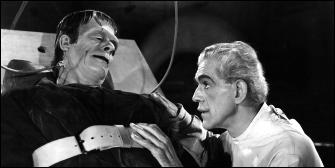
   However, the opportunity to see the cast that included almost all of the major (and minor) actors in the Universal horror films in a 35mm print was something of a treat. Karloff is a doctor who wants to revive the Frankenstein monster, Chaney reprises his famous role as the Wolfman, Carradine makes an honorable stab at Dracula, and Glenn Strange plays the Monster, with J. Carrol Naish as the hunchback assistant to Karloff who has promised to transplant his brain into a young, handsome body in return for his services.

   The film isn’t scary, but it’s handsomely produced, and Verdugo talked prettily about her career after the screening, although nothing particularly memorable came to light.

HOUSE OF FRANKENSTEIN

REVIEWED BY DAN STUMPF:         


WEREWOLF OF LONDON

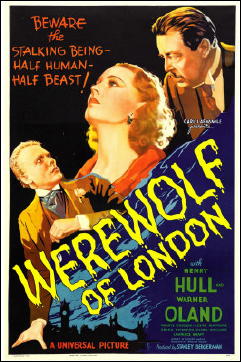
WEREWOLF OF LONDON. Universal Pictures, 1935. Henry Hull, Warner Oland, Valerie Hobson, Lester Matthews, Lawrence Grant, Spring Byington, Clark Williams. Director: Stuart Walker.

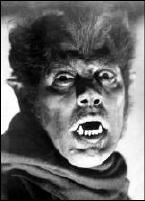
   The Wolf Man, one of Universal’s strongest monsters — probably the appeal to teenage boys of a conflicted being who finds his body changing and getting hairy as his emotions run wild — only got one film to himself, The Wolf Man (1941).

   For the rest of the run, he had to share the limelight with Frankenstein’s monster, Dracula and assorted mad doctors and hunchbacks, while second-string ghouls like the Creeper and Paula the Ape Woman got two or three films all to themselves and that lumbering bore Kharis got four. I guess there’s no justice for monsters.

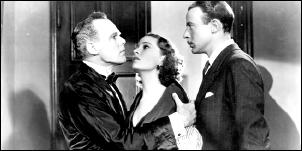
   Actually, Universal kicked off the idea in ’35 with Werewolf of London, a flawed-but-interesting effort laboring under the weight of Henry Hull’s stodgy scientist-turned-boogey-man.

WEREWOLF OF LONDON

   Hull (to the left, on the left) was a dashing leading man on stage and played a fine string of crusty old-timers in the movies, but as a suffering monster he totally fails to grab our sympathy.

   That’s rare in a monster movie, because normally the monster is the most interesting character. Here, Hull is such a constipated dullard, we want something unpleasant to befall him, and lycanthropy seems like just the thing.

   Too bad, because this movie offers an interesting plot, some catchy dialogue, worthy special effects and camera work that lingers in the mind’s eye long after the silly story passes on.

WEREWOLF OF LONDON

« Previous PageNext Page »