Characters


G. M. FORD – The Bum’s Rush. Leo Waterman #3. Walker, hardcover, 1997. Avon, paperback; 1st printing, March 1998.

   Before I begin, yes, in case you were wondering, that is the author’s real name. I had some serious doubts myself, way back when I bought his first book — in hardcover, no less. But, in spite of my best intentions, after shelling out big money for the book, I never got around to reading it, and in fact, this is the first in the Leo Waterman series that I have read. There’s just not enough time in a day, or a month, or a year, or a decade. Two decades.

   What’s strange, even after reading this one, I don’t have a clear picture of Leo Waterman in mind. His home town and primary stomping ground is Seattle, and in the beginning, he seemed to me to be a bit of a slacker, not taking his PI profession very seriously at all, punctuated by the fact that the gang he hangs out with are a bunch of — well, I’d call them homeless, but I don’t know that I can tell you where they do live. Mostly they hang out in a local bar and come to Waterman’s assistance every once in a while. While under the influence of varying amounts of intoxication, some more than others.

   But as the case goes on — two of them, in fact — Waterman displays a lot more toughness, and a lot more brainpower than he seemed to let on in the beginning. (He tells the story himself.)

   Case number one: a homeless woman whom Waterman and “the boys” rescue from an attack on the streets. She accidentally lets slip that she is the mother of a talented (and very wealthy) rock star who recently was found dead from an overdose of heroin, leaving an estate that’s worth upward of fifty million dollars. Against her wishes, Waterman decides to check out her claim.

   He is also hired to find a lady librarian who has absconded with a much smaller amount of the library’s money, but to libraries, even a smaller amount is a lot.

   The two cases do not ever really meet, only tangentially, but between them they keep Waterman busy. I should also mention that he’s a guy who’s quick with a quip, whenever needed, and of course he has a girl friend to spend a lot of time bantering back and forth with. Robert B. Parker has a lot to answer for, you may be thinking. Final verdict? While it’s far from being a classic, I had a good time with this one.

   And it may even be memorable, in a fashion, in that DorothyL, the well-known online mystery group, becomes an integral part of Waterman’s investigation. (How else to track down a missing librarian who loves mysteries?)

       The Leo Waterman series —

Who in Hell is Wanda Fuca? (1995)

Cast in Stone (1996)
The Bum’s Rush (1997)
Slow Burn (1998)

Last Ditch (1999)
The Deader the Better (2000)

Thicker Than Water (2012)
Chump Change (2014)
Salvation Lake (2016)
Family Values (2017)

THE BACKWARD REVIEWER
William F. Deeck


MOLLY THYNNE – He Dies And Makes No Sign. Hutchinson, UK, hardcover, 1933. Dean Street Press, UK, trade paperback, 2016.

   In the third and apparently final case of Dr. Constantine, he is asked to take steps to end the engagement of the son of the Duchess of Steynes. According to the Duchess, the young man has become engaged to a most unsuitable young woman, one who is an actress of sorts. Constantine meets her, finds her enchanting, and is then involved in the disappearance of her grandfather, a violinist. Unfortunately, when the grandfather turns up, he is in the unlucky circumstance of being a corpse.

   One can see why this was the last in the series. It is wretchedly dull, the villain is obvious, and none of the characters are the least bit interesting. What Constantine is a doctor of is left unmentioned in this novel. Perhaps Thynne thought readers of the third book would have read the first two, in which she may, though I doubt it, have provided more detail. All we learn here is that Constantine is not an M.D., that he has just returned from the Continent where he took part in a chess tournament, and that only a dedicated masochist would care to read about him and his investigations.

— Reprinted from CADS 27. Email Geoff Bradley for subscription information.


Bio-Bibliographic Notes:

      The Dr. Constantine series —

The Crime at the “Noah’s Ark”. Nelson, 1931.
Murder in the Dentist’s Chair. Hutchinson, 1932.
He Dies and Makes No Sign. Hutchinson, 1933.

      Non-series mysteries by Molly Thynne —

The Red Dwarf. Nelson, 1928.
The Murder on the “Enriqueta”. Nelson, 1929.
The Case of Sir Adam Braid. Nelson, 1930.

   All six have recently been reprinted by Dean Street Press, four for the first time in the US.

   For a long essay on the life of the author, go here on Curt Evans’ “Passing Tramp” blog. Highly recommended!

LINDA BARNES – Steel Guitar. Carlotta Carlyle #4. Delacorte Press, hardcover, 1991. Dell, paperback; 1st printing, January 1993.

   In case you haven’t come across any of her cases before, Carlotta Carlyle is a tall red-headed female PI who drives a cab in her spare time (and to make a living) in the Boston area. Whether she ever met a gent named Spenser, I don’t know. I don’t really think so, but it’s fun to wonder whether or not they’d get along.

   A lot of Carlotta’s past comes to the forefront of this one, as a blues singer named Dee Willis who’s now on the verge of becoming a huge success comes back into her life. They met in the folksinger days of their youth. Dee had a voice and a dream. Carlotta decided to pursue other goals, especially when Dee went off with her ex-husband, Cal.

   It turns out, though, that Dee now needs Carlotta. She is being blackmailed for allegedly stealing the songs that made her famous, and she hires Carlotta to find the person behind it. When the bass player (female) in Dee’s band is found dead, thoughg, the stakes, Carlotta realizes, are suddenly a whole lot higher.

   The show business portion of the plot seems authentic, especially when it comes down to old jealousies and friendships. Not as interesting is the real nuts and bolts of the motive, which is always present when there’s big money to be had.

   Carlotta Carlyle’s career lasted for a total of twelve books. She wouldn’t have lasted as long if author Barnes hadn’t always had something to say, and the bittersweet ending added to this one gives it quite a poignancy that few PI novels ever come close to achieving.

      The Carlotta Carlyle series —

A Trouble of Fools (1987)

Snake Tattoo (1989)
Coyote (1990)
Steel Guitar (1991)
Snapshot (1993)

Hardware (1995)
Cold Case (1997)
Flashpoint (1999)

The Big Dig (2000)
Deep Pockets (2004)
Heart of the World (2006)
Lie Down with the Devil (2009)

SHELLEY SINGER – Suicide King. Jake Samson & Rosie Vicente #5. St. Martin’s Press, hardcover, 1988. Worldwide Library, paperback; 1st printing, January 1990.

   Jake Samson is a non-licensed PI who lives in Oakland CA, His partner, Rosie Vicente, is a carpenter and is a tenant in the guest half of his house. They solved five cases together for St. Martin’s in the 80s, then one last one in 1999 for a small independent press. (I didn’t know about that one until now.)

   Suicide King has to do with the purported suicide of a would-be candidate for governor of California. I say would-be because he was looking to gain the nomination from the Vivo party, an offshoot of the Greens, and what chance does a third party have, even in California?

   But although the police are satisfied, most of his friends are not, and so Jake is hired. Shelley Smith is a good writer with a nice way with words, but keeping me interested in third party politics is a tough task for any author to accomplish. I found the book more enjoyable when Jake and Rosie are interviewing people; when it came down to talking about motive, it was politics all the way, and I found myself lagging far behind.

       The Jake Samson / Rosie Vicente series —

Samson’s Deal (1983)
Free Draw (1984)
Full House (1986)
Spit in the Ocean (1987)
Suicide King (1988)
Royal Flush (1999) .

MARGARET YORKE – Dead in the Morning. Patrick Grant #1. Geoffrey Bles Ltd, UK, hardcover, 1970. Bantam, US, paperback, 1982.

   A continuing character in many of Margaret Yorke’s early mysteries was Dr. Patrick Grant, an Oxford don, Dean of St. Marks. Some of the books have been published in this country. Some of the books have been published in this country by Walker [then others later in paperback by Bantam].

   The scene in Dead in the Morning, the first book in the series, however, is not academia at all. It’s between terms, and Dr. Grant is staying over with his sister, amusing himself in the meantime by snooping around for a mystery to solve. When the housekeeper of a neighboring family accidentally dies of barbiturate poisoning, his interests are piqued, to say the least.

   He plays the part of an interested bystander to the hilt — how the police stand for his interruptions and enthusiastic non-cooperation is impossible to fathom — and he glories in his role of benevolent meddler no end. He’s a likable fellow, mind you. His intentions, well, nothing could be finer, and they all seem to work out.

   The killer — for of course murder it is — fits the crime. Solid characterization means that the mystery can be seen through very early. The twist is so good, however, that if I’d have been wrong, I was going to use it in my own next novel, The writing, unfortunately, is only so-so.

— Reprinted from The MYSTERY FANcier, Vol. 4, No. 2, March-April 1980 (somewhat revised).


       The Patrick Grant series —

Dead in the Morning. Bles, 1970.
Silent Witness. Bles, 1972.
Grave Matters. Bles, 1973.
Mortal Remains. Bles, 1974.
Cast for Death. Hutchinson, 1976.

GAR ANTHONY HAYWOOD – Not Long for This World. Aaron Gunner #2. St. Martin’s Press, hardcover, 1990. Penguin, paperback, 1991.

   In this, the second recorded case for L.A.-based private eye Aaron Gunner, he’s hired by the female defense attorney for a young South Central gang member accused of killing the black founder of the L. A. Peace Patrol — a mild-mannered man who had taken it upon himself to try to rein in gang-related violence in the city.

   It takes Gunner a while to decide to take the case, mostly because he doesn’t believe there is much redeeming value in the boy, but the conviction by his lawyer that he’s innocent eventually helps persuade him. It isn’t an easy case to investigate. All of the witnesses and other people he must ask questions of are either gangbangers themselves, or people intimidated by them.

   To my mind there might be more social significance to this tale if Gunner were a stronger character. Even once he’s taken the case, he’s never quite sure if he made the right choice, nor is he the kind of guy who’s always infallible. Not helping matters is that the story is told in what I’ve decided to call the “impersonal third person” mode. Every so often, Gunner is referred to only as “the investigator,” not a description designed to give the reader a lot of confidence in his abilities.

   I’m also not a fan of PI’s going to bed with the dead man’s widow while on the case. Which is a complicated one in many ways, but not in one essential way: I believe the real villain is discernible immediately, once he (or she) steps onto the stage.

   Overall, then: quite readable, but flawed.

      The Aaron Gunner series —

Fear of the Dark (1988)
Not Long for This World (1990)
You Can Die Trying (1993)
It’s Not a Pretty Sight (1996)
When Last Seen Alive (1997)
All the Lucky Ones Are Dead (1999)

A 1001 MIDNIGHTS Review
by Kathleen L. Maio


RICK BOYER – Billingsgate Shoal. Doc Adams #1. Houghton Miff|in, hardcover, 1982. Warner Books, paperback, 1985; Fawcett, paperback, 1989.

   Rick Boyer won an Edgar for this, his first mystery novel — deserved recognition for a complex suspense novel set in coastal and suburban Massachusetts.

   Charles (“Doc”) Adams is a medical doctor turned oral surgeon. He is middle-aged, affluent, happily married, and intensely dissatisfied with his life. His depression and insomnia are symptoms of his mid-life crisis. The cure is worse than the disease, however, as Doc is thrown headlong into a very violent adventure. It starts with an early-morning sighting of a stranded fishing vessel on the title shoal, continues with the death of a young scuba diver who tries to check out the boat for Adams, and eventually escalates to a kill-or-die confrontation between Doc and the villains.

   Billingsgate Shoal has a little bit of everything for everybody. There is hidden treasure, political intrigue, and a murder mystery. There is even a good deal of gore for those who like their thrillers tough and bloody. But it is the believable and very personable voice of Boyer’s amateur sleuth that makes even the more outrageous elements of his plot come together in a way that seems realistic and truly suspenseful.

   Boyer’s second novel, The Penny Ferry (1984), a case focusing on present-day evidence of the guilt/innocence of Sacco and Vanzetti, is proof that Boyer’s talents are substantial and that Doc Adams has staying power as series sleuth.

         ———
   Reprinted with permission from 1001 Midnights, edited by Bill Pronzini & Marcia Muller and published by The Battered Silicon Dispatch Box, 2007.   Copyright © 1986, 2007 by the Pronzini-Muller Family Trust.

       The Doc Adams series —

Billingsgate Shoal (1982)
The Penny Ferry (1984)

The Daisy Ducks (1986)
Moscow Metal (1987)
The Whale’s Footprints (1988)

Gone to Earth (1990)
Yellow Bird (1991)
Pirate Trade (1994)
The Man Who Whispered (1998)

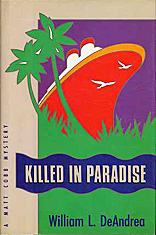
WILLIAM L. DeANDREA – Killed in Paradise. Matt Cobb #5. Mysterious Press, hardcover, 1988; paperback, July 1989.

   Officially Matt Cobb is a vice president in charge of special projects for a major TV network, but what that really means is that he’s a troubleshooter who’s put in charge whenever anything goes wrong. Not quite a private eye, but sometimes there’s not a lot of distinction between what he does and what PI’s do. (Think of all of the Hollywood troubleshooters who worked for movie studios in the pulps back in the 30s and 40s and bring them up to date.)

   In this case, though, all he is is a glorified chaperone to the winner of a mystery contest put on by the Network’s FM station in New York City, and a friend of her choice (also female). The top prize? A trip on a cruise liner to an island in the Caribbean and back. The bonus? Also on board are a flock of mystery writers and a mystery scenario that the passengers are asked to play along and solve.

   It is no wonder that the Chapter One is more or less a prologue to a scene that takes place much later in the book, one in which Cobb has just realizes who the killer is, just as he’s about to be tossed overboard. And that’s because otherwise there is no real mystery to be solved for well over a hundred pages, except for the mysterious disappearance of an arrogant mystery writer just after he is thoroughly trounced by Cobb in a not-so-friendly game of ping pong.

   Luckily DeAndrea was a good enough writer with a flair for light comedy and romance to keep the reader going through the not very suspenseful first chunk of the book, as the characters get to know each other (and as Cobb gets to know the prizewinner’s friend very well). Do you know, and to tell you the truth, and I almost wish I didn’t have to bring this up, but I found the ending — the solution to the mystery and all — to be forced and the weakest part of the book. All in all, though, I enjoyed this one, and I’d gladly read more of the series, which I seem to have accidentally jumped into the middle of.

      The Matt Cobb series —

Killed in the Ratings. Harcourt, 1978.
Killed in the Act. Doubleday, 1981.
Killed with a Passion. Doubleday, 1983.
Killed on the Ice. Doubleday, 1984.
Killed in Paradise. Mysterious Press, 1988.
Killed on the Rocks. Mysterious Press, 1990.
Killed in Fringe Time. Simon & Schuster, 1995.
Killed in the Fog. Simon & Schuster, 1996.

R. B. DOMINIC – The Attending Physician. Harper & Row, hardcover, 1980. Pinnacle, paperback, 1981.

   The pair of ladies who write as R. B. Dominic [Mary Jane Latsis & Martha Henissart], as well as the more famous Emma Lathen, obviously do not care much for doctors. This is the first murder adventure their series character hero, Congressman Ben Safford (D-Ohio), has stumbled across in some time. Where the medical industry fits in is right from the beginning, with a series of hearings Safford’s subcommittee as part of their investigation into widespread fraud in the Medicaid program.

   According to Dominic, doctors are an arrogant lot, but in works of fiction, at least, authors have a distinct advantage over the rest of us. They can make sure that at least one prime specimen chosen from among their targets of outrage gets, for once, what’s coming to him.

   Such as a mammoth malpractice suit, right after the subcommittee learns that one such doctor has falsely billed the same welfare mother for two hysterectomies and one abortion. And in that order, no less.

   Standing nervously in line to await the authors’ wrath are nursing homes and pharmacies as well. At times you may feel that the ensuing murder investigation has been all but forgotten, but have no fear. You’ll probably spot the culprit(s) easily enough without it. If you tend to agree with Ms. Dominic, the fun lies here in foiling villains of quite another stripe.

— Reprinted from The MYSTERY FANcier, Vol. 4, No. 2, March-April 1980 (very slightly revised).

      The Ben Safford series —

Murder Sunny Side Up. Abelard-Schuman 1968
Murder in High Place. Doubleday 1970
There Is No Justice. Doubleday 1971
Epitaph for a Lobbyist. Doubleday 1974
Murder Out of Commission. Doubleday 1976
The Attending Physician.Harper 1980
Unexpected Developments.St. Martin’s 1984

LIAM PHILLIPS on his father, PHILIP ATLEE,
Author of the Joe Gall Books:


   James Young Phillips, a/k/a James Atlee Phillips, a/k/a Philip Atlee, was my father. The man lived large and was somewhat of an enigma to us all. He was married three times and his last marriage was to my mother, Martha Phillips. Singer-songwriter Shawn Phillips is my half-brother from a previous marriage.

   I am the Copyright Holder of Record for all of his written works, excepting the screenplays which are the properties of the studios for whom he wrote them. We are working to get the books into digital format, including an unpublished autobiography, and at least one short story compilation. Jim wrote several unproduced screenplays as well, but the publication rights to those items is a bit more tricky. We will see what happens.

   To answer a few questions: My father resisted having his photograph taken under any circumstances. He reluctantly relented for obligatory family functions and even then often did so with a pair of his trademark dark sunglasses on. He was the subject of several newspaper articles over the years and always used the same picture — black turtleneck and dark glasses.

   Said photograph was taken for an article published in a Hong Kong newspaper in the late ’60s/early ’70s. There will be plenty of photos in the autobiography, including that one. The work is slow as I am at it by myself and struggled with serious health issues for over a decade. Thankfully, those problems are now fully resolved and I am capable of doing work again.

   The man pictured on the cover of the Joe Gall novels is an Irish bartender whose name may be lost to history. He was discovered by either Jim’s agent or a representative of Fawcett/Gold Medal and seemed to fit the description of Joe Gall. He was paid a flat fee for a photograph session and was thereafter pictured on the covers.

   We have had numerous inquiries over the years re: Joe Gall film projects. We had Clint Eastwood calling in the ’70s/80s and most recently David Mamet. We’ve also had some discussion about audio books and graphic novel versions, but the process is what it is in each case. There has never been any hesitance or reluctance (or greed) on my part, I can assure you. I, too, am a fan of the works and would love to get them out there for people to enjoy in whatever format I can.

   Jim went through life traveling light — he regularly discarded of documentation and paperwork for all aspects of his life. He did so to such a degree that the sum total of his possessions at the end of his life were a few pieces of clothing, a typewriter and a box of blank paper, and a few scribbles on notepads. Clarity on copyright, history, origins, all of that stuff, has been elusive to say the least.

   My intention is to get the works, including SOME of the unpublished material, onto Amazon this year. Digitizing via OCR, proofing, artwork – for a 22 book series, plus 5 other novels, and the short stories – is a MASSIVE amount of work for even a group of dedicated people. But we are determined! The autobiography will take a bit longer, what with the photos and so forth. The book itself is quite the read from a very opinionated character who didn’t have a PC bone in his body and we are all the better for it!

   I have cruised by Mystery*File over the years, but had nothing to add as I was too ill for even the obligations of a muted correspondence.

   I want to thank every single person who has said such positive things about my father and his works (and my brother as well). You are all truly appreciated and recognized. I hope that we can do your interests justice and produce material that meets your standards and that everyone can enjoy. Many thanks to all of you amazing people!

       The Joe Gall series —

The Green Wound. Gold Medal k1321, July 1963 [New Orleans, LA]
   — Reprinted as The Green Wound Contract, Gold Medal, 1967.
The Silken Baroness. Gold Medal k1489, 1964 [Canary Islands]
   — Reprinted as The Silken Baroness Contract, Gold Medal, 1966
The Death Bird Contract. Gold Medal d1632, 1966 [Mexico]
The Paper Pistol Contract. Gold Medal d1634, 1966 [Tahiti]
The Irish Beauty Contract. Gold Medal d1694, 1966 [Bolivia]
The Star Ruby Contract. Gold Medal d1770, 1967 [Burma]
The Rockabye Contract. Gold Medal d1901, 1968 [Caribbean]
The Skeleton Coast Contract. Gold Medal D1977, 1968 [Africa]
The Ill Wind Contract. Gold Medal R2087, 1969 [Indonesia]
The Trembling Earth Contract. Gold Medal, 1969 [U.S. South]
The Fer-de-Lance Contract. Gold Medal, Jan 1971 [Caribbean]
The Canadian Bomber Contract. Gold Medal T2450, August 1971 [Montreal, Canada]
The White Wolverine Contract. Gold Medal T2508, Dec 1971 [Vancouver, Canada]
The Kiwi Contract. Gold Medal T2530, Feb 1972 [New Zealand]
The Judah Lion Contract. Gold Medal T2608, Sept 1972 [Ethiopia]
The Spice Route Contract. Gold Medal T2697, April 1973 [Middle East]
The Shankill Road Contract. Gold Medal T2819, Sept 1973 [Ireland]
The Underground Cities Contract. Gold Medal M2925, Feb 1974 [Turkey]
The Kowloon Contract. Gold Medal M3028, August 1974 [Hong Kong]
The Black Venus Contract. Gold Medal M3187, Feb 1975 [South America]
The Makassar Strait Contract. Gold Medal P3477, March 1976 [Indonesia]
The Last Domino Contract. Gold Medal 1-3587, 1976 [Korea]

« Previous PageNext Page »