Characters


REVIEWED BY WALTER ALBERT:         


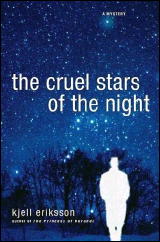
KJELL ERIKSSON – The Cruel Stars of the Night. St. Martin’s Press, hardcover, May 2007; trade paperback, April 2008. Translated from the Swedish by Ebba Segerberg.

KJELL ERIKSSON Ann Lindell

   Inspector Ann Lindell and her team at the Violent Crimes Division of the Uppsala Police struggle through much of this novel in an attempt to make sense of the murders of several elderly men, looking for connections that would link the murders in some rational fashion.

   In an initially apparently unrelated event, an elderly professor, the father of spinster Laura Hindersen, disappears. “He was a pain,” is the comment offered by a former colleague, and that rather general lack of interest and the absence of clues lead the investigator, Detective Sergeant Asa Lantz-Andersson, to conclude that she will have to wait for some unforeseen event that will resolve the stalled case.

   The novel is, for much of its length, a meticulously plotted procedural. In the final pages, it’s the characters and not the plot that dictate the genre-bending conclusion, undoubtedly less reassuring than the conventional wrap-up but intellectually more challenging and disturbing.

   And it’s that aspect of Eriksson’s artfulness that interests me and makes me eager to return to his work.

The Ann Lindell series —

    1. The Princess of Burundi (2006)

KJELL ERIKSSON Ann Lindell

    2. The Cruel Stars of the Night (2007)
    3. The Demon from Dakar (2008)

REVIEWED BY JEFF MEYERSON:         

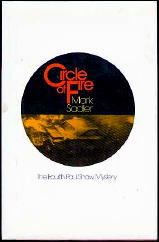
MARK SADLER – Circle of Fire. Random House, 1973. Berkley, paperback, 1989.

MARK SADLER Paul Shaw

   Mark Sadler is a pseudonym of the prolific Dennis Lynds, who also writes as Michael Colllins (about Dan Fortune) , William Arden, and John Crowe. As Sadler he writes about private eye Paul Shaw. Circle of Fire is the fourth in the series, a complex book that is readable without being outstanding.

   Paul Shaw is called in to investigate when Dick Delaney, his California partner, is shot and seriously wounded while working on a case. Local politician Russell Dobson was blown up in a car with Lilian Marsak, whom he apparently had just picked up.

   Shaw must determine whether the killer had a personal or political motive for getting Dobson out of the way, and eventually must decide if he was the intended victim after all.

   What did Delaney find out that got him shot? The book is very complicated and somewhat confusing, and Shaw is a little slow in recognizing one of the major possibilities in the case. It’s competent enough, I guess, but it has all been done before, and better (including the author’s own Dan Fortune series).

   One switch: for once the out-of-town investigator is not continually hassled by the local police.

— Reprinted from The MYSTERY FANcier, Vol. 1, No. 3, May 1977.


The Paul Shaw series —

    The Falling Man. Random House, 1970.
    Here to Die. Random House, 1971.
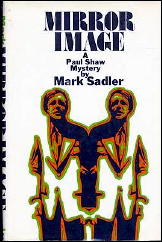
    Mirror Image. Random House, 1972.

MARK SADLER Paul Shaw

    Circle of Fire. Random House, 1973.
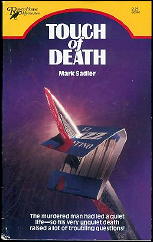
    Touch of Death. Raven House, 1981.

MARK SADLER Paul Shaw

    Deadly Innocents. Walker, 1986.

REVIEWED BY CURT J. EVANS:         


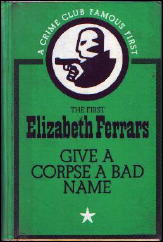
ELIZABETH FERRARS – Give a Corpse a Bad Name. Hodder & Stoughton, UK, hardcover, 1940. Collins Crime Club, UK, hc, 1981. Chivers, UK, large print edn, 2000. No US edition.

    Like Christianna Brand, the prolific, long-lived mystery doyenne Elizabeth Ferrars (1907-1995) slipped into print at the tail end of the Golden Age of British mystery (roughly 1920 to 1940); and, like Brand, upon her appearance in the detection field, she was raved as part of the “literary” school of British women mystery writers following Crime Queen’s Dorothy L. Sayers’ injunction to transmute detective novels into novels of manners with a crime interest.
ELIZABETH FERRARS

    Ferrars went so far as to use a Lord Peterish, Campionite series detective in her first five books, one Toby Dyke, who comes complete with a Bunterish, Luggite assistant, one George (no last name — George is wary about giving out personal details). Though Toby is no aristocrat, he is an winning gent; and George seems to have picked up quite a bit of knowledge of crime and criminals at some point in his life.

    I have read three of the later four titles in the series and thought the last, Neck in a Noose, the best, with the other two getting bogged down in messy plots. Give a Corpse a Bad Name, however, struck me as very good, with a particularly ingenious, twisting finish.

    In the English village of Chovey, the charming, youngish widow Anna Milne (formerly of South Africa but now residing at one of Chovey’s most desirable residences, “The Laurels”), reports to the police that she has run down and killed a man. Oddly, the dead man also comes from South Africa and has Anna Milne’s address in his pocket, yet Anna Milne claims not to recognize him.

    Since the man had been drinking heavily before the fatal accident and she herself had not, no legal culpability is attached to Mrs. Milne. But then anonymous letters begin appearing, suggesting that this “accident” was no accident….

    Soon former crime reporter Toby Dyke and his mysterious yet amiable friend George are investigating, with surprising results. And George proves no slouch himself as an “amateur” detective in the end.

    Give a Corpse a Bad Name is an enjoyable book, with sufficient, sometimes strong, characterization, good writing and an interesting puzzle with some coherent cluing. Toby and George remain more nebulous than Peter and Bunter and Campion and Lugg, yet they do have some nice moments, such as George’s lecture to Tony on the merits of barley sugar.

    Definitely worth reading, though the original edition, printed only in Britain by Hodder and Stoughton, is very rare and very expensive. Fortunately it was reprinted in hardcover by Collins in 1981 and also a new press, Langtail, appears to have reprinted it in paperback just this year.

   Some Brief Bio-Bibliographic Bits:

The Toby Dyke mysteries:    [Taken from the Revised Crime Fiction IV, by Allen J. Hubin.]

       Give a Corpse a Bad Name (n.) Hodder 1940.
       Remove the Bodies (n.) Hodder 1940. Doubleday, 1941, as Rehearsals for Murder.
       Death in Botanist’s Bay (n.) Hodder 1941. Doubleday, 1941, as Murder of a Suicide.
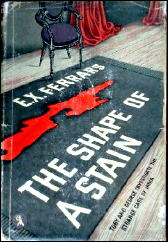
       Don’t Monkey with Murder (n.) Hodder 1942. Doubleday, 1942, as The Shape of a Stain.

ELIZABETH FERRARS

       Your Neck in a Noose (n.) Hodder 1942. Doubleday, 1943, as Neck in a Noose.

Note: Both Elizabeth Ferrars and E. X. Ferrars, her byline in the US, were pen names of Morna Doris Brown, 1907-1995. A long obituary for her by Jack Adrian can be found online.

Editorial Comment: I have found no website for Langtail Press, but there is a list of their forthcoming mysteries, all softcover reprints, on Amazon UK, with almost 50 titles scheduled for release on December 1st. The books are uniformly priced at 12 pounds; other authors include Anthony Berkeley, Freeman Wills Crofts, Fredric Brown, Gavin Black and John Dickson Carr.

IT IS PURELY MY OPINION
Reviews by L. J. Roberts


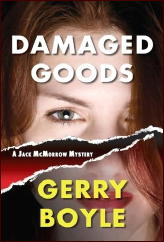
GERRY BOYLE – Damaged Goods. Down East Books, hardcover, May 2010.

Genre:   Unlicensed investigator. Leading character: Jack McMorrow; 9th in series. Setting:   Maine.

First Sentence:   I made my way down the trail through the pinewoods toward the house.

GERRY BOYLE

    Roxanne, the wife of freelance journalist Jack McMorrow has had a worse-than-usual day at work. A social worker for the state of Maine, she was forced to remove two severely neglected children from the home of a Satanist who is now threatening Roxanne and their daughter.

   In order to facilitate Roxanne leaving her job, Jack looks for more stories he can sell and finds Mindi, a young woman advertising to provide “companionship.” Mindi quickly becomes more than a story and it’s uncertain whether that is going to increase the danger to Jack’s family.

   I’ve missed Boyle’s Jack McMorrow and am very glad to see him back. While Jack, a journalist who isn’t afraid of physical violence, is an interesting character, his neighbor Clair, a Vietnam vet who has lost none of his edge, comes through as the more interesting character, especially when set off by his gentle wife, Mary.

   Jack’s wife, Roxanne, is one I’m not always certain I like, but her reactions are very realistic in view of the situation. The blending of all the characters is very well done.

   Boyle’s love of Maine is apparent as shares with us both the beauty and the problems of Maine. The story is has a good, tight plot and is layered with good suspense which escalates as things progress. The sense of anger and danger is there along with Jack and his friend’s protectiveness. The villain is satisfyingly nasty and while Mindi provides a somewhat unknown quantity element.

   It’s altogether quite well done. Boyle is a very good writer and journalistic background is very apparent. His books are ones I always recommend and I’m always anxious for the next one out.

Rating:  Good Plus.

       The Jack McMorrow series

1. Deadline (1993)

GERRY BOYLE

2. Bloodline (1995)
3. Lifeline (1996)
4. Potshot (1997)
5. Borderline (1998)
6. Cover Story (1999)

GERRY BOYLE

7. Pretty Dead (2003)
8. Home Body (2004)
9. Damaged Goods (2010)

    Also by Gerry Boyle: The Brandon Blake mysteries

1. Port City Shakedown (2009)

GERRY BOYLE


   Visit the author’s blog here.

IT IS PURELY MY OPINION
Reviews by L. J. Roberts


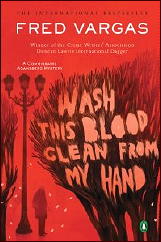
FRED VARGAS – Wash This Blood Clean from My Hand. Knopf-Canada, hardcover, 2007. Penguin, US, trade paperback, 2007. First published as Sous les vents de Neptune, Paris : Viviane Hamy, 2004; translated by Sian Reynolds.

Genre:   Police procedural. Leading character: Commisioner Adamsberg; 5th in series (4th translated into English). Setting:   Canada.

FRED VARGAS

First Sentence:   Leaning his shoulder against the dark basement wall, Jean-Baptiste Adamsberg stood contemplating the enormous central heating boiler which had suddenly stopped working, two days before.

   Comm. Jean-Baptiste Adamsberg and seven of his officers are getting ready for forensics training in Quebec, Canada. A few days before they are to leave, Adamsberg sees a news story about a murder where the victim received three stab wounds to the stomach and the accused has no memory of committing the crime.

   A number of similar crimes, including one where Adamberg’s brother was accused, occurred 16 years ago. Adamsberg is certain the true killer is back, except that he attended the man’s funeral. Now in Canada, another murder occurs, but this time it appears Adamsberg is the killer.

   The most important elements of a book, for me, are the characters. Vargas creates wonderful characters, although she does not provide as much background with each book as a reader coming into the middle of the series should have.

   However, once you do start to know the players, they become real and characters about whom you want to know more. What is appealing about Adamsberg is that is he a very unconventional policeman, yet he gets results and has the loyalty of his colleagues and friends.

   Vargas’s voice is wonderfully effective. Originally written in French, I appreciate that the translation still has a Gallic undertone to the text. Her descriptions are vivid and her phrasing lush. She has an excellent ear for dialogue, and a delightful sense of humor.

   The plot of Wash This Blood is so well done. Yes, there are coincidences — it is rare to find a book without them — but it is also very clever with excellent twists and a soupçon of poignancy that adds dimension to Adamsberg’s character.

   It is also the first time I recall that we see Adamsberg really lose his temper, which humanizes him even more. I’ve one criticism in that it feels as though there is a book missing from the series. Knowing how Have Mercy ended, this did cause a bit of confusion in terms of series plot continuity.

   This was an excellent read. I highly recommend both it and the series which must be read in order — frustrating as the English versions have not been published in series order.

Rating:   Excellent.

       The Chief Inspector Adamsberg series —

1.   The Chalk Circle Man (2009). First published in France as L’Homme aux cercles bleus (1991).

FRED VARGAS

2.   Seeking Whom He May Devour (2004). First published in France as L’Homme à l’envers (1999).

[*]   The Four Rivers. Date? [Graphic novel]. Published in France as Les quatre fleuves (2000).

3.   Have Mercy on Us All (2003). First published in France as Pars vite et reviens tard (2001).

FRED VARGAS

[*]   Coule la Seine (2002). [Collection of graphic stories.] Not yet published in English.

4. Wash This Blood Clean from My Hand (2007). First published in France as Sous les vents de Neptune (2004).

5.   This Night’s Foul Work (2008). First published in France as Dans les bois éternels (2006).

6.  An Uncertain Place (2011). First published in France as Un lieu incertain (2008).

Editorial Comment:   Please consider this bibliography a work in progress. Dates for the French editions are based on information obtained from Wikipedia-France. Dates for the English editions are (I think) a mixture of US and Canadian first printings.

   In any case, L.J. is correct in suggesting that readers of the series in the US have been treated badly by Ms. Vargas’s publishers. One can assume, however, that perhaps they started with what they believed to be a stronger title in the series, uncertain of the reception her books might receive.

   Whether one must read the graphic novel or collection listed above (without number) in order not to miss any of the overall series continuity is at present unknown, but it would explain L.J.’s comment regarding “a book [she felt was] missing from the series.”

REVIEWED BY BARRY GARDNER:


NOREEN AYRES – The World the Color of Salt. “Smokey” Brandon #1. Avon, paperback reprint, 1993. First published by William Morrow, hardcover, 1992.

NOREEN AYRES Smokey Brandon

   I bought this as much for the cover as anything — a blue and green composition that blends a mermaid-like naked body into a coastline. Strikingly attractive, and different. The title is from a poem by Richard Hugo, who wrote a mystery before his death.

   Smokey Brandon is a forensic Specialist for the Orange County Sheriff/Coroner’s office. She’s been a stripper, and she’s been a cop, and she’s about half tough. Her troubles start when a 20 year old kid she knew casually is killed in the robbery of a stop and go store. Though she’s developed a protective shield to go with her job, this one gets to her.

   She’s sort of in love with a married co-worker, and her best friend takes up with a guy with a record who was briefly a suspect in the killing. Things go from bad to worse on all fronts, and she finds herself hunting her friend while she continues to search for answers to the killing.

   Ayres is an award-winning poet, and this is her first mystery novel. It’s a good one, and I don’t know how I missed it in 1992. Ayres gives Brandon a glib, hard voice entirely in keeping with her character, and she is one of the best realized new characters, male of female, that I’ve come across in a while in hardboiled fiction.

   And this is hardboiled, make no mistake about that. The story is told in first person, and very effectively. Ayres has an eye for the California landscape and its denizens, and if the details of the forensic trade aren’t accurate, they’re done well enough to fool me.

   The only fault I found was an occasional jerkiness as the story shifted from reflection to action, and that wasn’t often. Ayres is good.

— Reprinted from Ah, Sweet Mysteries #10, November 1993.


The Smokey Brandon series —

      A World the Color of Salt. Morrow, 1992.
      Carcass Trade. Morrow, 1994.

NOREEN AYRES Smokey Brandon

      The Juan Doe Murders. Five Star, 2000.

Editorial Comments:   Once again I’m pleased to say that here online I can show you the cover that Barry was referring to, one he wasn’t able to in his printed zine. I think it lives up to his description of it, don’t you?

   As for the book itself, based on Barry’s review, it’s a shame that there’s been only three books in the series, the third of which was news to me. For whatever reason, the series didn’t catch on. Or perhaps Noreen Ayres herself had other options available to her.

   From her website: “Noreen Ayres has published novels, short stories, and poetry, and has had three teleplays produced, winning several awards for writing. Her varied career includes positions as a technical writer/editor and publications manager for major engineering, petroleum, and aerospace companies. Holding a Masters degree in English and post-grad certifications in business, she has taught composition, creative writing, business, and science.”

IT IS PURELY MY OPINION
Reviews by L. J. Roberts


WILLIAM G. TAPPLY – Dark Tiger. St. Martin’s, hardcover, September 2009. No softcover edition scheduled.

Genre:   Unlicensed investigator. Leading character: Stoney Calhoun; 3rd in series. Setting:   Maine.

First Sentence:   Stonewall Jackson Calhoun was sweeping the floor around the display of chest waders and hip boots when the bell dinged over the door, signaling that somebody had come into Kate’s Bait, Tackle, and Woolly Buggers shop.

WILLIAM G. TAPPLY Stoney Calhoun

    Stoney Calhoun has a lot of military-type skills but no memory of how he came by them. But The Man in the Suit checks periodically checks on him to see whether any memories have returns.

    Now the Man needs his help and Stoney can’t refuse. An operative and a young woman were found dead in a car, each with a gunshot wound. What’s interesting is they were both dead before they were shot.

    Stoney, half-owner in a fishing shop and an expert guide, is to go to an exclusive fishing lodge in Northwestern Maine to learn how they died and what the operative was investigating.

    I’ve always liked Tapply’s characters. Stoney is moral, principled, somewhat curious about his past, which he was told he doesn’t remember due to having been struck by lightning, but content to live his life from here forward.

    He is in love with Kate, his business partner, but understands women are different from men and is undemanding. He has skills he doesn’t remember learning and is more curious than surprised when he discovers a new one. Kate’s husband is in long-term care with MS, knows and approves of Kate and Stoney being occasional lovers. And then there’s Ralph, Stoney’s Brittany spaniel, as human as any character except when Stoney talks to him, Ralph doesn’t answer back.

    Tapply’s voice is very Downeast, almost folksy without being patronizing, yet comfortable. Whether Stoney remembers it or not, Tapply let you know he has seen a lot of life… “All creatures had repertoires of survival… All creatures except humans, he thought. Humans just killed each other.”

   You know from the descriptions that Tapply had a great love of Maine and of fishing — he wrote several books on fishing. Those descriptions remind me why I love and miss that part of the country.

    This is not a high-octane, shoot-em-up book. The book is much more character, than plot, driven but has its elements of suspense. Dark Tiger is the last Stoney Calhoun book and was written while Mr. Tapply was suffering from leukemia, from which he died in July 2009.

    I shall miss Stoney, Kate and Ralph, along with Mr. Tapply’s Brady Coyne books, but he is an author whose work I am glad to have read and do recommend.

Rating:   Good Plus.

The Stoney Calhoun series —

       1. Bitch Creek (2004)
       2. Gray Ghost (2007)

WILLIAM G. TAPPLY Stoney Calhoun

       3. Dark Tiger (2009)

Editorial Comment:   For this blog’s tribute to William Tapply at the time of his death, go here.

REVIEWED BY WALTER ALBERT:         


VAL McDERMID – Beneath the Bleeding. HarperCollins, UK, hardcover, August 2007. Harper, first US edition; trade paperback, September 2009.

VAL McDERMID Tony Hill

   This is the fifth of now six novels in the Val McDermid’s Tony Hill series. Dr. Hill, a clinical psychologist who works as a profiler for the Bradfield police, is sidelined for much of the novel after being severely wounded by an inmate in the Bradford Moor Secure Hospital. He had escaped from his “secure” cell and rampaged through the halls with an axe.

   The action then shifts to an investigation by DCI Carol Jordan of the murder of Bradford’s star midfielder, with Tony serving as a consultant and, as he slowly recovers, beginning to slip out of the hospital to interview suspects.

   The investigation leads to the discovery of related murders, all of them committed with the use of exotic poisons, while, unbeknownst to the police or to Tony, a local resident appears to be preparing to launch a major terrorist attack on Bradford’s stadium during a game.

   The novel may appear to be cluttered, but it’s superbly managed by McDermid, and makes one wish that she would put aside some of her stand-alone novels, which I’ve found overwritten and increasingly long-winded, for more of this still vital series. It seems to engage her considerable talents more richly than anything else she’s done recently.

The Tony Hill / Carol Jordan series:

      1. The Mermaids Singing (1995)
      2. The Wire In The Blood (1997)

              VAL McDERMID Tony Hill

      3. The Last Temptation (2002)
      4. The Torment of Others (2004)
      5. Beneath the Bleeding (2007)
      6. Fever of the Bone (2009)

              VAL McDERMID Tony Hill

   The cases of Tony Hill and Carol Hill have also been dramatized over the course of six seasons (31 episodes) of Wire in the Blood (UK-ITV, 2002-2008). Robson Green played Dr. Tony Hill, while DCI Carol Jordan was portrayed by Hermione Norris. (Perhaps someone can explain why the latter appeared in only 14 of the episodes shown.)

   All six series appear to have been released on DVD in the US.

REVIEWED BY BARRY GARDNER:


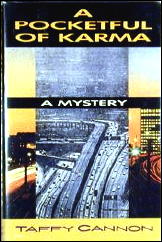
TAFFY CANNON – A Pocket Full of Karma. Nan Robinson #1. Carroll & Graf, hardcover, 1993. Reprint paperback: Fawcett Crest, 1995. This is Cannon’s first mystery, though she has had one novel published previously.

TAFFY CANNON

   Nan Robinson is an investigator with the State Bar of California, single and in her late thirties. She is surprised when a letter arrives at the office for her ex-secretary, Debra, who hadn’t worked there in three years.

   More puzzling still, it was from her mother. Nan and her secretary were from the same town, and though they had never been close friends, Nan feels guilty for not having kept better track of her.

   She decides to deliver the letter in person, but finds an empty house, with signs that the woman had vanished rather abruptly. Her curiosity aroused, she begins to try to track her down, and discovers that she has been working for a firm specializing in hypnotic regression to past incarnations.

   Just to complicate things, Nan finds herself attracted strangely to one of the owners of the firm. But what’s happened to Debra, and where is she?

   We know where Debra is, or at least what happened to her, because the book opens with a couple of pages from the mind of the killer. There are several other such interludes, though the rest of the story is told third-person from Nan’s viewpoint.

   This is a competently told first mystery, with only a few unlikely aspects to the plot. Nan is a likable enough character, though in all honesty not someone who really grabbed my attention or enlisted my sympathies.

   One saving grace is that she doesn’t fall in love with a cop. All told, this is a decent if not exceptional book, making it better than many.

— Reprinted from Ah, Sweet Mysteries #10, November 1993.


      The Nan Robinson series —

    A Pocketful of Karma. Carroll & Graf, hc, 1993.
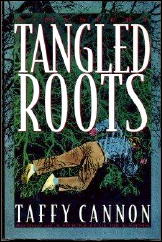
    Tangled Roots. Carroll & Graf, hc, 1995.

TAFFY CANNON

    Class Reunions Are Murder. Gold Medal, pb, 1996.

THE BACKWARD REVIEWER
William F. Deeck


D. B. OLSEN Rachel & Jennifer Murdock

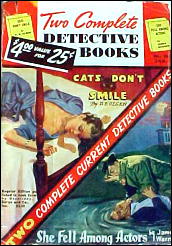
D. B. OLSEN [aka DOLORES HITCHENS] – Cats Don’t Smile. Doubleday Doran/Crime Club, hardcover, 1945. Later published in Two Complete Detective Books #36, pulp magazine, January 1946 (with She Fell Among Actors, by James Warren).

    Rachel and Jennifer Murdock, whose exploits — if Jennifer can be said to engage in exploits — Olsen has chronicled before and after this novel, go to Sacramento, Calif., to house-sit for Cousin Julia, who for reasons she doesn’t explain must leave the house and does not want her roomers unsupervised.

    Miss Rachel embroils herself in the roomers’ affairs and those of the next-door neighbors. Before she can meddle much, one of the roomers is murdered.

    For those who enjoy Little-Old-Lady detectives, this should be a pleasing mystery, particularly if active LOL’s are preferred. For my part, I have always thought Jane Marple was the perfect type. Not for her the burglary at dead of night or skulking in gardens eluding who knows what.

    Both interesting and unusual is the motive for murder. However, I had difficulty in accepting the solution, for reasons which I won’t go into since it would reveal the murderer’s identity.

    Warning: Cat lovers may be upset by one of the incidents in the novel.

— From The MYSTERY FANcier, Vol. 11, No. 2, Spring 1989.


       The Rachel & Jennifer Murdock series —

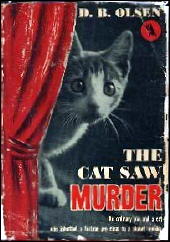
    The Cat Saw Murder. 1939. [Doubleday Crime Club for all but one.]

D. B. OLSEN Rachel & Jennifer Murdock

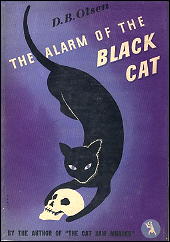
    The Alarm of the Black Cat, 1942.

D. B. OLSEN Rachel & Jennifer Murdock

    Cat’s Claw. 1943.
    Catspaw for Murder. 1943.
    The Cat Wears a Noose. 1944.
    Cats Don’t Smile. 1945.
    Cats Don’t Need Coffins, 1946.
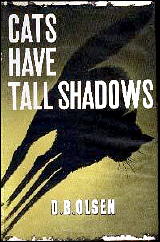
    Cats Have Tall Shadows. Ziff-Davis, 1948

D. B. OLSEN Rachel & Jennifer Murdock

    The Cat Wears a Mask. 1949.
    Death Wears Cat’s Eyes. 1950.
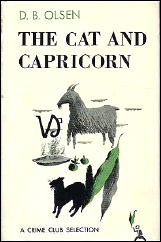
    The Cat and Capricorn. 1951.

D. B. OLSEN Rachel & Jennifer Murdock

    The Cat Walk, 1953.
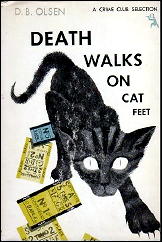
    Death Walks on Cat Feet. 1956.

D. B. OLSEN Rachel & Jennifer Murdock

« Previous PageNext Page »