Covers


   No cover artist this time, as you can see. If the object of a paperback cover is to attract potential buyers, this one should have. The strategy may not have worked, though. There are only 12 copies offered for sale on ABE, suggesting not many were sold in the first place. (Or perhaps anyone who has a copy is keeping it.)

Basil Heatter- The Golden Stag

PINNACLE paperback original; 1st printing, April 1976.

      From the front cover:

A gold artifact from the sixth century, a treasure of the Czars. Many had died for it, and the killing continues …

      From the back cover:

She was very convincing…

    “Like so many of the Scythian tombs; it had already been robbed, perhaps centuries before. But then a secret compartment was discovered. In it was a single artifact, a sold gold stag nearly two feet long and twelve inches high. It was resting on an iron shield which covered the bones of one of the chieftains. The stag was in a prone position with its forepaws folded under and a long golden mane flowing back from its antlers to its tail. Its design and concept are so close to the abstract forms of today that one can hardly believe it was created twenty-five hundred years ago. In terms of value, there is no way to put a price tag on it. Except for a few precious gems, it is probably the most valuable piece of its kind in the world today…”

    Devlin looked at Irina, drank in her exquisitely beautiful face, a figure that put his blood on fire, and wondered why she was so eager to tell him this Russian fairy tale. Especially now, after he was suspected of killing a French diplomat. Even that unfortunate event could be traced to his first meeting with Irina. A most innocent meeting.

    Now it would be different. Their eyes spoke a language that was anything but innocent. The strong, heady aroma of cognac — and Irina — decided it all.

    Tomorrow he would see about that finding that goddamn stag…

[COMMENTS] In case you were wondering, and are old enough to wonder, yes, Basil Heatter is the son of Gabriel Heatter, the well-known radio commentator for the Mutual Broadcasting System during World War II, and on through the 1950s.

   And Tim Devlin, the primary protagonist of The Golden Stag, is a series character. He also appeared in Devlin’s Triangle, Pinnacle, 1976. He’s the head of Devlin Underwriters, a “small but highly respected marine insurance firm.”
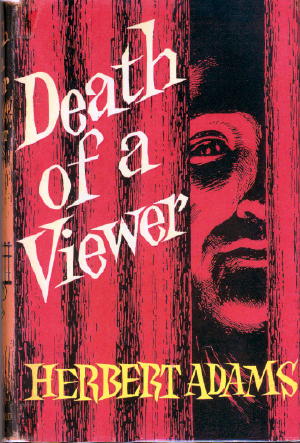
   Tom Taylor is a Herbert Adams collector as well as the author of The Golf Murders (Golf Mystery Press, 1997), a bibliography of golfing mysteries, and yesterday he sent me the cover image below. It’s for Death of a Viewer (Macdonald, 1958), a book that Mary Reed reviewed back in August. I couldn’t come up with a copy on my own, so he sent me one. (The cover image, not the book.) Tom also says that he’s working on an Adams bibliography and has a complete collection except one title, Black Death (Collins, 1938).

Herbert Adams: Death of a Viewer

   A partially illustrated checklist of Adams’s Roger Bennion novels, of which this is one, appeared along with Mary’s review. Follow the link above.

   Cover by Jim Manos, about whom Google turns up nothing, but a James Manos, Jr., is a writer-producer for movies & TV, including The Sopranos, The Shield, and Dexter.

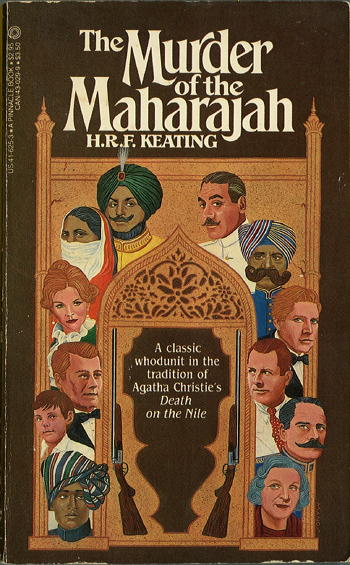
Keating: Murder of the Maharajah

Pinnacle, paperback; 1st printing, Sept 1983. UK hardcover: Collins (Crime Club), 1980; US hardcover edition: Doubleday & Co., 1980.

   From the back cover:

A New York Times
Notable Mystery of the Year!

————————————————————-

THE LAST LAUGH

Famed for his extravagant houseparties and his nasty jokes, the Maharajah of Bhopore had asembled as odd assortment of guests for his annual April Fool’s Day fun. With consummate charm, he plies them with luxuries — and then, he tortured them with his tricks.

But mirth turned to murder with the crack of the Maharajah’s backfiring rifle. Obviously someone in the palace had a deadly sense of humor … and Detective Superintendent of Police Howard was just the man to find out who the joker was.

————————————————————-

“A pleasure!
The Armchair Detective

————————————————————-

By the creator of the world-famous Inspector Ghote.

   The cover artist is Roger Roth, who is perhaps best known for his detailed illustrations for children’s books — but that’s not all he’s done:

Charteris: Last Hero

IPL. Hodder & Stoughton, UK, hc, 1930. Doubleday Doran (Crime Club), US, hc, 1931. Also published as: The Saint Closes the Case, Sun Dial Press, hc, 1941; paperback reprint: Fiction K103, 1967 [TV series tie-in with Roger Moore cover]. And as: The Saint and the Last Hero, Avon #544, pb, 1953. Other paperback reprints, under original title: Ace Charter, February 1982; International Polygonics, November 1988.

      From the back cover:

   How Simon Templar makes the acquaintance of arch-villain Dr. Rayt Marius, destroys a dangerous death ray, and thereby saves the world from catastrophe and a second Great War.

   Business as usual — for the Saint.

      From inside the front cover:

   ‘My name is Templar — Simon Templar.’

SIMON TEMPLAR: a/k/a The Saint, the Happy Highwayman, the Brighter Buccaneer, the Robin Hood of Modern Crime.

DESCRIPTION: Age 31. Height 6 ft., 2 in. Weight 175 lbs. Hair black, brushed straight back. Complexion tanned. Bullet scar through upper left shoulder; 8 in. scar on right forearm.

SPECIAL CHARACTERISTICS: Always immaculately dressed. Luxurious tastes. Lives in most expensive hotels and is connoisseur of food and wine. Carries firearms and is expert knife thrower. Licensed air pilot. Speaks several languages fluently. Known as “The Saint” from habit of leaving drawing of skeleton figure with halo at scenes of crimes.

   Cover art credited to John Jinks, the overall design to Barbara Buck.

Joseph Hansen - Obedience

MYSTERIOUS PRESS. Hardcover edition, November 1988. Paperback reprint, November 1989. The same cover art was used on both editions.

      From the back cover:

OBEDIENCE

   Andy Flanagan is an angry man. A one-armed veteran of the Vietnam war, he lives on a leaky boat at L.A.’s Old Fleet Marina. Now the marina is to be sold, and Flanagan — along with a hundred others — is to be ousted, with no place to go.

   His protests ignored, he phones the marina’s wealthy owner, an importer named Le Van Minh, and arranges a meeting. But Le never shows — until Flanagan stumbles over his corpse on the dock and is arrested fro murder.

   Public Defender Tracy Davis thinks Flanagan is innocent, and hires Dave Brandstetter to find the real killer. Brandstetter soon finds himself on the unseen border where American and Asian cultures meet and clash. Other wealthy Vietnamese have met violent ends recently. What role does the gang lord Don Pham play? What did a black street runner see that he shouldn’t? What angry secret do the young people of Le’s family share between them?

   Obedience is a story of ancient verities trashed by 20th-century greed and corruption. Never before has Dave Brandstetter ventured into so alien a world, and rarely has his dogged search for the truth put his life in such danger.

    “Excellent.”       —  Alfred Hitchcock’s Mystery Magazine

    “Fast paced … Hansen readers should delight in it.”       —  Publishers Weekly

   This is the movie tie-in edition, with a photo of Elizabeth Montgomery taken from the film. The film was in black-and-white, though, and this cover is in color:

McPartland- The Kingdom of Johnny Cool

   From the front cover:

A raw, renegade kid with enough guts to take on the whole damned underworld — A beautiful girl with enough innocence to believe in him.

   From the back cover:

They picked their man, and taught him well.

All the right names.

All the right tricks.

All the ways to kill a man and never leave a trace.

And when they had a fine, smooth precision tool for death, they gave him the name of a gangland titan and turned him loose in the underworld empire the mobster had once owned. And they said: Take it, Johnny. Get it back. It’s yours.

McPartland- The Kingdom of Johnny Cool


GOLD MEDAL k1343. Second printing, September 1963. [above] First printing: Gold Medal 881, 1959. I don’t happen to have at hand my copy of the first printing, but I found a cover elsewhere on the Internet. Both editions are scarce. On ABE when I checked just now, there were 9 copies of the first printing, and two of the second.

McPartland- The Kingdom of Johnny Cool


   The movie was simply titled Johnny Cool (United Artists, 1963). Henry Silva played the title role.

   To read Gold Medal aficionado Bill Crider’s take on both the book and the movie, go here.

   Cover art unidentified, although there are two P’s in the upper and lower portions of a boxed H to the left of the lady’s leg (her right). I’ve lightened the image slightly for a better overall look.

Craig Rice- The Lucky Stiff


BANTAM. Simon & Schuster (Inner Sanctum), hardcover, 1945. Reprint hardcovers: Unicorn Mystery Book Club [four-in-one], 1946; World, 1947. Paperbacks: Armed Services Edition 914 [oblong binding]; Pocket 391, 1947; Bantam edition, June 1987.

      From the front cover:

   “Extra good.” — SATURDAY REVIEW

      From the back cover:

            dead girls have more fun

   The reporter at her trial wrote: “Anna Marie St. Clair, convicted murderess of Big Joe Childers, seemed like a woman carved out of stone.”

   A sentence of death by electrocution will do that to a murderess. The problem was, Anna had not, in fact, killed her lover. She’d been cruelly framed.

   Then, at the eleventh hour, the true murderer confesses. Anna becomes a free woman. A free woman with a frightening plan. She blackmails the authorities into reporting her execution. Now the world at large, including those who had sent her up, thinks she fried.

   Anna’s next step is to seek out gin-soaked, falling-in-love lawyer J. J. Malone. And with his exuberant approval, Anna sets out on a devilish trail of haunting revenge.

    “The wildest series of adventures that Craig Rice has yet put on paper.” — THE NEW YORK TIMES

[FOLLOWUP COMMENTS] 11-26-07. The back cover fails to report that Craig Rice’s other pair of sleuths, Jake and Helene Justus, are in this book, a significant oversight, I would say.

   As for me, I failed to report that there was a movie made of The Lucky Stiff, and the link will lead you to the IMDB page for it. Brian Donlevy played Malone, and Dorothy Lamour was Anna Marie St. Clair. Jake and Helene Justus were not in the movie, which does not seem to be available, either commercially or on the black market.

   The book itself is part of the online George A. Kelley collection, where you’ll find a detailed write-up of the entire story. For much more about Craig Rice’s career in mystery fiction, mostly of the comic variety, check out Mike Grost’s website. Magnificent!

   First in a series of cover artwork, mostly paperbacks, and all from my collection. The only criterion for this one and ones to come: These are books that I’ve found pleasures in various ways in having them in hand to look at, up close and personal.

   Artist: Kirwan:

Shoot the Piano Player

BLACK LIZARD. First published as Down There, Gold Medal, 1956. Reprinted as Shoot the Piano Player, Grove Press (Black Cat), 1962. Black Lizard edition, 1987. Introduction by Geoffrey O’Brien. Filmed as Tirez sur le pianiste; adapted and directed by François Truffaut.

      From the front cover (top):

    “David Goodis is the mystery man of hardboiled fiction — the poet of the losers.”

— Geoffrey O’Brien, Mystery Scene

   From the front cover (bottom):

      Eddie was a piano man on the skids, about as far from the top as he could slide. Then he met a girl, the right girl, and she gave it all back to him. He’d kill anyone who came between them.

      From the back cover:

   Eddie had been a big shot one, a concert pianist at the top of his profession, able to fill Carnegie Hall whenever he chose to perform. His brothers were in a different business, however; they were thieves, killers. Until now he’d been able to avoid them, to live his life in his own way. But things were different now; they’d been different since his wife and career went out the window. He hit bottom fast.

   Then this girl came along, and Eddie began the long, slow climb out of the gutter. When his brother Turley showed up Eddie knew it was bad news — he couldn’t say no to Turley, no matter how painful the consequences proved to be.

      “Action and thrills!”           — San Francisco Call Bulletin

      “Goodis’s characters are not just hard-boiled, they’re pickled and then deep frozen … bad-dream Bogarts on the far ledge of existence.”          — Mike Wallington

   You’ll have to go to the main Mystery*File website to find the checklist, I’m sorry to say, but on the other hand, it’s only a link away. Just click on the one provided.

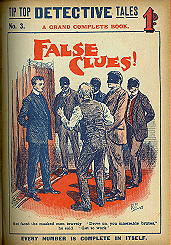
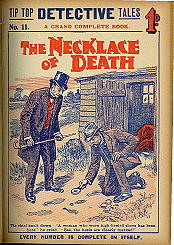
   Here’s Victor’s introduction, along with a cover image or two —

   Tip Top Detective Tales was one of the Aldine Publishing Company’s many library series produced to capture the fancy of the youth of Great Britain. This particular one ran from 1910 through 1912 when it morphed into just Tip Top Tales, produced to include stories of adventure, as well as those of criminal content. With one exception, all of the novels included in the series were published anonymously.

   For a short history of the trials and tribulations of the Aldine Publishing Company, which was founded by Charles Perry Brown (1834-1916), see the excellent article by John Springhall, “Disseminating impure literature: the ‘penny dreadful’ publishing business since 1860” in ECONOMIC HISTORY REVIEW, XLVII, 3 (1994), especially pages 578-584.

         Tip Top Detective Tales

      Tip Top Detective Tales

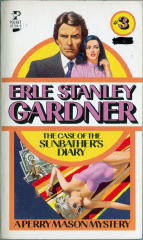
   I was looking over the previous post here on the M*F blog this morning, the one on Gardner paperbacks, wondering if I need tweak anything here or there, and it occurred to me that that last cover was the only one that I could remember having a portrayal of Perry Mason on it.

   Perhaps I could have you just go back and take a look, but since it’s handy, why don’t I simply show it to you again:

Perry Mason

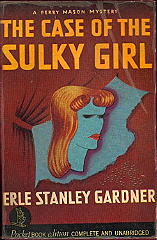
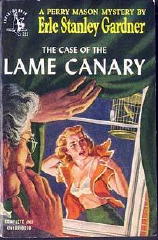
   The covers on the earliest Pocket paperbacks, going back to the early 1940s, always seemed to me to be attempts to imitate the art on hardcover jackets, rather subdued and far from lurid:

Perry Mason

   Later on toward the end of 1940s, the covers at Pocket seemed more and more designed to do their job properly, to catch the eye of the guy (usually) at the newsstand:

Perry Mason

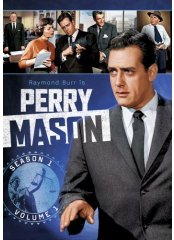
   That cover at the top of this page must have come from the end of the Pocket era. If that’s Perry Mason who’s pictured on it, it certainly doesn’t look like Raymond Burr, who was perfect in the part, but very much an establishment figure. He was a whole lot younger when he started, though. Here’s the cover of the recent box set, which I’ve bought but (all together now) I haven’t started to watch yet:

Perry Mason

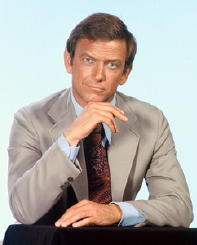
   To me, the guy on the Pocket cover looks more like Monte Markham, who had the role for about half a season, 1973-74, before they pulled the plug on him. To TV viewers, it was Raymond Burr who was Perry Mason, and no one else. Even though he may not have been playing Mason at the time, this is what Markham looked like then:

Perry Mason

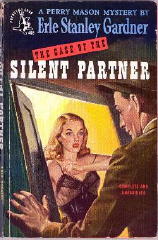
   But getting back to covers with Mason himself on them, I think I may have found an earlier one after all. It’s from the late 1940s era, and as a character, I don’t think all of his rough edges had rubbed off yet. Mason was a tougher guy at the beginning, his roots (as well as Gardner’s) being solidly in the pulp era, and more specifically Black Mask and Dime Detective.

   I think those roots are still showing here:

Perry Mason

« Previous PageNext Page »