Covers


Online cover scans for the Phoenix Press mysteries are now complete from 1936 through 1952, when the last of their titles was published.

Coming up next: the crime fiction published by Hillman-Curl between 1936 and 1939. Authors included in this line of lending-library mysteries include Bram Stoker, Steve Fisher, J. S. Fletcher, E. R. Punshon, Roger Torrey and many others. Look for the covers soon. You will read about it here first.

    I was cleaning out the far end of my Toyota minivan yesterday, and I came across a box of books that had been there since last December, which coincidentally enough was the last time I went out bookhunting. My friend Paul and I had gone up to the Northampton MA area for the day, and when we came home I thought better of lugging the books into the garage, which I was in the process of cleaning out, or trying to, and decided just to leave them in the back of the car.

    Which they were happy to be, until yesterday. And I was quite pleased to sort through my purchases again, marveling at what presence of mind I had to pick up so many books that I needed and still wanted.

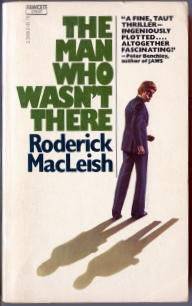
    And two of them were more relevant than others. In my recent post on Roderick MacLeish, for example, I tried to explain the plot line for The Man who Wasn’t There, but without the book in hand, I didn’t know what I was trying to convey, and so how possibly could you?

    I have a copy of the paperback edition now, and thanks to the person who wrote the blurb on the back cover, it makes a lot more sense now:

Man

    “Aren’t you Rex Carnaby, the movie star?” asked the stranger on the plane. His name was Follensby.

    “No,” said Rex.

    “Jesus, you sure look like him!”

    “I’m his brother, Frederick Jackson Carnaby. We’re twins!”

    — This was the kind of lie with which millionaire film star Rex Carnaby often rid himself of autograph seekers. But this time it had very different results. The next day in Washington, Rex was shocked to read that the man he had invented was dead!

   This is more like it. A book to be put immediately on the To Be Read pile.

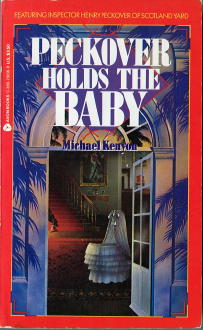
   The other book, one by Michael Kenyon, whose passing was also noted here not too long ago, was an Avon paperback reprint of Peckover Minds the Baby. The plot line was described before in a couple of short lines, so I won’t repeat it, even at longer length.

   But I like the cover, the artwork uncredited as usual, even in 1988, and here it is. (The details are very fine, and I hope you can make them out. That’s a portion of the arm of a body that you see toward the bottom of the stairs, for example.)

Peckover Baby

    And yes, you’re right, another book To Be Read, as soon as I can get to it.

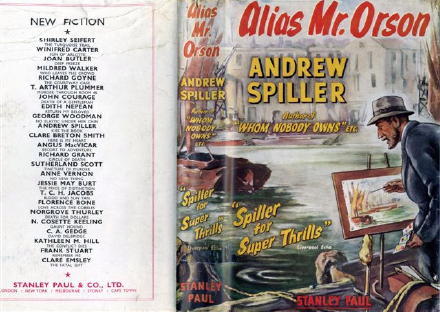
   Jamie Sturgeon just sent me a rather striking cover to add to the Andrew Spiller cover gallery set up after the author was discussed here on the M*F blog a couple of months ago.

   You can find the other covers we’ve collected at mysteryfile.com/Spiller/Covers, and I hope you’ll go take a look, even if you did before. For the most part the covers are more colorful (if not lurid) than the ones used to decorate mysteries in the US in the same time period, 1945-1960.

Alias Mr. Orson


   Coming up soon will be a review by me of one of Spiller’s crime fiction novels. It was, to say the least, “unusual.”

   A short while ago I posted a blog entry about a group of authors whose deaths had recently been noted. One of those authors was Andrew Spiller, about whom I knew nothing at the time, except for the list of mystery fiction he wrote, which you’ll find by following the link.

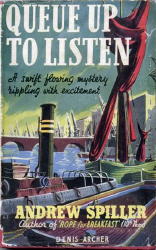
Queue

   To learn more, I first emailed John Herrington:

 John

   I tried a Google search for Spiller and/or Inspector Mallard, and found … nothing. Another author like Brian Flynn, perhaps, popular only because he wrote a lot of books and for very little other reason?

Best

      Steve

  Hi Steve,

   I wouldn’t disagree. I have managed to borrow a couple of his books though inter library loans and they are nothing special.

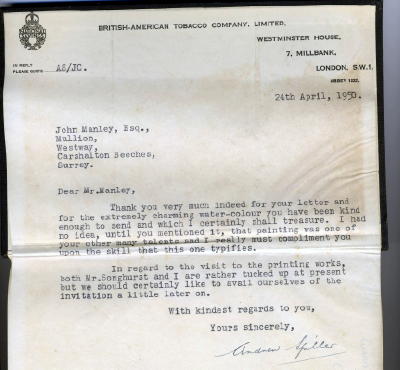
   Have discovered that he was working for the British-American Tobacco Company in 1950. He is like a lot of writers of the 1940s and 1950s, who stopped writing by the end of the 1950s. A lot of the smaller publishing companies were disappearing (or being bought up) and perhaps he realised that there was no longer a market for his books. This happened to the likes of ‘Ernest Dudley’ who stopped writing crime around the same time because there was no money in it.

Regards

      John

   Then arrived a welcome email from Jamie Sturgeon:

  Steve,

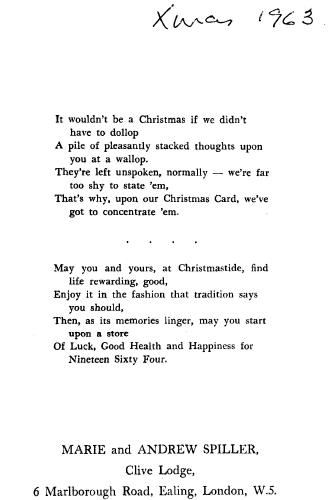
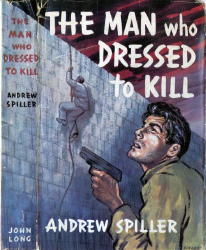
   Did John mention that Andrew Spiller worked for British American Tobacco and his wife’s name was Marie? Please see attached scans, including two more covers in DJ.
Cheers,

   Jamie

Letter

Xmas


   Then from Victor Berch, who has managed to delve deeply into Andrew Spiller’s traveling days:

  Steve

   Remember my mentioning that database which contained information on aliens and citizens entering the US? Well, I decided to poke in Andrew Spiller’s name and to my surprise two hits came up. I wasn’t too sure I had the right Andrew Spiller, but when I spotted his birthplace of Bridport, I knew I had the right person. So, here are some of the details from those records that I gathered from the ships’ manifests:

   On his first trip to the US, Andrew Spiller came aboard the SS Olympic which left Southampton, Eng on Feb. 25, 1925 and arrived in New York March 4, 1925. From this manifest, it stated that he was in transit to visit his cousin, C. James, in New Zealand. He was listed as an advertising agent for the British American Tobacco Co, Ltd (which, by the way is still in operation). His age at the time was given as 35 years old. He was 5’9 1/2″ with brown hair and grey eyes.

   On his second trip, he came aboard the SS Aquitania, which left Southampton, Eng on April 28, 1928 and arrived in New York May 4, 1928. Spiller was still listed as advertising manager for the British American Tobacco Co., Ltd and was going to stay in the US for 60 days.

   On this record he was required to give the name and address of his nearest kin, which was Mrs. A. Spiller, 26 Heathfield Rd., Acton, W. 3 , London. These records seem to predate his writing period.

Best,

      Victor


Dressed

   And so there you are. Bits and pieces of a life of a mystery writer who’s become obscure and all but forgotten now, but who was very prolific in his time.

   For a gallery of even more covers, provided by Jamie Sturgeon, I’ve set up a separate website here.
   Just a quick note to let you know that the covers to the Phoenix Press mysteries are now complete through 1946. Check out the latest additions here.

   Some additional comments on David Hume, discussed first in my review of Requiem for Rogues, with a followup post a few days later. From the Yahoo Golden Age of Detection group is this from Curt Evans:

Steve,

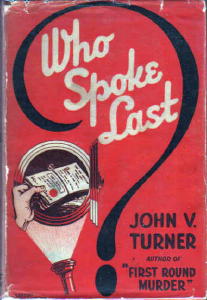
   Murder-Nine and Out involves the boxing world, as does, judging from the dust jacket (the book is for sale for $180 on ABE), Death Must Have Laughed. I would put Murder-Nine and Out in the detection school, as I would the two Ebenezer Buckles I read. But “tough” elements crop up, by which I mean elements associated more with thrillers than with the British genteel school of the Crime Queens. I’ve got another Turner, Who Spoke Last?, which seems to be about crooked financiers, but I have not read it yet. Amos Petrie’s Puzzle sounds interesting, but I have not found a copy.

Curt

Hume

   You’re right. Some of the books that Turner wrote, especially those not as by Hume, are very expensive and hard to find. Wait until you read this from Bill Pronzini, though, who has this to say, plus some show-and-tell afterward:

Steve

   Just read your blog piece on David Hume (John V. Turner). So happens I’ve been collecting his work for years, under his own name and his two pseudonyms. Attached is some biographical info, photos, and a sketch from the DJ’s of three of his U.K. mysteries. I can send you some cover scans as well, if you like — Humes, Bradys, and Turners.

   The Cardby novels are enjoyable Edgar Wallace type gangster stuff, and comprised his most popular series in England, but for my taste his other two series are better — the Reverend Ebenezer Buckles as by Nicholas Brady and the Amos Petries as by J.V. Turner. These are Golden Age fair-play mysteries with more spice than is usual in the breed.

   One of the Reverend Buckle tales, Ebenezer Investigates, for instance, deals with the murder of a pregnant young village woman who had relations with several different men; the subject matter was evidently considered too controversial for its day (1934) for Holt, which published a couple of the other Buckle mysteries, to bring it out here. One of the titles that Holt did publish, Carnival Murder (The Fair Murder in the UK), is a first-rate macabre puzzler set at a village fete at which a small traveling carnival is the main feature.

   Two of the Amos Petrie novels are “impossible crime” tales of some ingenuity; the best of them is First Round Murder (Death Must Have Laughed in the UK), which has a boxing background and concerns the baffling murder of a fighter in the midst of a bout.

Best,
Bill

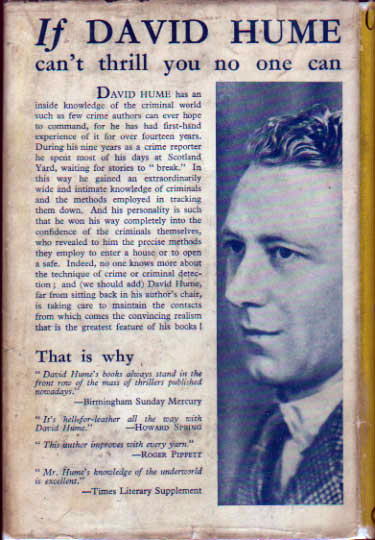
   I’ve used one of the cover scans to lead off this blog entry, and I used the back cover sketch of Hume�s face on the previous Hume-Turner post. I�ll post one of the back covers with the biographical info at the bottom of this post � I hope you can make out the print! The rest of the covers I’ve uploaded on a separate page where you can see them more clearly. Go take a look. It�s worth the trip!

Back Cover

[UPDATE] From Bill Pronzini: Attached are three more scans which you might want to include, two Humes and a Turner.

   Curt Evans is right about the grotesque elements of The Carnival Murder; grisly might even be a better word.

   Most of the other books I have by Turner under his three names are jacketless, unfortunately. One of these is the Turner title Curt mentioned, Amos Petrie’s Puzzle. It’s not as good as the two of the “impossibles,” First Round Murder and The House of Strange Guests, but still enjoyable. Concerns the murder at a country house party of the owner of three West End theatres, after the gent received an anonymous threatening note stating “Millionaires Must Die.” Theatre folk and film stars are among the suspects, and as usual with Turner’s detective novels, there are both bizarre and sexual aspects to the case. Amateur sleuth Petrie is on hand to solve it with the aid of his long-suffering friend, Inspector Ripple of Scotland Yard.

Best,

Bill

The covers page has been revamped, with the new scans added. Thanks! –Steve

   Covers for the 1945 mysteries are now included in the online Phoenix Press project. Right now 1945 begins a page to itself, so if you don’t mind, would you check to see that the links to all of the earlier years are working the way they’re supposed to?

   Excerpted from a recent email from Bill Pronzini:

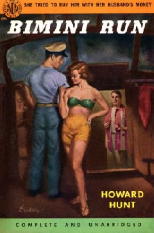
   The Howard Hunt bibliography and commentary on your blog recently was of particular interest, since I’ve always had a soft spot for his fiction (if not for his politics). Among my personal favorites are two first-rate suspense novels written early in his career, MAELSTROM and BIMINI RUN, his first three Gold Medals, and the Steve Bentley series. The Bentleys are pure potboilers, but done with a style and flair that make them compulsive reading.

Bimini

   And from one a few days later:

   The man could write when he put his mind to it, as in BIMINI RUN. Farrar Strauss published the hardcover, Avon a reprint edition. It’s well worth reading. May be in his best novel, in fact. MAELSTROM is very good, though flawed, and the same is true of THE VIOLENT ONES and his other early Gold Medal originals.

   My reaction? More books to track down and read!

         —

   The online Phoenix Press project Bill and I are working on and which I mentioned a few weeks ago stalled out this past week for a few days while I got caught up on other matters, but the pace has quickened again. The covers for the Phoenix Press mysteries are now complete through 1942. We hope that you’ll keep checking out the site, as we plan to continue uploading covers as quickly as we can.

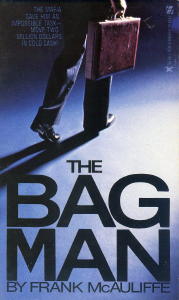
Following up on the previous post, here’s an email that Bill Crider just sent me, along with a scan of the missing cover:

Hey, Steve.

Haven’t read this in over 25 years. All I remember is that it’s about a bag man for the mob and that I didn’t think it was in the same league with the Mandrell books.

Best,

Bill

                            Bag Man

Thanks, Bill. I knew that someone must have a copy kicking around. Why am I not surprised that it was you?

The image is a little too dark to make out the text in the upper right corner. Here’s what it says:

THE MAFIA GAVE HIM AN IMPOSSIBLE TASK — MOVE TWO MILLION DOLLARS IN COLD CASH!

— Unfortunately another impossible task for the rest of us is to find a copy of our own, unless it’s one of the ones that PointBlank will be doing. Eventually, perhaps?

« Previous Page