The entry for Gertrude Walker in Crime Fiction IV, by Allen J. Hubin, looks like this, or at least this is how it looked until this past week, supplemented slightly by the information on the paperback editions:
WALKER, GERTRUDE (1920- )
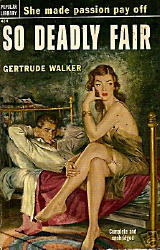
* * So Deadly Fair (Putnam, 1948, hc) [Minnesota]. Bestseller B105, digest pb, abridged, 1948. Popular Library 424, pb, 1952.
* * Diamonds Don’t Burn (Jenkins, 1955, hc)
* * The Suspect (Major, 1978, pb) [Los Angeles, CA]
So Deadly Fair has a modest reputation among fans of hardboiled mysteries, but otherwise is probably little known. I don’t remember seeing a copy myself, in any of its various editions, although it’s not uncommon, at least in paperback form, so I probably have.
From the blurb on the hardcover edition: “When the Minneapolis-bound freight train pulled out of the small Middletown, Minnesota, freight yard, it left behind it very little of importance: a few rolls of barbed wire, some packing cases, and me. And god knows I wasn’t important. I wasn’t important to anyone. Not even to myself.”
An investigation into both the book and the author began with an email from British bookseller Jamie Sturgeon to Al Hubin:
Al,
Whilst looking for info on Gertrude Walker I found the following on her on IMDB:
It says she married Charles Winninger who she met in 1932 when both were in Showboat. The year of birth you have in CFIV as 1920 seems unlikely to say the least.
I found some more on Gertrude Walker here. This message in [theYahoo group] Rara-Avis mentions a third book The Face of Evil, but I can’t find anything about this title.
Maybe the third book you have of hers listed as The Suspect is by a different Gertrude Walker?
Odd that her second book Diamonds Don’t Burn (the one I have) wasn’t published in the US.
Al sent the email on to me, along with his reply, and I’ll get back to that in a minute.
Taking a look at Walker’s credits in the film-making industry, the following caught my eyes, all more or less in the crime fiction genre:
Mystery Broadcast, 1943. “A radio detective (Ruth Terry) sets out to solve an old murder case, with the help of her sound man and another radio detective.” [Additional dialogue.]
Whispering Footsteps, 1943. “A bank clerk in a small town returns home from a vacation in Indianapolis, and hears a story on the radio about a girl found murdered there. The description of the killer fits him exactly, and when two girls are murdered in his town, suspicion falls on him…” [Co-screenwriter.]
Silent Partner, 1944. “Reporters investigating the death of a friend begin to suspect that their newspaper’s editor may have been responsible for it.” [Screenwriter.]
End of the Road, 1944. “A crime writer believes that a man imprisoned for committing the notorious ‘Flower Shop Murder’ is innocent of the crime…” [Co-screenwriter.]
Crime of the Century, 1946. “Ex-convict Hank Rogers is searching for his brother Jim, a newspaperman, and becomes involved with a group of people trying to conceal the death of the president of a large corporation…” [Screenwriter.]
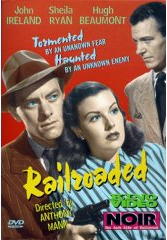
Railroaded!, 1947. “Sexy beautician Clara Calhoun, who has a bookie operation in her back room, connives with her boyfriend, mob collector Duke Martin (John Ireland), to stage a robbery of the day’s take.” [Original story.]
The Damned Don’t Cry, 1950. “The murder of gangster Nick Prenta touches off an investigation of mysterious socialite Lorna Hansen Forbes (Joan Crawford), who seems to have no past, and has now disappeared…” [Based on Gertrude Walker’s story, “Case History.”]
Insurance Investigator, 1951. “When a businessman who has had a double indemnity policy taken out on him dies mysteriously, his insurance company sends an undercover investigator to town to determine exactly what happened.” [Screenwriter and co-author.]
Some of these I’m sure you may have heard of, others most probably not, but they all seem to fit the category of black-and-white film noir, some more than others, of course. Walker also has a few miscellaneous credits in television, including a stint on The New Adventures of Charlie Chan (1958).
The IMDB link that Jamie provided actually leads to biography of Charles Winniger, long-time comedian and song-and-dance man. Here’s the key line: “Divorced from wife Blanche in 1951, Charlie subsequently married stage actress-turned-novelist and screenwriter Gertrude Walker whom he originally met on Broadway when he returned to “Show Boat” in 1932 (Gertrude played the role of Lottie).”
Here now is Al Hubin’s reply to Jamie, as sent on to me:
Jamie,
There is a Gertrude W. Winninger in the social security death benefits record, born 4/8/1902, died 6/1995 in Palm Springs, CA. I rather think that’s the author in question, and that I (or my original source) transposed a couple of digits into giving her a birth year of 1920. The fact that Charles Winninger died in Palm Springs seems to clinch it for me. What think ye?
The birth and death dates now having been established with a certainly, it was time, I thought, to take a closer look at the books she wrote.
The link Jamie provided to the “Rara-Avis” group was also the only one that I found that was of any great use. It was a message posted by Etienne Borgers, in response to another’s request for information about her. It reads as follows:
Gertrude Walker
I do not have complete facts or bio, but gathered the following:
– she was born in Ohio (date?)
– studied journalism in Columbus
– published critical articles about poetry and theatrical plays
– published articles about screen stars in magazines
– she was a comedian for a while in Hollywood (theatrical plays) and, later, even a singer
– wrote texts for stand-up comedians (during wartime)
– wrote scripts (and stories) for about 10 films (B-series) during the forties
– wrote for TV serials like The Californians and The New Adventures of Charlie Chan.
As far as I know, she wrote only 3 novels:
+ So Deadly Fair (1947)
+ Diamonds Don’t Burn (1955)
+ The Face of Evil (1978) which seems to be a novelization of her script for Whispering Footsteps (1943)
I read only the first one. Some American critics compared the novel to James Cain’s works at the time of first publishing.
She also wrote some short stories starting during her twenties.
I do not know if this helps.
E. Borgers: Hard-Boiled Mysteries http://www.geocities.com/Athens/6384
There’s some duplication of information here, so please forgive me for that. I haven’t yet looked into the short fiction that Walker may have written. Etienne’s mention of a book entitled The Face of Evil, one that Al Hubin didn’t seem to know about, was what attracted my attention the most. That the date (1978) was the same as the book The Suspect (Major, 1978) made me wonder if perhaps the two books were the same. Neither one showed up for sale on the Internet, but knowing that Bill Pronzini collects the paperbacks published by Major, I emailed him.
In a moment, the results of that inquiry.
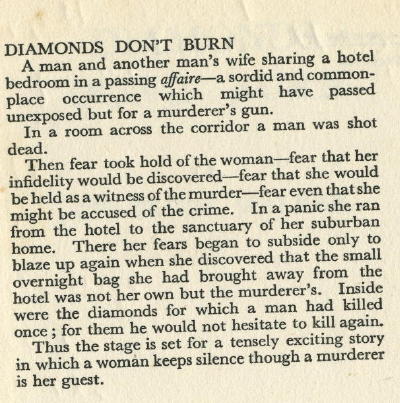
In the meantime Jamie had sent me a scan of the jacket blurb for the book he had, the British hardcover, Diamonds Don’t Burn. My thought was that perhaps the British edition was simply retitling of the earlier US book, So Deadly Fair, but Jamie said no, the in book he had mentioned the first one by title. I think the scan is readable, and it looks as though the book itself would be worth reading. Why it was never published in the US is a question as yet unanswered.
An email reply from Etienne Borgers was in essence an apology that he hadn’t any more information about Walker than was posted earlier, but no matter. He had already posted more information about Gertrude Walker than was available anywhere else.
Etienne offered to double check with friends, but by this time, I’d heard back from Bill Pronzini. One of the questions I’d asked him is whether of not The Suspect, the 1978 paperback from Major, actually existed, there being no copies offered for sale on the Internet:
Steve:
Al is surely right that Gertrude W. Winninger and Gertrude Walker were one in the same individual, and that her correct birthdate is 1902, not 1920.
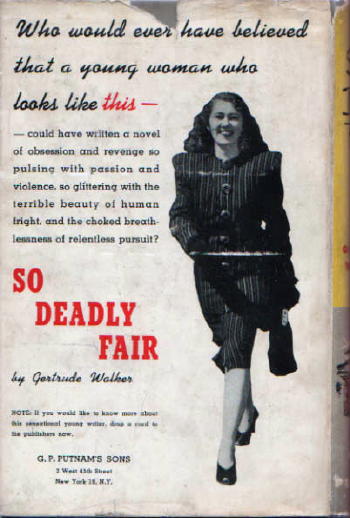
Attached is a photo of Gertrude Walker from the back jacket of her first novel, So Deadly Fair. The accompanying bio calls her “a young woman,” and the photo indicates the same, but my guess is that it’s just publicity hype and the photo an old one.
My copy of the book includes a separate publicity photo in which she looks older, closer to her age at the time the novel was published, 46.
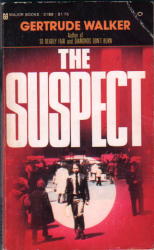
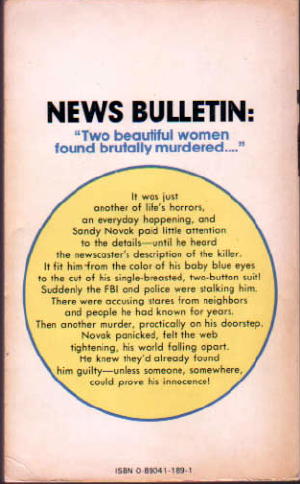
The Suspect does indeed exist; attached are scans of the front and back covers. If it’s a novelization of a 1943 screenplay, it was definitely updated to the 70s milieu. I can’t say for sure, but The Suspect is probably a retitling, either by the author or Major Books, of a manuscript submitted as The Face of Evil. I don’t know of any novel by Walker or anybody else published in 1978 or thereabouts under the latter title.
Diamonds Don’t Burn and So Deadly Fair are definitely separate books. Fair is a sort of hardboiled and frenetic road novel that jumps from Minnesota to New York City and points in between and is narrated by a male protagonist named Walter Johnson.
Best,
Bill
Here’s the front cover of the Major book. It’s obviously a tough book to find. If it’s on your want list, good luck to you!
But what’s more important is the back cover. Check the plot synopsis of the movie Whispering Footsteps up above, and read the back cover again:
Bingo. We have a match.
—
[UPDATE] 03-27-07. Excerpted from an email I received this morning from Victor Berch, suggestions which I’ve accepted with many thanks:
Steve:
You might want to consider adding these to Gertrude Walker’s repertoire:
1935–Mary Burns, Fugitive.
Had a minor acting role in this crime film.
1943–Danger! Women at Work
Described as a homefront comedy, but the hijacking of trucks is part of the plot. GW responsible for the story along with Edgar G. Ulmer.
1945–Behind City Lights.
Described as a crime drama with songs. GW responsible for the adaptation.
1946–My Dog Shep
Described as an animal and youth drama. (involves a kidnapping plot). GW was screenwriter.
Thu 22 Mar 2007
BRIAN FLYNN – The Sharp Quillet. John Long, hardcover, no date stated (1947). No US edition.
You’ll have to fasten your seatbelts, because I’m going to begin this review with a list of Brian Flynn’s mysteries, and it’s going to be a long one. Taken from Crime Fiction IV, by Allen J. Hubin, these are the British titles only. Most of these were published only in England, but those preceded by (**) did have US editions.
The detective in every one of these works of crime fiction is a chap named Anthony Bathurst, and since he’s in the book at hand, there will be more about him in a minute. At the present time, there’s no year of death given for his author, Brian Flynn, and I’ll ask a couple of people what they might know about that. First, though, the list of titles:
FLYNN, BRIAN (1885- ) An accountant in government service, a lecturer in Elocution and Speech, an amateur actor.
** The Billiard-Room Mystery (n.) Hamilton 1927.
** The Case of the Black Twenty-Two (n.) Hamilton 1928.
** The Mystery of the Peacock’s Eye (n.) Hamilton 1928.
** The Five Red Fingers (n.) Long 1929.
* Invisible Death (n.) Hamilton 1929.
** The Murders Near Mapleton (n.) Hamilton 1929.
** The Creeping Jenny Mystery (n.) Long 1930.
** Murder En Route (n.) Long 1930.
* The Orange Axe (n.) Long 1931.
* The Triple Bite (n.) Long 1931.
* The Edge of Terror (n.) Long 1932.
* The Padded Door (n.) Long 1932.
* The Spiked Lion (n.) Long 1933.
** The Case of the Purple Calf (n.) Long 1934.
* The Horn (n.) Long 1934.
* The League of Matthias (n.) Long 1934.
* Tragedy at Trinket (n.) Nelson 1934.
* The Sussex Cuckoo (n.) Long 1935.
** Fear and Trembling (n.) Long 1936.
* The Fortescue Candle (n.) Long 1936.
** Tread Softly (n.) Long 1937.
* Cold Evil (n.) Long 1938.
* The Ebony Stag (n.) Long 1938.
** Black Edged (n.) Long 1939.
* The Case of the Faithful Heart (n.) Long 1939.
* The Case of the Painted Ladies (n.) Long 1940.
* They Never Came Back (n.) Long 1940.
* Such Bright Disguises (n.) Long 1941.
* Glittering Prizes (n.) Long 1942.
* Reverse the Charges (n.) Long 1943.
* The Grim Maiden (n.) Long 1944.
* The Case of Elymas the Sorcerer (n.) Long 1945.
* Conspiracy at Angel (n.) Long 1947.
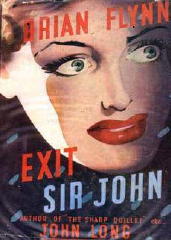
* Exit Sir John (n.) Long 1947.
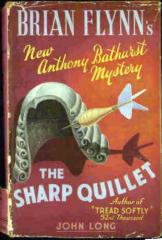
* The Sharp Quillet (n.) Long 1947.
* The Swinging Death (n.) Long 1948.
* Men for Pieces (n.) Long 1949.
* Black Agent (n.) Long 1950.
* And Cauldron Bubble (n.) Long 1951.
* Where There Was Smoke (n.) Long 1951.
* The Ring of Innocent (n.) Long 1952.
* The Running Nun (n.) Long 1952.
* The Seventh Sign (n.) Long 1952.
* Out of the Dusk (n.) Long 1953.
* The Doll’s Done Dancing (n.) Long 1954.
* The Feet of Death (n.) Long 1954.
* The Mirador Collection (n.) Long 1955.
* The Shaking Spear (n.) Long 1955.
* The Dice Are Dark (n.) Long 1956.
* The Toy Lamb (n.) Long 1956.
* The Hands of Justice (n.) Long 1957.
* The Wife Who Disappeared (n.) Long 1957.
* The Nine Cuts (n.) Long 1958.
* The Saints Are Sinister (n.) Long 1958.
It certainly isn’t likely to mean anything, but Mr. Flynn didn’t do anything like slow down toward the end of his writing career, did he? Sixteen books between 1951 and 1958, after reaching the age of 66. One might guess that he’d retired from his day job (see above).
Heading off to see what Google says, with the author having such a common name, it was quickly discovered that any kind of effective search was going to have to be done on Bathurst the character, rather than Brian Flynn the author. And — there’s nothing to be found. All that comes up are books by Flynn for sale from various dealers’ catalogues. Other than what Al Hubin has provided for him in his entry in CFIV, there’s not a single website providing information on either author or character to be found, not one citation, nothing. (That’s about to change, however, isn’t it?)
Obviously Brian Flynn was no rival to Agatha Christie, but why has he so drastically dropped out of sight? Were his books so indifferently or badly written? On the basis of one example, I’d say no, but on the basis of the very same example, I’d have to agree (if asked) that the style of story is outdated, or at least its ending is. The detective work is essentially sound, although the reader is not made privy to all that Anthony Bathurst knows.
And I see that I’m writing this review wrong end to, and so to right this wrong, let me jump back to the prologue, in which a defendant in court is sentenced to die (and does), but so does the entire jury, all twelve individuals, wiped out in a rocket bomb attack and preceding the defendant to death. I don’t think I’ve ever read that in a book before!
At some length of time later, more deaths begin occurring, the first being that of Nicholas Flagon, a justice on the panel that denied the appeal of the defendant in the prologue. Which is why I so strongly dislike prologues, if I may bring this small rant out into the open one more time. I hate knowing facts and information that the detectives on the case do not have. I don’t enjoy it, I don’t like watching bright policeman and even brighter private detectives work their way through investigations on a case that doesn’t really begin (for me) until they’ve caught up to where I already am, due to the wisdom imparted to me when I didn’t really want it.
End of rant. Dr. Harradine and the local Inspector, a man named Catchpole, are the first on the scene. Tied around the shaft of the dart that has just killed its victim is a slip of paper that says, “A nice sharp quillet. Ay!”
Off to the dictionary go I, and wouldn’t you? A quillet is not a small pen, as suggested on page 30, but: “An evasion. In French ‘pleadings’ each separate allegation in the plaintiff’s charge, and every distinct plea in the defendant’s answer used to begin with qu’il est; whence our quillet, to signify a false charge, or an evasive answer.” Emphasis on “a false charge.”
The policemen on the case, and Anthony Bathurst, do not get back to this point until page 111, so OK, I did some investigating on my own and learned something before they did. I’m not contradicting myself, in terms of what I said about prologues just moments before. I think that this is acceptable, isn’t it?
As for Anthony Lotherington Bathurst, he enters the scene on page 50, when he’s asked by Commissioner Kemble of Scotland Yard to add his expertise to the men on the ground (so to speak) where the victim was killed, their efforts seemingly going nowhere. Bathurst agrees — there’s nothing like a good solid case of mystery to work on — and together with Chief Detective-Inspector MacMorran he makes his way to the otherwise sleepy village of Quiddington St. Phillip, just in time for another death to have occurred.
From this you may thinking that Bathurst is just another policeman highly regarded for solving crimes, but he is not. He’s a private detective. PI’s in the US have seldom had this kind of respect for their abilities as those who plied their trade in England. Perhaps Bathurst should be called a private inquiry agent, along the lines of a Sherlock Holmes. The name of the profession makes all of the difference in the world.
By page 113 Bathurst has decided that he knows who the killer is, but (of course) he has no proof. On page 174 he explains, but he fudges a little, in my opinion, for back on page 113, as he relates it later, all he had were the same four suspects that the reader had, with only a high probability as to which of the four it was likely to be.
Coming in between is a matter of filling in of the details, plus a long stretch of about 25 pages’ worth of unadulterated thriller-like behavior in which the next projected victim of the killer must be protected and the reader (literally) comes along only for the ride. Which is to say that if the reader were kept informed of what is happening, he (or she) would also know who it was the victim is being protected against.
If that makes any sense at all. In any case, everything works out fine, and handshakes all around are the order of day. While Flynn was no rival to Christie or any of the other names you’re a lot more familiar with, in my opinion neither does he deserve to be forgotten. There are some scenes in this book, well-described, that will linger in memory for a while, including the prologue, and yes, I’d read another adventure of Mr. Bathurst at any place and time that you say, other than the break of dawn.
— January 2007
Wed 21 Mar 2007
Noted comic book writer Arnold Drake died last week at the age of 83. Among his many accomplishments in that particular field were the stories he wrote for “Batman” in that hero’s early days; he was also the creator of the supernatural hero “Deadman” and the action team called “The Doom Patrol.”
Of the many comic book sites where the news of his passing was announced, Mark Evanier’s blog, with his personal insight into Mr. Drake’s career, may be the single best place on the net to learn more.
It was author Edward D. Hoch, however, who first spotted Arnold Drake’s name as being included in Allen J. Hubin’s Crime Fiction IV. In an email sent first to Marvin Lachman, however, he wondered if it was indeed the same Arnold Drake. It was, as it turns out, the same man.
The entry is small, but it’s there. Here it is, as slightly revised over the last couple of days. After an afternoon of discussion, there has been an addition made, but we’ll get to that in a minute:
DRAKE, ARNOLD (Jack) 1924-2007. Joint pseudonym with Leslie Waller, 1923- , q.v.: Drake Waller, q.v.
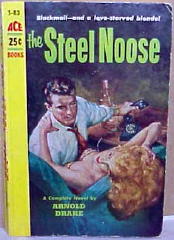
The Steel Noose (Ace, 1954, pbo) [New York City, NY]
You may not be able to read the small print on the cover. It says along the top: “Blackmail – and a love-starved blonde!” The leading character is a hardboiled gossip columnist named Boyd McGee. (That there was only the one novel meant that McGee could never be upgraded to a series character.)
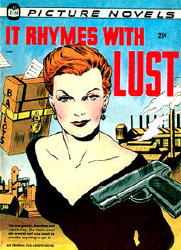
An new addition to Mr. Drake’s entry in CFIV was mentioned earlier. In 1950 Arnold Drake and Leslie Waller teamed up to produce what is generally considered to be the first “graphic novel,” a digest-sized paperback entitled It Rhymes with Lust. The interior black-and-white art was by the highly collected GGA artist, Matt Baker. (For the uninitiated, GGA = Good Girl Art.)
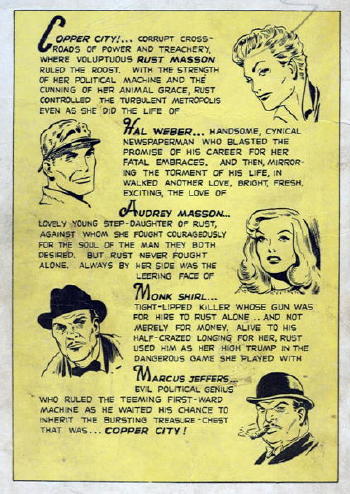
Is It Rhymes with Lust a crime novel? When I found my copy and skimmed through it, I described it to Al Hubin thusly: “The lady on the cover wants to run a copper town (her name is Rust) and she hires thugs and at least one killer (with a machine gun) to keep the miners in line; and there’s graft involved, and the cops.”
Machine guns and graft do not necessarily make a novel a work of crime fiction, of course. In this case they are incidental to the plot, and not the heart of the story itself. The back cover will make this clearer, I believe:
Marginal works like this are already included, but indicated by a dash, and in the Addenda #12 to the Revised Edition of CFIV, that’s how it’s now given:
WALLER, DRAKE Joint pseudonym of Leslie Waller, 1923- , q.v., and Arnold (Jack) Drake, 1924-2007, q.v.
-It Rhymes with Lust. St. John pb, 1950 (Graphic novel.)
It’s a minor footnote in the field of crime fiction, but as was indicated earlier, it made history in the world of comic books as the very first graphic novel. If you check the shelves at your favorite chain bookstore, you will see how large a statement that is.
« Previous Page — Next Page »