Wed 4 Nov 2015
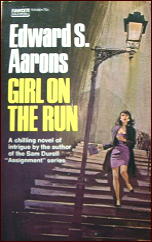
EDWARD S. AARONS – Girl on the Run. Gold Medal #424, paperback original, August 1954. Reprinted several times, including Gold Medal R2142; paperback, 1969.
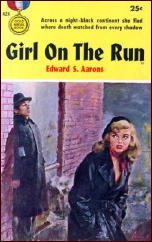
Edward S. Aarons is best known, of course, for his long-running “Assignment†series, featuring the intrepid Cajun CIA operative Sam Durell. The first of these was Assignment to Disaster (Gold Medal, 1955), so Girl on the Run, being published a year earlier, might be considered a dry run for the series, without being a series novel itself, with no other books coming between.
The hero of Girl on the Run, Harry Bannock, is a structural engineer between jobs and at loose ends in France before heading back to the states, does not happen to work for any espionage organization, however. He’s just a guy, who because of a girl, Lorette O’Bae, whom he earlier loved and lost to a friendly rival, finds himself at her service, and soon thereafter, not surprisingly, involved way over his head in non-stop action and nail-biting adventure.
What the bad guys are after – and this includes his not-now-so-friendly former rival – is either (a) an enormously valuable medieval treasure, or (b) a secret, hidden lode of uranium, either of which will have a great influence on France’s political role in the postwar world.
Honed by working in the pulps, one imagines, Aarons’ prose is clear, clipped, crisp and clean. From page 19:
From pages 33-34:
Here’s an action scene, from page 53:
On page 93, he becomes philosophical, the following thoughts going through his mind:
The sun that warms me now also warms Lorette. Somewhere nearby, perhaps within walking distance, she is asleep or just awakening in a bed she thinks is safe; but it isn’t safe, and I want to be with her and guard her and, if she will let me, to love her. And when I am with her again, then this or that earth will make no difference at all because it will be all one and the same. And if anyone tries to stop me from finding her and being with her, no matter who it is, including this thief sitting beside me, then I will send him to join and become part of this soil here. I never wanted to kill anyone and I still don’t want to kill anyone, because it’s an awful thing to take another’s life since there is nothing more important to a man than to continue in the casement of his body that holds his brain and his soul, if he has a soul. When the body is killed and the man is dead, then his identity is gone, and he no longer thinks or feels or observes or enjoys or suffers, and in a small way the earth itself is robbed by his death.
There is much to this story that would also be considered hard-boiled, and I would recommend at least the first 75% of the book to you, including the parts I quoted from. It is also true that the tale seems to get away from Aarons from that point on, out of control and misfiring at precisely the wrong time and the wrong place. He is beat up and left for dead at one point, for example, but he is not dead. With the use of not a single bullet, Bannock lives somehow, he recovers, and he prevails.
We knew he would, but all in all, I think (just maybe) it could have been made a teensy bit more of a challenge for him. Not that Bannock — if you were to ask him, given all that he goes through — would agree!