MEET BOSTON BLACKIE. Columbia, 1941. Chester Morris, Rochelle Hudson, Richard Lane, Charles Wagenheim, Constance Worth. Screenplay: Jay Dratler; based on a character created by Jack Boyle. Director: Robert Florey.

   I was warned by Vince Keenan that in spite of their popularity at the time — there were 14 of these Boston Blackie films with Chester Morris in all — they (um) weren’t very good, or certainly not as good as he’d expected. He taped a few of them last month from TCM, just as I did, only he got around to watching some of them before I did.
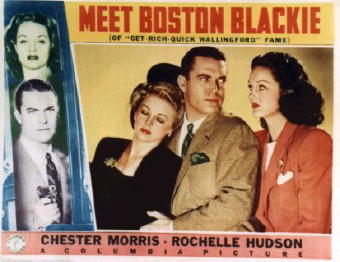
Poster

   This is the first one, as you might have guessed from the title — the series lasting until 1949 — and even before I started watching it, I was convinced that Vince was wrong. And for the first 10 or 15 minutes or so, I was even more convinced. After that, well, I’ll get back to it, but Vince — crossing my fingers where you cannot see them as I say this — I’ll never doubt you again.

   In this movie, it isn’t made clear whether Blackie is a reformed jewel thief or a very tricky one whom the persistent Inspector Faraday (Richard Lane) simply hasn’t been able to catch yet. They are on friendly enough terms, but Faraday has this obsession about finally outwitting his (much) more quick-witted nemesis, and he can’t quite do it.

   A body found in Blackie’s cabin on a ship returning from Europe gets the chase started, and to clear himself, Blackie has to nab a gang of foreign agents hanging around a Coney Island carnival. The black-and-white atmospherics are nicely done, and then done again, until finally overdone. Another location would have been welcome, but it’s not difficult to figure out that a lot of money, time and effort had already been spent on this one.

Morris

   Chased by the aforementioned gang, Blackie commandeers a roadster driven by a dark-haired beauty named Cecelia Bradley (Rochelle Hudson), whose charms Blackie doesn’t seem to recognize as quickly as the audience does — speaking only for myself, of course — but charms nonetheless.

   Running the car up into a freight train to escape doesn’t work as well as planned, but after a desperate automobile chase and dodging a few bullets, the pair finally manage to get away. Miss Bradley, no weak-kneed spinster lady she, discovers that she has had the time of her life, and signs herself up with Blackie to solve the case together. While her company is certainly welcome, in my heart of hearts, I am not entirely persuaded.
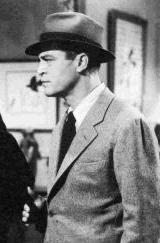
Hudson

   I see that I am on the verge of revealing more of the plot than I should, and I had better watch what I say from here on out, except to say that the story line goes drastically downhill from here.

   The light-hearted approach is a little too light-hearted. The funny lines are tired, worn and generally not very funny, even (I would have thought) for 1941 audiences. The gang of agents couldn’t smuggle their way out of wet paper bags. And for most of their time together, Blackie seems to connect with Miss Bradley on a buddy-buddy basis more than he does on a man-to-woman basis

   On the other hand, Miss Bradley is definitely smitten, but as for the hint at movie’s end that she’d be coming back to appear in Blackie’s next exploit, well, it never happened. Too bad. While I’m sure Blackie will find plenty of women to pair up with through the course of his follow-up adventures, too bad indeed.

   Screenwriter Jay Dratler was later nominated for an Oscar (for the movie Laura) and won a Edgar in 1949 as one of the people responsible for Call Northside 777. He was still in the minor leagues, though, when he was assigned this one to work on.

[UPDATE] 04-17-07. Looking at this blog entry this evening, checking for errors and tweaking the prose a little, neither of which I actually did, it occurred to me that none of the images I’ve posted actually came from this particular movie, not even the one in the poster. The two women in the film never met, not once.

   And as long as I’m doing this update and to remain fair and balanced in my presentation, why don’t I give equal time to someone who liked the movie? Leonard Maltin gives it three stars (***) and goes on to say, “… a slick and fast-paced mystery comedy … Franz Planer’s stylish cinematography enhances this solid programmer.”
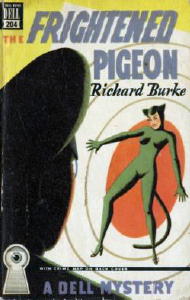
RICHARD BURKE – The Frightened Pigeon

Unicorn Mystery Book Club; hardcover reprint, June 1946. First Edition: G. P. Putnam’s Sons, 1944. Paperback reprint: Dell 204, mapback edition, 1947.

   When Victor Berch, Bill Pronzini and I did our annotated bibliography of the Ziff Davis line of Fingerprint Mysteries , we included a short profile of Richard Burke, which of course you should go read. Many of his books, we said, involved a Broadway private detective named Quinny Hite, but as it happens, this is not one of them. In fact The Frightened Pigeon takes the reader to another part of the world and (one imagines) another kind of mystery altogether.

Pigeon-Front

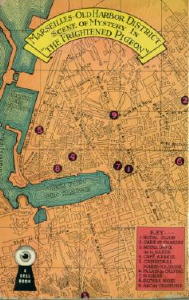
   But first a word on the cover that’s shown, though, before getting down to details. This is, of course, the Dell mapback edition that’s mentioned above, and in case you can’t make out the details, the map on the back below is that of the city of Marseilles, which is where the last eighty percent of the story takes place.

   The setting of the first fifty pages is Paris, 1942, with the Germans solidly in control of the city. An American dancer named Valerie Bright is still there, however — the pigeon of the title –- and very determined to stay non-political. From page 8, of the Unicorn edition:

   Of course after the Axis had decided to include the United States in the war, she had regarded them as enemies, but there wasn’t anything personal about her feeling.

   Her close male friend, Charles John Dillon, nicknamed “Ching,” is working closely with the French underground, however, and events, beginning with a stolen German diary, bound to be embarrassing if it falls into the wrong hands — as, for example, into Ching’s hands — soon make the light-hearted Val realize how dirty — and dangerous — war really is, not knowing what will happen next nor whom your friends really are. By page 40, she is one frightened pigeon indeed, as off to Marseilles they and a small group of displaced others go, hoping to find a way out of France and its closed borders.

Pigeon-Mapback

   The diary appears and disappears with amazing regularity. It is, in fact, amazing, how much mileage an author (Burke) can make of one small important object. Otherwise here is a novel one can learn a large amount from — supposing, that is, that one has never been in a place controlled by Nazi-like enemies one is trying his or her best to avoid — both in term of locale (well-described) and people, especially those like Valerie, whose mind is soon brought down to earth in satisfying (but not very surprising) fashion, but also the large number of others who find themselves caught up in events far beyond their say.

   Don’t get me wrong. This is by no means a major work. It’s no more than ordinary at best, in the overall scheme of things, but what it does have is atmosphere, and plenty of it.

— September 2006

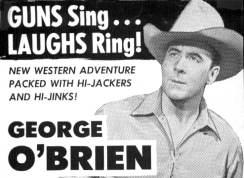
PRAIRIE LAW. RKO Radio Pictures, 1940. George O’Brien, Virginia Vale, Slim Whitaker, Paul Everton, Cy Kendall. Directed by David Howard.

   Generally speaking, I didn’t intend to include reviews of B-western movies here on the M*F blog, but since there’s more than the usual amount of criminous activities going on in this film’s 60 minutes, I decided to break my own rule, and who better?

   A crooked land promoter, Judge Ben Curry (Paul Everton), is taking money from farmers hand over fist, without telling them two things: One, that the former ghost town of Olympia City, where his headquarters are, has no water, and two, that the land he is selling them belongs to cattleman Brill Austin (George O’Brien).

O'Brien

   Yes, in this movie it is the cattlemen who are the good guys and not the usual other way around. Among the settlers is the daughter of one of the farmers, Priscilla Brambull (Virginia Vale) – and no, I didn’t think of that until right now, and no, it’s not that kind of movie. Among other legal misbehavior committed by Judge Curry is his blatant attempt to call for an election without proper notice, stuffing the ballot box, and declaring Olympia City the county seat so that the killer of the sheriff, Brill Austin’s Uncle Jim, can be set free.

   Later on in the movie while a valid trial is being held in Prairie Rose, the jury does double duty: while deliberating on the verdict, they’re also dodging bullets by the judge’s henchmen. All this in sixty minutes, I remind you, which also includes a song sung by the uncredited Ray Whitley and his band.

   There’s nothing here to be taken too seriously, as the players certainly don’t, but other than that, it’s a rather pleasurable experience. As for George O’Brien, a former silent film star who went into non-series westerns like this one when talkies came in, this was close to the end of his steady movie career.

    [Truth in advertising: The photo of O’Brien comes from another film of the same vintage and not this one — but it could have been.]

  Dear Steve,

   Someone sent me your review of my long lost book Dreamboat. I write to say that you are correct that the Flippo series is packed up and put away, and that I remain at the Dallas Morning News as a reporter and editor. You were too kind to Dreamboat, I thought. I wrote it in a tremendous hurry, and never liked it. But thanks, anyway.

   Writing crime novels started out as a hobby, then became a part-time job, then a burden. The books weren’t making enough money for me to quit my newspaper gig, and after number five all the pleasure had drained away. So I stopped writing for a few years.

   About a year ago I started writing again, but once again as a leisure-time activity. The new book is a one-off suspense that bears little resemblance to the previous five. Don’t know if I’ll ever finish it..

   It was a fun ride for a while, but you’re right: it didn’t last long. Long enough, though. I had a good time while it lasted.

Best wishes,

      Doug Swanson


>>   Thanks for writing, Doug, and best wishes in return on getting that new novel finished!    — Steve

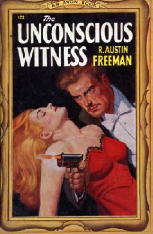
R. AUSTIN FREEMAN – The Jacob Street Mystery.

Hodder & Stoughton, 1942. US title: The Unconscious Witness; Dodd Mead, 1942. US paperback: Avon #122, 1947.

   As Tom Pedley is painting in Gravel Pit Woods, concealed by shrubbery from the casual glance, he observes a woman whose odd behaviour shows she is eavesdropping on a pair of men who have just walked past. One man returns and is furtively followed by the woman, and the intrigued Pedley checks the other end of the path but sees no sign of the second man.

   A week later, the artist, who has no wireless and does not read the papers, learns a murder by forcible administration of poison was committed in the wood during the very time he was painting the sylvan scene, and from a description circulated in print and on the airwaves he is obviously the man being sought for interview by the police.

Witness

   Around this time Pedley makes the acquaintance of brassy Mrs Schiller, a modernist artist separated from her husband and now living next door to Pedley. There is also Mr William Vanderpuye, who meets Mrs Schiller when he visits Pedley’s studio to arrange for a portrait sitting. The pair strike up a close friendship and Mr Vanderpuye is the last person seen with her before her disappearance. For while a dead woman is found locked in Mrs Schiller’s room with the key on the inside, she is not its tenant.

   We now leap forward a couple of years. Mrs Schiller is still missing, and Freeman’s most frequently used detective character Dr Thorndyke and his assistant Dr Jervis become involved in the case due to a large bequest which would be hers if she was still alive. A presumption of death has been requested but the solicitor feels uneasy under the odd circumstances. Is she still living, and if she is, why has she not been found despite sterling efforts by the authorities and a vast amount of publicity in the press? Who was the woman found dead in her room and what is the connection between them?

   My verdict: Readers will learn yet another way to open a door locked from the inside. The method in this case needs a particular type of key, common at the time, so fair enough, and its use helps point up the fact that, despite appearances, the dead woman found in Mrs Schiller’s room was not a suicide.

   There are sufficient and fair clues, and the investigations are described in lively fashion. It turns out to be a more complicated case than it seems at first glance. I guessed part of the solution but not the whole. All in all I found this, the final mystery novel Freeman wrote before his death in 1943, one of the better Thorndyke outings.

            Mary R
http://home.epix.net/~maywrite/


   Etext: http://gutenberg.net.au/ebooks05/0500481.txt


[UPDATE]   Later the same evening, excerpted from an email from Mary, after she’d seen her review online:

  Dear Steve

   It looks very good. The cover is certainly eye-catching!

   I suspect the illustrator’s artistic license had been recently renewed and was operating at its highest level! A pistol shot is mentioned at one point but there is no gunplay of the kind depicted on this cover.

   The woman looks as if she has fainted but it may be a clever bit of word play since we can take it she is intended to represent the dead woman. This is because the latter could be said to have acted as an unconscious (in the sense of unknowing) posthumous witness to her own murder due to certain evidence her remains provide.

   On the other hand, the publisher may have simply got the cover details mixed up…

As ever

      Mary R

   Jill McGown, best known as the author of a series of thirteen British police procedurals starring Chief Inspector Lloyd and Sergeant Judy Hill (later also Chief Inspector, and Lloyd’s wife) died last Friday, April 6th, after a long illness. This according to a statement recently posted on her website.

   She was 59 at the time of her death.

   Also on the website is a lengthy autobiography, where among many photos and details about growing up in Campbeltown, Argyll, Scotland, she says: “Campbeltown is on the Mull of Kintyre, made famous by Paul McCartney and Wings, and I knew the piper who plays the solo on the record, so there!”

   Also of interest, she says in passing: “From junior school, I went to Corby Grammar School, where I was taught Latin by Colin Dexter who went on to write the Morse books, though I didn’t know that when I wrote my first book.”

   Her detective stories bridge the gap between the meticulously plotted stories of the 1930s and 1940s Golden Age of mysteries, and the psychological crime stories of the 1950s, suggests one source. Not only do Ms. McGown’s series characters, Lloyd and Judy Hill solve the most deviously twisted crimes together, but they’re also lovers, their slow-moving romance part of the reason readers kept returning for the next installment.

Shred

   Excerpted from an online interview with Jill McGown:

How do you start your novels – do you have a character, plot, ending or title first?

   I start with a character, almost always. I then rummage in my mental plot drawer for a plot that might fit this character. My ‘plots’, if you can call them that, are minimalist to say the least, so that bit isn’t difficult. With Redemption, for instance, it was simply a joke someone told me.

   The character of the vicar came into my mind one night, complete with a daughter who had an abusive husband. I thought about the vicar and his family for a little while, and then saw how they could fit my ‘joke’ plot.

   The complexity comes as I write, and is dictated by the characters as they are revealed to me. The plot will always give way to the characters, so even I don’t always know how the story will end.

   The title usually emerges during the writing, but sometimes it’s the very last thing I think about. And it often has to be changed.

If someone was going to read one of your novels – which one would you recommend they start with?

   The Lloyd and Hill novels are, of course, each complete in themselves, but there is a continuing story and the characters develop through each novel, so I would recommend starting with A Perfect Match, being the first one.

Match

   This is not, however, essential — the back-story is sketched in each time. That in itself is quite a challenge — finding new ways to explain the set-up to readers requires some ingenuity!


BIBLIOGRAPHY, as expanded from Crime Fiction IV, by Allen J. Hubin:

McGOWN, JILL (1947- 2007); see pseudonym Elizabeth Chaplin.

      Lloyd & Hill titles:

* A Perfect Match (n.) Macmillan 1983
* Redemption (n.) Macmillan 1988 [US title: Murder at the Old Vicarage]
* Death of a Dancer (n.) Macmillan 1989 [US title: Gone to Her Death]
* The Murders of Mrs. Austin and Mrs. Beale (n.) Macmillan 1991
* The Other Woman (n.) Macmillan 1992
* Murder Now and Then (n.) Macmillan 1993
* A Shred of Evidence (n.) Macmillan 1995
* Verdict Unsafe (n.) Macmillan 1997
* Picture of Innocence (n.) Macmillan 1998
* Plots and Errors (n.) Macmillan 1999
* Scene of the Crime (n.) Macmillan 2001
* Births, Deaths and Marriages (n.) Macmillan 2002. [US title: Death in the Family]
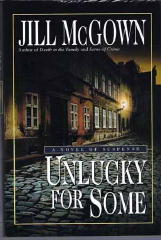
* Unlucky For Some (n.) Macmillan 2004

Unlucky

      Standalones:

* Record of Sin (n.) Macmillan 1985
* An Evil Hour (n.) Macmillan 1986
* The Stalking Horse (n.) Macmillan 1987
* Murder Movie (n.) Macmillan 1990

CHAPLIN, ELIZABETH; pseudonym of Jill McGown

* Hostage to Fortune (n.) Scribner 1992

Cast

   A Shred of Evidence was the basis of a TV movie entitled Lloyd & Hill, starring Michelle Collins as DI Judy Hill, and Philip Glenister as DCI Danny Lloyd. According to Ms McGown, it was for this film that Lloyd gained a first name.

[UPDATE] 04-15-07. For another tribute to Jill McGown, Jeff Pierce has one he posted earlier on The Rap Sheet. It’s excellently done, as usual, and one you should most definitely read.

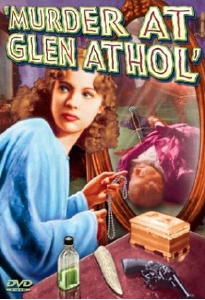
MURDER AT GLEN ATHOL. Invincible/Chesterfield, 1936. John Miljan, Irene Ware, Iris Adrian, Noel Madison, James Burtis. Based on the Doubleday Crime Club novel by Norman Lippincott. Director: Frank R. Stayer.

   The date of the movie as given on the DVD case is 1932, but that’s in error. The book of the same title that the film is based on is 1935, a one-shot detective novel by Norman Lippincott, about whom very little is known. The book itself is scarce, with no copies being offered for sale by anyone on the Internet at the present time.

DVD

   I happen to have a copy myself, but of course it’s inaccessible, along with most of my collection of Crime Club mysteries, shelved away in the far end of the basement, which I do intend to get to one day. Really soon now. So any impression of the mystery that Mr. Lippincott wrote is going to have to come from this filmed version instead, and I must say that I was impressed.

   Within the 64 minutes that it takes to watch this tightly directed detective movie are all of the standard ingredients of the Golden Age mystery yarns of the time: A detective, Bill Holt, on holiday, played rather stiffly by John Miljan; his trusted and slightly comic assistant, Jeff (James Burtis) who looks like an ex-prizefighter; a brash and sexy vamp who lives next door, Muriel Randel (Iris Adrian), who’s not afraid of a little blackmail on the side, even if one of her victims is local gangster Gus Colletti (Noel Madison). See below.

Scene 2

   Visiting next door, where Holt is invited to a dinner party one evening is Jane Maxwell (Irene Ware), who in this movie is merely wholesomely pretty, not beautiful. Holt’s eye lights up as soon as he sees her; Muriel’s overt charms mean nothing in comparison. Jane Maxwell has her own secrets, but no one this wholesomely pretty could be guilty.

   And Muriel is one of three people who are murdered later that same evening. I haven’t mentioned the other two, but suffice it to say that one of them is assumed to have killed both Muriel and the other victim, which suits the local police just fine. They’re wrong, of course, and the job Bill Holt takes upon himself is to prove it, and it isn’t easy, what with all of the red herrings, lies and false trails he’s forced to dodge and make his way down before doubling back.

Scene 1

   Movies like this are often played for laughs as well as for the detective aspects, but thankfully such small hilarities are kept to a minimum. It’s only a guess, but I’d have to say that the movie stuck fairly well to the novel it was based on. Whether that’s so or not, and low budget or not, this is detective movie that’s both worthy of the name and the just over sixty minutes that’s needed to take it all in.

PostScript: Here are the two leading ladies of this film, neither of whom are dressed as they are in this movie, but as if this blog weren’t classy enough, they do add a little something to the overall ambience, don’t they?

Iris Adrian
Iris Adrian


Irene Ware
Irene Ware

   — Continuing our conversation posted not too long ago, I said, “What I found extremely interesting is something that has always been at the back of my brain. With all of the interest in the hero pulps, I’ve always wondered why I found them childish if not boring. Your comments answer the question I must have had and never knew enough to ask. They WERE designed for kids. It’s obvious, but I never really realized that.”


  Hi Steve,

   Another funny thing about my visit that I just remembered: I had an attache case full of Dime Detective and Black Mask pulps to have him autograph but I completely forgot to get his [Morton Wolson’s] signature! I’ve never been much of a collector of signed first editions and this incident proves that I have no interest in autographs. I just want to read the stories.

   Concerning the hero pulps, in 1969 I saw my first large group of hero pulps at Jack Irwin’s house. I had visited him to buy Black Mask, Dime Detective, Detective Fiction Weekly and Weird Tales. I read and looked through a few pages of G-8, Doc Savage, The Shadow, etc. I still remember my puzzled reaction and question to Jack along the lines of: “But why are you reading and collecting children’s magazines?” I found the stories clearly unreadable and silly.

   He defended them along the lines of nostalgia which is OK, but to this day, I do not understand how adults can read these stories. That’s why I often engaged Harry Noble and my wife’s father in long conversations about the pulps that they and their friends read back in the 1930’s and 1940’s. I was curious as to pulps the adult working man really read. Because to read some of these recent articles, you would think that a lot of men read these poorly written, silly hero pulps. I guess some did read them, but according to my verbal research, the main readership of the hero pulps was definitely teenage boys.

   The teenage girls made the love pulps the biggest seller of all. If you really want to turn your brain into mush, try reading a love pulp. Talk about formula fiction! I read a few issues, and I still have not recovered from the experience. Every story had the same plot with a happy ending of course because that’s what the girls wanted in their romance fiction back in the 20’s, 30’s and 40’s. Boy meets girl, girl and boy have some troubles, things look bad for the romance, boy and girl resolve their problems, and live happily ever after.

   I only know of one collector that seriously collects the love pulps and I have to withhold his name to protect the innocent plus it would ruin his life and reputation if the news ever got out.

Best,

   Walker

AN OLD FRIEND HAS LEFT US
By Iwan Morelius

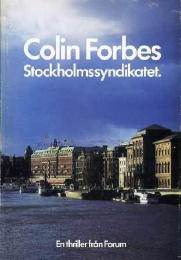
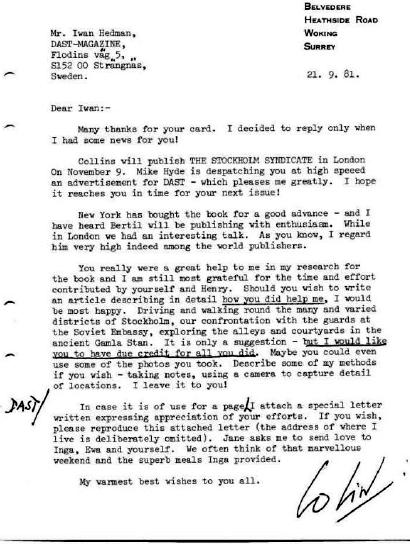
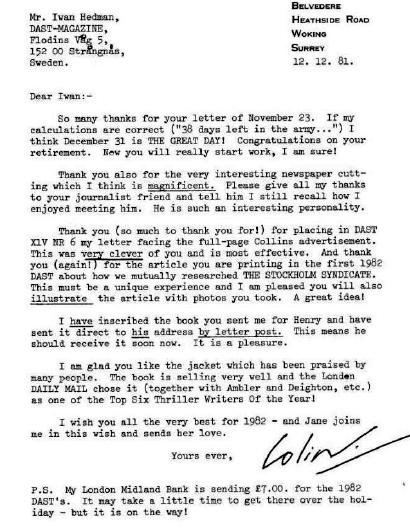
   As long back as I started to collect books I had as a habit to write to those authors I liked very much. After a while they were many of them and among the earlier ones was Colin Forbes , well known thriller writer from England. The first thriller by him was in fact Avalanche Express, which turned out to be a smashing movie some years later.

   Colin was kind enough to answer my letters and we were pen friends for many years before he wrote me a letter telling me he was going to visit Sweden ( Stockholm) in order to make research for his next thriller. Wow, how exciting! Hopefully I should meet him in person. Of course! Colin asked me if I wanted to help him with his research. To that it was only one answer – YES!

Cover

   Colin and his wife, Jane, should come for one week in June 1978 and we met the first day he was in Stockholm at his Swedish Publisher’s office. The Publisher invited us for a lunch and there were Colin, Jane and the publisher Bertil Käll and me, a captain in the Swedish Army. We had a nice – and very good tasting – typical Swedish lunch together and during it Colin informed me what he wanted for the research.

   The next morning I met Colin outside his hotel, Grand Hotel, in Stockholm and we started to have a typical Swedish breakfast. Then we started by car to my hometown Strängnäs, situated 70 km west of Stockholm. During the drive Colin gave me more details about the book and what help he wanted from me. First of all he wanted two things:

1.    First an exciting place where his hero should be involved in a fight and nearly killed
2.    The second thing he wanted to see was a typical Swedish forest with giant trees. He had heard we had trees being as high as 30 meters.

   I suggested a place, which I had visited many times and found very, very exciting. It was situated in the middle of a forest and had once been used for mining. Still there were many deep (I mean really deep) holes and the fence was gone many years ago. Some people used the holes to put their old cars in). Colin inspected the place carefully and he was very satisfied with the place I had chosen.

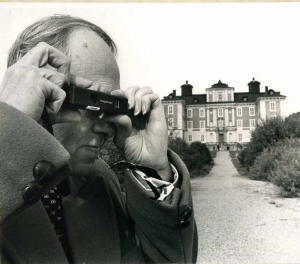
Castle
               Outside the Mälsåker’s Castle.


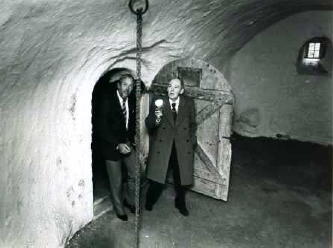
Castle2
            Colin and I deep in the cellar vaults.

   On our way to my home we took a little extra driving and found a place with the kind of trees he wanted (so far I didn’t know why he wanted to find them). Colin was very satisfied with his first day on his research. We drove to my home and had some tea and Colin inspected my library and he was especially satisfied with my collection of signed books by so many famous authors. At that time I had around 15,000 mystery books (Mystery/Thrillers and Science Fiction plus non-fiction in the genre).

   We offered Colin and Jane to stay over night but they refused. Colin wanted to work on his book and wanted to be in his hotel then, which I respected of course. So I drove them back to Stockholm and their hotel.

   Before I left Colin asked me if I knew someone who knew Stockholm on his five fingers, as we say in Sweden. Of course I did and I phoned my old friend Henry Augustsson, a goldsmith in Stockholm, who was more than happy to be of help. He was also a keen book collector.

   Next day we were outside the hotel very early and our first goal was the Russian Embassy, situated in the middle of Stockholm. I parked my car (a Volvo Station wagon) outside the Embassy and took out a big (large?) map and put it on the car. It took only two minutes and a special guard, not from the Embassy, but from a Swedish guard company who have guards outside every embassy in Stockholm. The guard told us to leave at once but we told him we would not.

Embassy
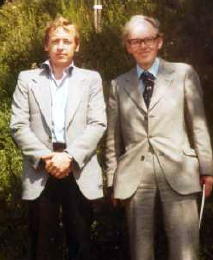
Henry and Colin outside the embassy.

   This is a common place where everyone who wanted it could stay or park his car. So we continued to study our map over Stockholm and make some notes and drawings when the guard disappeared. Henry, who knew what he was doing, told us he phoned the Swedish police. Before the police arrived we took our photos and waved goodbye to the guard – the “Dummy”, we called him.

   Our next stop was Djurgården (Animal garden, roughly translated), one of the most beautiful places in Stockholm with water, open places, parks and paths for walking etc. Colin wanted to find a luxury yacht for his book. And that was very easy to find here where the rich people in Stockholm had their yachts and big motorboats.

   Next stop was Kaknäs tower, a tower from where you could view the whole of Stockholm. I think it is around 60 meters height and on top there is a restaurant. Colin invited Henry and me for lunch. From the top we could see the Värta Harbour, from where the ferries to Finland go and were also most of the oils are placed. Colin asked Henry if it was possible for a big Russian fright boat to anchor there. The answer to that was YES and Colin was satisfied again.

   Next goal was Stockholm’s The Old Town (Gamla Stan) where he could look at all those very old houses, walk in the narrow streets and also have a look inside the yards of the houses. We talked to some people who lived there and they showed Colin the use of the key locks (the coded ones). He liked that and told us it should be in the book.

   Colin was very satisfied with his day and asked us if we would like to join him and Jane for dinner at Grand Hotel’s French Veranda (a glassed veranda), from where we could have a nice look over The Strömen (the water between Grand and the Royal Castle). Another YES, of course!

   This was Colin’s first visit to Stockholm, but not his last and later on I was to be invited to their home in England (Woking, Surrey).

Letter

Letter2

BIBLIOGRAPHY: Expanded from Crime Fiction IV, by Allen J. Hubin:

FORBES, COLIN
; pseudonym of Raymond H. Sawkins, (1923-2006); other pseudonyms Jay Bernard & Richard Raine (books)

* -The Heights of Zervos (n.) Collins 1970 [Greece; 1941]
* The Palermo Ambush (n.) Collins 1972
* Target Five (n.) Collins 1973 [Arctic]
* Year of the Golden Ape (n.) Collins 1974 [San Francisco, CA; 1977]
* The Stone Leopard (n.) Collins 1975 [France]
* Avalanche Express (n.) Collins 1977 [Train]
* The Stockholm Syndicate (n.) Collins 1981
* Double Jeopardy (n.) Collins 1982 [Tweed; Vienna]
* The Leader and the Damned (n.) Collins 1983 [Germany; WWII]
* Terminal (n.) Collins 1984 [Tweed; Switzerland]
* Cover Story (n.) Collins 1985 [Tweed; Scandinavia]
* The Janus Man (n.) Collins 1987 [Tweed]
* Deadlock (n.) Collins 1988 [Tweed]
* The Greek Key (n.) Collins 1989 [Tweed; Greece]
* Shockwave (n.) Pan 1990 [Tweed]
* Whirlpool (n.) Pan 1991 [Tweed]
* Cross of Fire (n.) Pan 1992 [Tweed]
* By Stealth (n.) Pan 1993 [Tweed]
* The Power (n.) Pan 1994 [Tweed]
* Fury (n.) Macmillan 1995 [Tweed]
* The Precipice (n.) Macmillan 1996 [Tweed]
* The Cauldron (n.) Macmillan 1997 [Tweed]
* The Sisterhood (n.) Macmillan 1998 [Tweed]
* Sinister Tide (n.) Macmillan 1999 [Tweed]
* This United State (n.) Macmillan 1999 [Tweed]
* Rhinoceros (n.) Simon & Schuster, 2001 [Tweed]
* The Vorpal Blade (n.) Simon & Schuster, 2002 [Tweed]
* The Cell (n.) Simon & Schuster, 2002 [Tweed]
* No Mercy (n.) Simon & Schuster, 2003 [Tweed]
* Blood Storm (n.) Simon & Schuster, 2004 [Tweed]
* The Main Chance (n.) Simon & Schuster, 2005 [Tweed]
* The Savage Gorge (n.) Simon & Schuster, 2006 [Tweed] Published posthumously.

Note: Tweed is Deputy Director of the SIS, the British Secret Intelligence Service.

SAWKINS, RAYMOND H(arold); see pseudonyms Jay Bernard, Colin Forbes & Richard Raine.

* Snow on High Ground (n.) Heinemann 1966 [Supt. John Snow; England]
* Snow in Paradise (n.) Heinemann 1967 [Supt. John Snow; Italy]
* Snow Along the Border (n.) Heinemann 1968 [Supt. John Snow; England]

BERNARD, JAY; pseudonym of Raymond H. Sawkins; other pseudonyms Colin Forbes & Richard Raine

* The Burning Fuse (n.) Harcourt, US, 1970 [Germany]

RAINE, RICHARD; pseudonym of Raymond H. Sawkins; other pseudonyms Jay Bernard & Colin Forbes

* A Wreath for America (n.) Heinemann 1967 [David Martini; England]
* Night of the Hawk (n.) Heinemann 1968 [David Martini; England]
* Bombshell (n.) Dent 1970 [David Martini; Switzerland]

   Kurt Vonnegut died yesterday at the age of 84. In many ways, he was the Mark Twain of our time, and there are many other websites which will discuss his life, his writings, and his awards and accolades. What follows in this blog entry will be less an obituary, however, than a personal note or two about the author, no more or no less.

   Back in the mid-1960s, I responded to a poll in a science fiction fanzine which wished to know my Top Ten SF novels. I remember only my top two choices, Number One on my list being The Man in the High Castle by Philip K. Dick, which won the 1963 Hugo award for Best Novel of the Year.

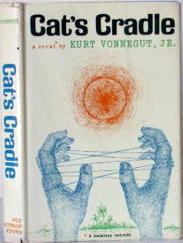
Cradle

   Number Two was Cat’s Cradle, by Kurt Vonnegut, Jr. Thinking about the book as soon as I heard the news last evening about Mr. Vonnegut’s death, I realized that besides being about the mysterious substance “ice-nine,” a dangerous alternative form of water, I no longer remember very much else about the book. I probably do not remember the details of very many other books I read 40 to 45 years ago, but no matter; this realization is jarring, and it means that I shall have to do something about that.

   From the Wikipedia page for Mr. Vonnegut, I have excerpted the following passage:

   In Chapter 18 of his book Palm Sunday “The Sexual Revolution,” Vonnegut grades his own works. He states that the grades “do not place me in literary history” and that he is comparing “myself with myself.” The grades are as follows:

* Player Piano: B
* The Sirens of Titan: A
* Mother Night: A
* Cat’s Cradle: A-plus
* God Bless You, Mr. Rosewater: A
* Slaughterhouse-Five: A-plus
* Welcome to the Monkey House: B-minus
* Happy Birthday, Wanda June: D
* Breakfast of Champions: C
* Slapstick: D
* Jailbird: A
* Palm Sunday: C

   That the author gave himself an “A plus” for Cat’s Cradle reassures me somewhat, that as a critic at the young age I was at the time, my judgment on a book’s worth was not entirely lacking.

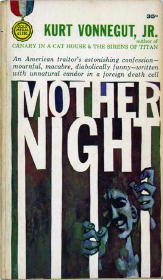
   Very soon after writing Cat’s Cradle, Mr. Vonnegut declared himself not a science fiction writer, as I recall, nor (I suspect) did he ever consider himself to be a crime fiction writer. But one of his books, Mother Night (Gold Medal s1191, paperback original, 1962) is included in Crime Fiction IV, by Allen J. Hubin.

Mother Night

   I have to confess that I’ve never read the book, and my records reveal that I do not even own a copy. Nor do I remember the movie made from it, a 1996 film starring Nick Nolte, Sheryl Lee and Alan Arkin. It seems to have come and gone having made impression on me whatsoever. Whether this was due to a limited release to a diminishing number of “art” theaters in the country, or my own lack of attention, I do not know, but once again, here is a situation that I see needs remedying.

   I’ve tried to understand the detailed synopsis of Mother Night which I found on Wikipedia, but perhaps Mr. Vonnegut’s are too complex to be summarized in a short detailed synopsis. Either you write a book about one of his books, or you try not at all. Or maybe you resort to only one line – this one, perhaps, from the IMDB page for the movie:

   “An American spy behind the lines during WWII serves as a Nazi propagandist, a role he cannot escape in his future life as he can never reveal his real role in the war.”

   One thing I’m sure of, or maybe it’s two. Mother Night was certainly not a typical Gold Medal book, nor was Kurt Vonnegut, Jr., a typical American author.

« Previous PageNext Page »