A day or so after Bill Pronzini’s short article on Elliott Chaze appeared on this blog, Ed Gorman posted the following over on his site. It is reprinted here with his permission:


   Chaze is known in pulp circles for his flawless novel Black Wings Has My Angel, which many people feel is the single best novel Gold Medal published during its heyday. As Bill details, Chaze also wrote several other novels, a few of which are also fine books.

   As I was reading the Chaze piece last night, I started remembering the two or thre phone calls I had with him. At that time the original Black Lizard Publishing Company seemed to be flourishing. Both Barry Gifford, the line’s editor, and I wanted to get Angel back into print. I agreed that I’d try and track Chaze down. Took a while but I finally got a phone number.

   He seemed almost amused that anybody remembered Angel with such respect and interest. He talked first about a few of his other books. My interpretation – and I may be wrong here – is that he felt hardbacks published by major houses should be of more interest than a paperback original.

   But as we talked, I kept bringing up scenes from Angel. And finally he began speaking enthusiastically about it. That is, until I told him what we could pay him for it. He then went into a low key but bitter story about how “New York” screwed writers at every turn. They didn’t pay much, they didn’t promote, they cheated you on royalties. While these were all standard writer complaints, he delivered them with singular ferocity.

   He assured me several times that he liked me, that he just might have to look up one of my books, that he’d appreciate seeing some Black Lizard novels to look over. He obviously didn’t want to end on a bitter note. He even invited me to call him again, which I did. The next call we mostly talked books and movies we liked. And toward the end about his career as a journalist in the South during the most turbulent decades since the Civil War.

   He was a bright, gifted man. We never did reprint Angel because the line was sold suddenly. But I sure wish we had. I can see it with one of those great Kerwan covers on that shiny stock the Lizards used. Chaze would have been right at home with the other hardboiled greats, Fredric Brown, Peter Rabe, Jim Thompson, Charles Willeford and many others – Barry had developed, for my taste, the best reprint line of American hardboiled fiction ever offered anywhere.

>>  Bill Pronzini’s reply:   I envy Ed’s contact with Chaze, who was clearly a writer after my own heart. I’d have enjoyed knowing him, I’m sure. His experiences with and feelings toward publishers and publishing pretty much mirror mine.

   Before breaking up part of it a few years ago, Walker Martin had one of the largest collections of pulp magazines in the world. It’s still large, and he’s in the process of building some of it back up again. Two of his favorite pulp magazines have always been Black Mask and Dime Detective. After he commented on my recent review of the Charlie Chan movie, The Scarlet Clue, I asked him if he’d seen the blog entries on Morton Wolson, aka Peter Paige:


  Hi Steve –

   Yes I read the Morton Wolson post but somehow missed the letter from his son. I think I mentioned to you a couple years ago how I had tracked Morton Wolson down and visited him in his furniture store in Manhattan.

   It was in the 1980’s and my wife was with me. We spent a couple hours talking about his pulp career, Ken White, who was the editor of Dime Detective, and Joe Shaw. I got the impression he was the owner of the store, which was quite large but empty of any customers while I was there.

   Wolson was amazed that anyone was interested in talking about the pulp days. He said he was paid quite well for the Peter Paige novelettes, most of which starred Cash Wale and his sidekick Sailor Duffy. He received around $500 per novelette which in the 1940’s was a big sum of money. His agent was Joe Shaw (which he referred to as Cap Shaw) and when the pulps died off in the early 50’s, an attempt was made to break into the paperback market but nothing came of it.

   He remembered all the Dime Detective and Black Mask authors and had nothing but good things to say about his pulp days. When nothing came of his attempts to write mainstream literature, he somehow got into the furniture business and was successful.

   I asked him about the other pulps that Popular Publications published but he said he had no interest in them because except for Black Mask, Dime Detective, Detective Tales, New Detective, Adventure, the other pulp titles were slanted for the teenage boy market. Adults did not really read the hero pulps like Spider, G-8, Operator 5, etc.

   This is an interesting comment that I have heard from other old timers that actually bought the pulps off the newsstand. Harry Noble, who I was friends with for almost 40 years, used to laugh to see the adult collectors of today making such a fuss over The Shadow, Doc Savage, etc. When these hero pulps were on the newstands, the main audience was kids, teenagers, mainly boys. The girls were interested in the love pulps.

   My wife’s father who died recently at age 93, often told me that he and the other blue collar working men bought the adult pulps like Blue Book, Adventure, Black Mask, Western Story, etc. It never crossed his mind to save the issues. They were read to pass the time and then thrown away.

   Anyway these were the things that Morton Wolson talked about. We kept in touch for a while, and then I guess he retired and eventually I mislaid his new address. One funny thing, a year or so later I came across some cancelled checks from the files of Popular Publications. I still have some showing payment of several hundred dollars to Morton Wolson for the Peter Paige novelettes. I sent Morton some copies of these checks and he was astonished to see such things still in existence.

   I’m sorry to learn he is no longer with us. I always enjoyed the Cash Wale stories.

SUED FOR LIBEL. RKO Radio Pictures, 1939. Kent Taylor, Linda Hayes, Lilian Bond, Morgan Conway, Richard Lane. Based on a story by Wolfe Kaufman. Director: Leslie Goodwins.

   I don’t know about you, but while watching the cast credits go by at the beginning of this movie, Kent Taylor was the only one I recognized right away. Morgan Conway I knew played Dick Tracy in a couple of films later on, but the others, including the two ladies, were only names to me, and more about them later.

   But whenever the star appeal is as low as this, as it was to me, I start thinking “low budget.” And on occasion, starting with low expectations is not all that bad, as this rather generic detective film met or surpassed those low expectations, and then some. Not by a mile, I grant you, but at least by a hair. It’s built around a radio program put on by a newspaper to dramatize the day’s events live. Being an Old Time Radio fan myself, that was a plus right there.

   Thanks to a practical joke one reporter (Linda Hayes) plays on another (Richard Lane), the program directed by a third (Kent Taylor) gets the jury’s verdict in a murder case backwards, “guilty” instead of “innocent.”

   Hence the title of the movie. To win the resulting lawsuit, it is up to the threesome above to solve the murder themselves, and with degrees of trepidation and humor, they do. Morgan Conway is the accused murderer, and Lilian Bond is the wife of the murdered man who’s also a close friend of the defendant. Maybe you could write your own scenario from this.

Bond

Lilian Bond

   Wolfe Kaufman, who did write the story, which holds water only as long as you don’t watch too closely, has one title listed in Al Hubin’s Crime Fiction IV: an Inner Sanctum Mystery entitled I Hate Blondes, published by Simon & Schuster in 1946. Kent Taylor, an actor in the Clark Gable vein, but nowhere near as successful, later played Boston Blackie on TV, and Clark Gable didn’t.

   Lilian Bond plays her role in the courtroom strictly on the straight and narrow, but later on when the hairpins start flying, she becomes quite a looker, even though her career never went anywhere. I think it should have. That’s her photo up above, but (truth in advertising) she never looked like that in this film, no matter what I just said.

Hayes

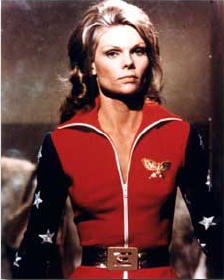
   As for Linda Hayes, the snappy gal reporter lady, her career lasted only for 17 movies, all filmed between 1939 and 1942. She may be more famous as the mother of Cathy Lee Crosby, who later briefly played the super-powered crimefighter Wonder Woman on television. Perhaps you can see the resemblance.

Crosby

   In the course of our conversations via email about Donald Hamilton’s death today, Charles Ardai, publisher of the Hard Case line of hardboiled paperbacks, confirmed that “a final, unpublished Matt Helm book exists but that Don’s son isn’t ready to publish it yet.”

   There was more that was said about the book, but at the moment this is all I’m at liberty to pass along. Personally, this is good news, but it certainly would be better, if not great news if there were any indications that it would be published soon. Which, on the other hand, you should not take as implying that it won’t be.

   I refrained from posting this yesterday, in case it would be considered a particularly cruel April Fool’s joke if we were wrong. I also waited until we had obtained as much information as we could about what we have discovered, we being Al Hubin, Marv Lachman, Victor Berch and myself.

   First came an email from Al:

   Although I don’t recall any word about Donald Hamilton’s passing, it certainly appears that he has. Contemporary Authors gives his birth date as 3/24/1916, and there’s a Donald B. Hamilton in the Social Security death benefit records with this birth date who died 11/20/2006 in Ipswich, MA.

   From Marv Lachman:

   I think I can confirm that it was THE Donald (Bengtsson) Hamilton who died. He formerly lived in Santa Fe and was listed in our phone book as Donald B. Hamilton, though no street address was given. I checked our phone book today and there is [only] a Donald R. Hamilton, with a street address. I then spoke to someone at the library who knew him, and she says that he moved “back east.” That would account for his death in Ipswich, Mass.

   From Victor Berch:

   There was no obituary for Donald Hamilton in the Boston papers. There was even no death notice. This can happen since someone has to pay in order for a death notice to be inserted in the newspapers. If Hamilton was in a nursing home at the time or a hospital, neither institution would pay for such a notice.
   At any rate, I did find some information about Donald Hamilton. He was born in Upsala, Sweden. Came to the US aboard the SS Droltingholm on the 6th of October in 1924. He was the son of Bengt and Elise Hamilton. His father was a doctor and at that particular time was associated with the Childrens’ Hospital in Boston. He was also a professor at Harvard (probably Harvard Medical School). By 1930, the family had moved to Baltimore, MD.
   That’s about all I could dig up on his early years.

   From Al Hubin:

   I think it must be “our” Donald Hamilton, though it is surprising his passing went unnoticed for so long.

   So here is where we stand. You now know as much as we do. Obviously there are many questions as yet unanswered. Victor also suggested getting the death certificate of the Donald Hamilton who died, but at this point in time we have not done so.

   For a long retrospective look by John Fraser into the mystery and espionage fiction of Donald B. Hamilton, best known as the creator of secret agent Matt Helm, go to https://mysteryfile.com/Hamilton/Hamilton.html.

   Highly recommended also is a followup piece that Doug Bassett did for Mystery*File, a nicely done in-depth comparison of Matt Helm with Travis McGee, the colorful series character created by John D. MacDonald.

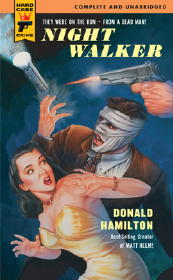
Night Walker
      Cover art by Tim Gabor.

[UPDATE] Early this afternoon Charles Ardai confirmed the death of Donald Hamilton. Charles is the man behind Hard Case Crime, who reprinted Hamilton’s Night Walker in January 2006. […] Charles has now left a comment to this effect. In a separate email to me he added, “We are very proud to have worked with Don and to have published one of his books. He was one of the giants, and he’ll be missed.”

GILLIAN LINSCOTT – Widow’s Peak

Warner Futura, UK, pb. Hardcover editions: Little Brown, UK, 1994; St. Martin’s Press, US, 1995, as An Easy Day for a Lady.

   Over her career Gillian Linscott’s sizable list of mystery fiction has featured two different series characters. Nell Bray, who is in this one, first appeared in print in Sister Beneath the Sheet, which was published in 1991. Timewise, that book took place in 1909, or very early on in her life as a militant London-based suffragette. Her adventures have appeared more or less chronologically ever since, except for the last two, at least one of which has jumped back in time to her earlier, more formative years.

   In Linscott’s first four books, the detective of record was Birdie Linnet, a divorced former policeman trying to maintain contact with his daughter. Not having read any of them, I know little more than that. Nor I have come across any reason why Linscott abandoned him as a character, though the most likely one, of course, is that it happened at the publisher’s wishes, not hers. There are also three non-series books in her bibliography, which I’ve expanded below from the one found in Allen J. Hubin’s Crime Fiction IV:

      British editions only:

# A Healthy Body (n.) Macmillan 1984 [Birdie Linnet; France]
# Murder Makes Tracks (n.) Macmillan 1985 [Birdie Linnet; Italy]
# Knightfall (n.) Macmillan 1986 [Birdie Linnet; England]
# A Whiff of Sulphur (n.) Macmillan 1987 [Birdie Linnet; Caribbean]
# Unknown Hand (n.) Macmillan 1988 [Oxford]
# Murder, I Presume (n.) Macmillan 1990 [London; 1874]
# Sister Beneath the Sheet (n.) Scribner 1991 [Nell Bray; France; 1909]
# Hanging on the Wire (n.) Scribner 1992 [Nell Bray; Wales; Hospital; 1917]
# Stage Fright (n.) Little 1993 [Nell Bray; London; 1909]
# Widow’s Peak (n.) Little 1994 [Nell Bray; France; 1910]
# Crown Witness (n.) Little 1995 [Nell Bray; London; 1910]
# Dead Man’s Music (n.) Little 1996 [Nell Bray; England; 1910 ca.]
# Dance on Blood (n.) Virago 1998 [Nell Bray; London; 1912]
# Absent Friends (n.) Virago 1999 [Nell Bray; England; 1918]
# The Perfect Daughter (n.) Virago 2000 [Nell Bray; England; 1914]
# Dead Man Riding (n.) Virago 2002 [Nell Bray; England; 1900]
# The Garden (n.) Allison & Busby 2003
# Blood on the Wood (n.) Virago 2003 [Nell Bray; England; early 20th century]

   Many of these have been published in the US by St. Martin’s, so Linscott is far from an unknown author on this side of the Atlantic. On the other hand, none of them have been published over here in a mass market paperback edition, so I could easily be wrong about how recognizable her byline might really be.

   There are several websites devoted to her and her fiction, but none of them seems to answer the question whether or not she is still writing. If you know more, you might pass the word along to me.

   The primary factor in knowing Nell Bray as a character is her passionate devotion to the Right of Women to Vote, ironically making the one book of hers that I have happened to read, Widow’s Peak, perhaps the least typical in the series. Nell is on vacation in France from her brick-throwing proclivities in this one – in Chamonix, to be exact, at the foot of Mont Blanc, where very early on in the book a dead man is found in the ice, having known to have been killed in an “accident” which occurred thirty years earlier. The only early feminist items on the agenda are subtle, and they appear only in context, but (strangely enough) they manage to be all the more noticeable when they do.
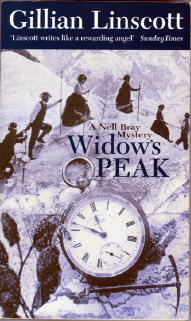
Peak

   You will, of course, have noticed that I placed the word “accident” in quotes. Any self-respecting mystery reader will know immediately that there no accident is involved, and there never had been. Nell, who is also a skilled translator by profession, is hired by the dead man’s brother and his family to help facilitate their taking the dead man’s body back to England. This gives her an immediate, insider’s view of their various activities – which I’ve deliberately phrased this way, since for a good portion of the book, there is no investigation into a murder, per se.

   But the dead man’s journal, found in the ice near his body, contains several entries with sobering implications, and soon enough Nell finds herself in the thick of things, as seems to be the usual case for her. As a historical novel, Widow’s Peak is quite delightful, picturing as it does the Bohemian way of life in the village in some detail, not to mention (if you take a good look at the cover) sharp images of pre-war hiking expeditions up the mountain. Both men and women were in these co-educational parties, as if they were on larks of some magnitude, which indeed they were.

   While keeping me up far past my bedtime, the detective story unfortunately concludes in more post-Victorian melodrama than I’d have preferred. The twists and turns of the plot along the way, however – some foreseeable, others thankfully not – certainly made up for it in spades (and ropes and axes and all other shapes and forms of primitive mountaineering equipment).

— January 2007


PostScript: For an excellent overview of other mysteries taking place in the days of women’s rights movements, check out this recent post in Elizabeth Foxwell’s blog, The Bunburyist.


      Excerpted from his Wikipedia entry:

    “R(ichard) Austin Freeman (April 11, 1862 – September 28, 1943) was a British writer of detective stories, mostly featuring the medico-legal forensic investigator Dr Thorndyke. He invented the inverted detective story, in which the identity of the criminal is shown from the beginning: some of these were collected in The Singing Bone in 1912.

    “[Using] some of his early experiences as a colonial surgeon in his novels … a large proportion of the Dr Thorndyke stories involve genuine, but often quite arcane, points of scientific knowledge, from areas such as tropical medicine, metallurgy and toxicology.”


R. AUSTIN FREEMAN – Mr Polton Explains

Hodder & Stoughton, UK, 1940. Dodd Mead, US, 1940. Popular Library #70, pb, 1946.

   We’ve probably all played “what if,” going further and further back in our lives to establish the chain of circumstances which led to playing the very game itself, and in this case to your reading this review.

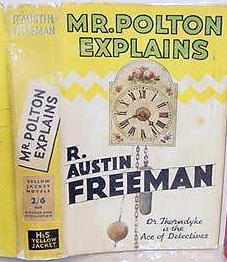
Polton-UK

   Mr Polton Speaks, written in two parts, begins in this fashion. Nathaniel Polton, orphaned as a toddler, relates the various stages of his somewhat Dickensian life up to his making Dr Thorndyke’s acquaintance, the circumstances of which explain his devotion to the good doctor. He also tells how he learnt certain skills, some of which will be very useful to his employer when he becomes servant/assistant to Dr Thorndyke.

   Much detail is given about Mr Polton’s interest in a particular profession and a specific invention of his which, years later, provides a vital clue to unraveling a mysterious death, the circumstances of which form the second part of the book, narrated by Dr Jervis. To my surprise Mr Polton actually states which particular knowledge contributed to the solution of the crime, though this revelation was not really needed because between autobiographical comments and the description of the scene of the crime it is obvious how the murder was accomplished, if not the person responsible.

   In brief, a fire completely guts a house where Mr Haire has taken rooms. Fortunately for him, he was in Ireland at the time, but unfortunately his cousin, Cecil Moxdale, was staying in the flat. The building is completely burnt out and the body is found more or less charred out of recognition although items found in the debris establish its identity.

   And yet … certain aspects of the death suggest it was not accidental or even suicide and so Thorndyke and Jervis become involved. Although the resolution hinges on a whacking great coincidence which stretches the long arm of coincidence so much it’s amazing it didn’t fall off, on rereading Mr Polton’s section I found circumstances described there (in a more subtle manner than the statement mentioned above) do in fact provide a fair clue or two to the alert reader.

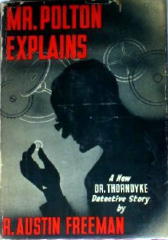
Polton-US

   My verdict:  Alas, this is the most disappointing of this author’s works read so far. In fact, it gives the distinct impression Mr Polton’s autobiography was grafted onto a short story to form a novel. The necessary information could, I believe, have been provided within the section penned by Dr Jervis easily enough and in a far less obvious manner. Shocking to relate, I found Mr Polton’s life story more interesting than the mystery and its resolution, though the latter did have an unexpected twist.

            Mary R
http://home.epix.net/~maywrite/


   E-text link: http://gutenberg.net.au/ebooks05/0500371.txt

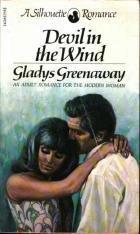
   Every one of author Gladys Greenaway’s 11 books listed in CFIV are indicated as having marginal crime content.

GREENAWAY, GLADYS (1901- )
   * -Shadows in the Sand (n.) Hurst 1958
   * -View of the Mountain (n.) Hurst 1959
   * -Follow a Shadow (n.) Hale 1961
   * -Spring Came Late (n.) Hale 1961
   * -Week of Suspense (n.) Hurst 1962
   * -No Looking Back (n.) Hurst 1963
   * -Sing Softly, Stranger (n.) Hurst 1963
   * -The Affair at Little Todsham (n.) Hurst 1964 [England]
   ** -Devil in the Wind (n.) Hurst 1966
   * -Follow My Leader (n.) Hurst 1966
   ** -Feather Your Nest (n.) Hurst 1967

Greenaway

   Those with double asterisks were reprinted in the US by Ace in paperback form, suggesting that they were published as “gothics” at a time when gothics ruled the paperback book business. Gladys Greenaway has a number of other titles to her credit, continuing on to 1982, if not longer. Presumably these are straight romances, with no criminal content to speak of.

   It was John Herrington again who has confirmed her year of death as 1991. Other than her books being offered for sale on the Internet, a Google search brings up no additional information about her.

[UPDATE] 03-31-07. To demonstrate that research into the writing careers of mystery authors never ends, John Herrington has pointed out that Gladys Greenaway’s middle name and initial are “Ivy M.”

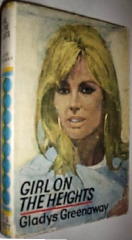
   Also, while looking for copies of her books online, or other information about her, I discovered that Girl on the Heights, a title not listed above, was described by one bookseller as a “Inspector Henry Mason novel.” Even with only this one line, it was immediately obvious that this is a book that should be included.

Height

   I sent the information on to Al Hubin, and he immediately agreed. Not only that, well, read his reply:

  Steve,

   You’re right, and I can’t discount most of her other novels either. They may be straight romances (at least one of them is), but I guess these additions/changes should be made to her entry in the CFIV Addenda #8:

-Cousin Alison. Hurst, 1969
-Girl on a Ladder. Hurst, 1972
Girl on the Heights. Hurst, 1968
-The Late Summer of Christine Hargreave. Hurst, 1970
-My Mother’s Daughter. Hale, 1983
-No Looking Back. Correct publication date to: 1960
-The Past Is the Prelude. Hurst, 1971
-The Small Circle. Hale, 1979
-Trial Run. Hale, 1982
-View of the Mountains. (title correction)
-Where the Wind Whistles. Hurst, 1964

   And I wonder about her novels as Julia Manners, but I can’t find any definite information.

Best,

   Al

   The hunt for new facts and data never ends!

   It was John Herrington who came up with some data on Andrew Spiller, a prolific British author essentially unknown in the US. Not one of his books was ever published in this country. To demonstrate what I meant by “prolific,” here’s his complete bibliography, thanks to CFIV:

SPILLER, ANDREW
   * If Murder Interferes with Business (n.) Archer 1945 [England]
   * Rope for Breakfast (n.) Archer 1945 [England]
   * Whom Nobody Owns (n.) Archer 1945 [England]
   * Queue Up to Listen (n.) Archer 1946 [Det. Insp. Arthur “Duck” Mallard; England]
   * Crooked Highway (n.) Archer 1947 [Det. Insp. Arthur “Duck” Mallard; England]
   * What’s in a Name? (n.) Archer 1947 [Det. Insp. Arthur “Duck” Mallard; England]
   * When Crook Meets Crook (n.) Archer 1947 [Det. Insp. Arthur “Duck” Mallard; England]
   * And Thereby Hangs- (n.) Paul 1948 [Det. Insp. Arthur “Duck” Mallard; England]
   * Murder Has Three Dimensions (n.) Archer 1948 [Det. Insp. Arthur “Duck” Mallard; England]
   * You Can’t Get Away with Murder! (n.) Archer 1948 [Det. Insp. Arthur “Duck” Mallard; England]
   * Brief Candle (n.) Paul 1949 [Det. Insp. Arthur “Duck” Mallard; England]
   * Birds of a Feather (n.) Paul 1950 [Det. Insp. Arthur “Duck” Mallard; England]
   * The Man Who Caught the 4:15 (n.) Paul 1950 [Det. Insp. Arthur “Duck” Mallard; England]
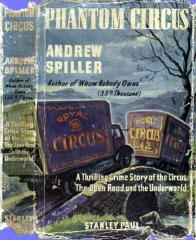
   * Phantom Circus (n.) Paul 1950 [Det. Insp. Arthur “Duck” Mallard; England]

Spiller

   * Alias Mr. Orson (n.) Paul 1951 [Det. Insp. Arthur “Duck” Mallard; England]
   * Who Plays with Sin (n.) Paul 1951 [Det. Insp. Arthur “Duck” Mallard; England]
   * As They Shall Sow (n.) Paul 1952 [Det. Insp. Arthur “Duck” Mallard; England]
   * Kiss the Book (n.) Paul 1952 [Det. Insp. Arthur “Duck” Mallard; England]
   * The Evil That Men Do (n.) Paul 1953 [Det. Insp. Arthur “Duck” Mallard; England]
   * They Tell No Tales (n.) Paul 1953 [Det. Insp. Arthur “Duck” Mallard; Ship]
   * Murder Is a Shady Business (n.) Paul 1954 [Det. Insp. Arthur “Duck” Mallard; England]
   * Murder Without Malice (n.) Paul 1954 [Det. Insp. Arthur “Duck” Mallard; England]
   * It’s in the Bag (n.) Paul 1955 [Det. Insp. Arthur “Duck” Mallard; England]
   * Ring Twice for Murder (n.) Paul 1955 [Det. Insp. Arthur “Duck” Mallard; England]
   * Black Cap for Murder (n.) Paul 1956 [Det. Insp. Arthur “Duck” Mallard; England]
   * Brains Trust for Murder (n.) Paul 1956 [Det. Insp. Arthur “Duck” Mallard; England]
   * Curtain Call for Murder (n.) Long 1957 [Det. Insp. Arthur “Duck” Mallard; England]
   * Murder on a Shoestring (n.) Long 1958 [Det. Insp. Arthur “Duck” Mallard; England]
   * Sing a Song of Murder (n.) Long 1959 [Det. Insp. Arthur “Duck” Mallard; England]
   * The Man Who Dressed to Kill (n.) Long 1960 [Det. Insp. Arthur “Duck” Mallard; England]

   What John recently discovered is that Spiller was born in Bridport, 20 June 1891, and he died in Ealing, London 11 February 1976. Neither his year of birth or the year he died had been known before. And surprisingly enough, what you see here on this page, right now, is all that is known about the author.

[UPDATE] 04-09-07. It hasn’t taken long before some additional information about Andrew Spiller has come to light. Look for that, plus a few more cover images, in this later blog entry, posted today.

   Until a couple of weeks ago, all that was known about Poppy Nottingham, author of four gothic romantic suspense novels included in Crime Fiction IV, except her real name:

NOTTINGHAM, POPPY; pseudonym of Patti Dunaway
   * Hatred’s Web (n.) Ace 1974 [Louisiana]
   * Shadow of a Cat (n.) Ace 1974 [Canada]
   * Without a Grave (n.) Ace 1975
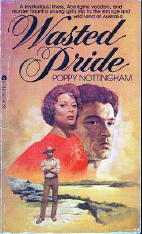
   * Wasted Pride (n.) Ace 1978 [Australia]

Nottingham

DUNAWAY, PATTI; see pseudonym Poppy Nottingham
   * Surrender by the Sea (n.) Jeremy 1979

   What happened a couple of weeks ago was that a woman in California purchased from me one of these gothic paperbacks written as by Poppy Nottingham, explaining that the author was the wife of her former pastor and she remembered both of them well. That was enough information to help Al Hubin locate her husband, Jack Dunaway, still alive and well in Oregon. In a letter Al received from him recently, Mr. Dunaway said his wife was born October 9, 1936 and died September 12, 1988. He also added that “she always wanted to be a writer; she wrote gothic novels because they were clean and she knew what they wanted.”

« Previous PageNext Page »