The first syllable of Rosemary Gatenby’s last name rhymes with “late,” which means I’ve been pronouncing incorrectly to myself all this time. According to Social Security records, this author of nine suspense thrillers listed in CFIV died January 3, 2007, but her writing career ended with her final mystery in 1979, when she was still a youthful 61.

   Below is a semi-annotated list of the mysteries she wrote, using CFIV as the basis. One gauge of an author’s popularity, perhaps, is how many of their books are picked up by one or the other of the book clubs which were in operation during their career. In Mrs. Gatenby’s case, this would have been either the Mystery Guild or the Detective Book Club. I’ve indicated those of her books which were published by either of the two with a double asterisk (**).

GATENBY, ROSEMARY (1918-2007)

   * Evil Is As Evil Does (n.) M. S. Mill–William Morrow 1967. No paperback edition. “Betty Graham, formerly Liz Melinder, returns to Rockton, NY, to attend a round of parties for herself and her new husband. Little did people know that she had escaped the worst train wreck in history and her former life as wife and mother.”

   * Aim to Kill (n.) William Morrow, 1968. Pyramid X-2094, pb, October 1969.

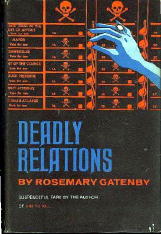
   ** Deadly Relations (n.) William Morrow, 1970. Pyramid T2528, pb, 1971.

Deadly

   ** Hanged for a Sheep (n.) Dodd Mead, 1973. Jove 04418, pb, 1977. “Taut dramatic story of a successful, solidly married man who is unable to convince the law and even his friends of his innocence [in his wife’s murder].”

   ** The Season of Danger (n.) Dodd Mead, 1974. Jove 04429, pb, 1977. “How could America’s most famous novelist be held a prisoner by his own guards on his own estate?”

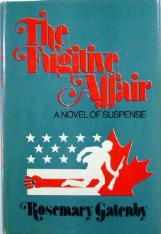
   ** The Fugitive Affair (n.) Dodd Mead, 1976. Jove 04428, pb,1978.

Fugitive

   * The Nightmare Chrysalis (n.) Dodd Mead, 1977. Jove 04805, pb, 1979. “Even before the half nude body of the strangled girl was found in the woods in back of his house, Ferguson Brady’s live had begun to change.”

   * Whisper of Evil (n.) Dodd Mead, 1978. Berkley 04673, pb, March 1982. “The young red-haired woman on the plane to Mexico City did not know that someone urgently wanted her death … that it had already been discussed …”

   ** The Third Identity (n.) Dodd Mead, 1979. No paperback edition.

   Among the various pieces of data that Al Hubin is always on the lookout for, in terms of adding and correcting information in Crime Fiction IV, his all-inclusive bibliography of the field, are the death dates of authors who have passed away, but for whom this information has never been recorded, for whatever reason.

   This does not include the giants of the field, of course. It’s almost always the lesser known writers, those who were popular at one time but whose career in the area of mystery fiction faded away after their death; or those who wrote only a handful of books to begin with, perhaps more for the love of the field rather than for the money, and so never had a following at all.

   Most of these authors were active and their careers ending before the Internet came along. With a few exceptions, most of today’s authors have their own web pages or have been interviewed often enough online or in the print media that we know as much about them as we could possibly want to know.

   What I’m grouping together this evening are some of the authors whose deaths have been recently discovered. There is no other factor that they have in common than that. Truthfully, each of these deserves a blog entry of their own, and if I ever accumulate enough interesting facts about any one of them, that is exactly what will I will do.

[UPDATE] 07-01-07. And that is exactly what I have done. Each of the authors in this original post now has his or her own entries, dated the same day as this first one. Follow the links to find each of the author’s new entries:

      Rosemary Gatenby.

      Poppy Nottingham.

      Andrew Spiller.

      Gladys Greenaway.

   About a month or so ago I posted a review of Travis, an all-but-unknown private eye novel by M. E. Knerr. In the review I included all I was able to find out about the author, who also wrote a few crime-related novels as Michael E. Knerr.

   After the review was posted, I continued trying to find out more about Knerr, eventually coming across several Internet postings about him by John F. Carr. Carr is a science fiction writer and editor with a long list of credits on the Internet Speculative Fiction Data Base.

   Carr’s recent endeavors have largely been in conjunction with the SF (and occasional mystery) writer, H. Beam Piper, keeping his work in print and writing several stories and novels in Piper’s “Lord Kalvan” series. He recently finished a biography, H. Beam Piper: A Biography for McFarland & Company, which will be published next year. There’s a connection between Piper and Knerr, which Carr addresses in his reply to me, after I was able to get in touch with him:


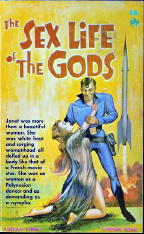
   You came to the right person, as I knew Michael – not very well, but better than probably any other writer left alive. Michael’s middle initial was E., and while I’m not familiar with Travis, according to his son, it’s Mike’s book. He wrote a number of books for Monarch and Pinnacle in the late 50’s and early 60’s. In 1962 he went to Southern California, where he wrote a number of soft-core porn books for various outfits, like Uptown Books – all pretty harmless in today’s vernacular! I have a copy of The Sex Life of the Gods, and it’s pretty typical hackwork… Better than some, but not up to the stuff Sturgeon and Farmer were doing a few years later.

Sex

   Mike was in many way Beam’s protege, and his closest friend during his last few years in Williamsport, Pennsylvania before Piper shot himself on November 9, 1964. They met at a local Williamsport writers’ group in 1959 and they spent a lot of time together talking about writing and drinking. Mike was absolutely devastated by Beam’s suicide. In fact, he blamed himself for not realizing that Beam needed help. The truth was that Mike was married, with two young sons and working full time as a reporter, and had neglected, for these very good reasons, his friend Beam Piper.

   I’m sure Piper understood, and his problems were far deeper than any small loan would have addressed. Piper was a very private man and would have never burdened a friend with his personal or financial problems. He took what he thought was the only sensible way out of what he saw was a closed box — a stalled career, the recent death of his friend and long-time agent Kenneth White, a bad case of writer’s block and no money. He was too proud and self-sufficient to ever go on relief!

   I first heard about Mike Knerr through the offices of Ace Books and my then editor Beth Meacham, when Mike called her, extremely irate over my factual errors about his “best friend, H. Beam Piper” in my introduction to the Piper short story collection, Federation. I told Beth to have Mike call me direct and we had a good conversation; I told him that I was only writing what other people had told me that Piper had said about his ex-wife and other factual errors. After Mike calmed down, he admitted that Piper “told a lot of bullshit about his past” and we ended the conversation on a good note. We corresponded and he provided me some information on Beam’s life and quotes from his diaries, which he had in his possession.

   After our talk Mike discovered the “lost” Fuzzy novel (Fuzzies and Other People) in one of the trunks that he’d taken from Piper’s apartment mislabeled in a box as “second pages.” In lieu of payment (Ace Books offered him several thousand dollars — Mike called it “blood money”) for the “lost” Fuzzy book — Mike stuck a deal whereby he would write a biography of Beam based on his first-hand knowledge and Piper’s diaries which ran from 1955 to his death. Ace agreed and he sat down and over the next several years wrote the book Piper. Unfortunately, when he turned the book in Ace reneged and told him they were no longer interested. He was about to destroy it when I called to obtain his permission to quote his letters for the article, “The Last Cavalier: H. Beam Piper,” I was writing for Analog Science Fiction–Fact magazine.

   Mike was mad as hell, and I managed to calm him down a bit and told him it would be a crime if he destroyed Beam’s legacy in a fit of pique, since he had the only copy of the diaries. Instead, I suggested that he send me a copy of his Piper biography for safe keeping. You could have knocked me over with a paper clip when three months later it arrived in my P.O. Box! He sent me the original manuscript; I know that because it was backed with several other manuscripts (a lot of old timers did this to save on paper). I am certain that I have the only copy in existence…

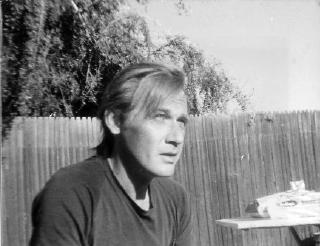
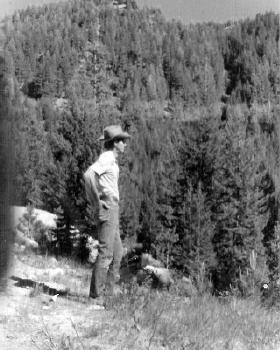
   I lost contact with Mike in 1992, when he was living in Sausalito with his third or fourth wife. He was a good looking guy, and a great man for the ladies. He moved around a lot, and did the typical writer’s gigs, worked at Sylvania, a local newspaper, etc.

   See the attached photos. In person, he had a raspy voice and a violent demeanor, like one of his own anti-hero protagonists! He wasn’t someone you’d mess around with.

Mike Knerr

   His books, like The Violent Lady (Monarch, 1963), were pretty good for the time and the outfits he wrote them for. He really wanted to write historical novels based in Central Pennsylvania, but couldn’t sell them. His agent was Kenneth White, who died in 1964, which is when Mike decided to cut back his writing to hobby status, although he would have never put it that way!

   I talked to his son recently and he told me his father was born on May 31, 1936 in Williamsport, PA (where Piper was based in the early 60’s, which is my connection). He was a hunter, civil war re-enactor, horseman, built flintlock rifles, and loved boats and sailing.

   Mike was a former newspaper man (the Shamokin newspaper) and in 1973 moved permanently (except for a short time in Woolrich, PA) to Southern California, specifically Alameda, Sausalito and L.A.

   Here’s the list of titles his son gave me of Knerr’s works: The Violent Lady, 3 Willing Females, The Sex Lives of the Gods, Heavy Weather, Sasquach, Suicide in Guyana, Brazen Broads, Operation: Lust, and Travis. He isn’t sure if this list is complete, probably not since many were written under pseudonyms and/or were lost in his many moves…

Mike Knerr

   Mike Knerr died in 1999. I don’t have the actual date, just a note from his son that he died at age 64.

   This is about the sum total of my knowledge of Mike, except that I liked him even though he was a rough cob – I sure as hell wouldn’t have wanted him as an enemy!


   NOTE: A chapter excerpted from The Last Cavalier, John’s biography of H. Beam Piper, has been uploaded to the original Mystery*File website. Entitled “California Dreamin’” and largely in Mike Knerr’s own words, it describes his experiences writing soft-core porn in California before returning to Pennsylvania, and the time he spent with H. Beam Piper in Williamsport before the latter took his own life.

ON ELLIOTT CHAZE
by Bill Pronzini

   Elliott Chaze (1915-1990) was an old-school newspaperman who began his journalism career with the New Orleans Bureau of the Associated Press shortly before Pearl Harbor, worked for a time for AP’s Denver office after paratrooper service in WW II, and then migrated south to Mississippi where he spent twenty years as reporter and award-winning columnist and ten years as city editor with the Hattiesburg American.
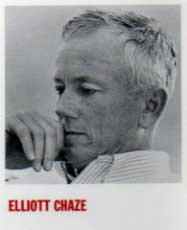
   In his spare time he wrote articles and short stories for The New Yorker, Redbook, Collier’s, Cosmopolitan, and other magazines, and all too infrequently, a novel. In an interview he once stated that his motivation in writing fiction, “if there is any discernible, is probably ego and fear of mathematics, with overtones of money. Primarily I have a simple desire to shine my ass — to show off a bit in print.”

   His first two novels were literary mainstream. The Stainless Steel Kimono (Simon & Schuster, 1947), a post-war tale about a group of American paratroopers in Japan, was a modest bestseller and an avowed favorite of Ernest Hemingway.


   The Golden Tag (Simon & Schuster, 1950), like most of his long works, has a newspaper background, contains a good deal of autobiography, and is both funny and poignant; it concerns a young wire service reporter and would-be novelist in New Orleans who becomes involved with two women, one of them married, while reporting on a sensational murder case.

   His third novel was the one for which he is best remembered today, Black Wings Has My Angel (Gold Medal, 1953; also published as One for My Money, Berkley, 1962 and as One for the Money, Robert Hale, 1985).
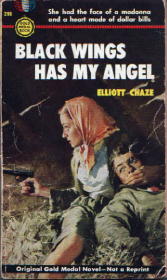
   Black Wings Has My Angel is an indisputable noir classic, arguably the best of all the crime novels published by Gold Medal during its glory years. Barry Gifford, in an article in the Oxford American, called it “an astonishingly well written literary novel that just happened to be about (or roundabout) a crime.”

   The protagonist, ex-convict Tim Sunblade, is a quintessential antihero — an unrepentant bastard who executes a daring armed car robbery in Colorado with the help of a call girl, Virginia, whom he picked up in a backwoods Mississippi motel.

   The details of the crime and its aftermath are vividly described, and the love-hate relationship between Sunblade and the woman and the demons in both that lead to their downfall are masterpieces of dark-side character development. Unreservedly recommended.

   It was ten years before Chaze published another novel, and sixteen years before his next crime novel, Wettermark (Scribners, 1969). In its own quiet, sardonic way, Wettermark is every bit as good as Black Wings Has My Angel. Its setting is the small town of Catherine, Mississippi, a thinly disguised Hattiesburg, where the protagonist, the eponymous Wettermark, toils as a newspaper reporter for the local paper.
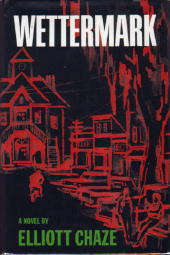
   Wettermark is a tragicomic figure, accent on the tragic — a tired, financially strapped, ex-alcoholic wage slave whose novelist ambitions have long since been shattered by rejection and apathy. His arrival on the scene of a recent successful bank robbery plants a seed in his mind, a “glimpse of the green” that is nurtured by circumstance and his private demons until it blossoms into a daring heist scheme of his own.

   Wettermark is by turns funny, sad, bitter, mordant, and ultimately as dark and unforgiving as Black Wings — a brilliant character study that is likewise unreservedly recommended and that somebody damned well ought to reprint.

   Late in his life, after he had retired from the Hattiesburg American, Chaze wrote three offbeat, ribald (occasionally downright bawdy), and often hilarious mysteries, all published by Scribners, featuring Kiel St. James, a well-meaning but somewhat bumbling city editor for the Catherine Call (Catherine having been mysteriously moved from Mississippi to Alabama for this series); Crystal Bunt, Kiel’s highly sexed young photographer girlfriend; and Chief of Detectives Orson Boles, a tenacious cop given to wearing hideous lizard green polyester suits ( “I like green, hoss”) and speaking alternately in Southern grits-and-gravy dialect and perfect English.

   Each of the three, Goodbye, Goliath (1983), Mr. Yesterday (1984) and Little David (1985), drew enthusiastic critical praise — The New Yorker called them “good, down-home fun [with] much flavorful redneck talk…plenty of excitement too” — but they seem to have been inexplicably neglected, if not all but forgotten, in the years since.
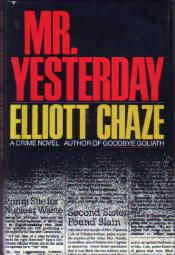
   The best of the trio is Mr. Yesterday, which deals with the murders of two eccentric old spinsters, one by a fall and one by a bizarre (very bizarre) stabbing. The motive for the two killings, and the method employed in one, are the weirdest, wildest, most inventive, most audacious (and yet completely plausible) ever devised in a mystery novel.

   Some readers no doubt did and will find the explanation offensive, even borderline obscene. I laughed out loud when it was revealed, which may tell you more about my sense of humor than you care to know, but I’m pretty sure the author would have approved.

   Elliott Chaze was a fine prose stylist, witty, insightful, nostalgic, and irreverent, and a first-class storyteller. If you’ve never read anything of his, or nothing except Black Wings Has My Angel, by all means hunt up copies of Wettermark, Mr. Yesterday, and anything else with his byline. You won’t be disappointed.
   In my recent review of British author Brian Flynn’s The Sharp Quillet, I included all of the information about him that I had or was able to come up with Not included in this data was his year of death, which was suspiciously missing, given that he was born in 1885. I asked John Herrington if he might look into the matter.

   I also asked him if there was any way of gauging how popular an author Flynn may have have been in the UK. Obviously, I said, he’s all but unknown here, and apparently his work seems to have faded badly in England as well. But with all of the books he had published, he must have had some readers who followed him … ?

   Here’s John’s reply, cobbled together out of two emails I received from him today.


  Hi Steve,

   Flynn died in Deal, Kent on 5th February 1958. He must have been writing right up to the end as his last two books followed later in 1958.

   Unfortunately, that is the sum of my findings. Kent record office know nothing about him. But I do have a couple of suggestions to follow up.

   [As far as Brian Flynn is concerned as a writer] Barzun in Catalog of Crime, says of the one book he lists “Straight tripe and savorless. it is doubtful, on the evidence, if any of his others would be different.”

   I know nothing about him and reckon he is what I would call a journeyman writer, writing prolifically to make some money. Though he must have some effect to have written 50 books, which is 49 more than lot of people. Perhaps being so prolific, and keeping the same character throughout, was his error.

   He wrote for what we call library publishers, publishers whose aim was to produce books which libraries would buy – often by quantity rather than by author. If libraries bought his books, he would keep on writing. Sadly, just because libraries buy one’s books it does not necessarily mean you are a good writer. Most books, especially fiction, will find library readers because “they have read everything else on the shelves” (This is personal experience speaking, having worked for 3 decades in a public library and seen some right rubbish get elevated to “I must look out for the next one”!) I suppose some library borrowers will read anything as they don’t need to buy it.

   Sadly, I get the impression that Flynn was one of the lucky ones who found his niche and carried on till he died (and two books did come out after he died).

   How good was he actually? No idea. Barzun condemned him on one book, right or wrong. But I simply think he was writing for the library market and that could be a limitation as far as style and improvement would be concerned. In those 50 books there may have been a good writer struggling and failing to improve his lot.

   Anyway, will let you know if I find anything else.

Regards

      John

   From the online Wikipedia: Richard Horatio Edgar Wallace (April 1, 1875 – February 10, 1932) was a prolific British crime writer, journalist and playwright, who wrote 175 novels, 24 plays, and countless articles in newspapers and journals. Over 160 films have been made of his novels, more than any other author. In the 1920s, one of Wallace’s publishers claimed that a quarter of all books read in England were written by him.

E Wallace

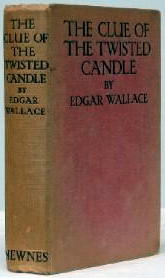
EDGAR WALLACE – The Clue of the Twisted Candle

George Newnes, London, hc, 1917. Small Maynard & Co.,Boston, hc, 1916. Numerous reprints in both hardcover and paperback. TV Film: An episode of The Edgar Wallace Mystery Theatre, 15 August 1960, with Bernard Lee as “Superintendent Meredith.”

   Assistant Commissioner of Police T. X. Meredith, a man of unorthodox though successful methods of detection and best friend of mystery writer John Lexman, has been investigating Remington Kara, an extremely rich Greek with something of a turbulent history and a former suitor for the hand of Lexman’s wife.

   Kara was almost murdered years ago, and such is his fear of another attempt being made his bedroom is “practically a safe.” It features burglar-proof walls, reinforced concrete roof and floor, an unreachable window, and its sole door has in addition to a lock “a sort of steel latch which he lets down when he retires for the night and which he opens himself personally in the morning”.

Hardcover

   Of course Kara is eventually found dead, locked in this safe-like room. How was Kara’s murder accomplished, why did his secretary disappear and his manservant run away, and for that matter who killed the dog in the basement of his house? Was Kara killed by the men he has feared for years or someone else, and if so, who was it and why?

   Answers to these conundrums are revealed at a gathering at the end of the book in which All Is Explained, including how the challenge presented by the locked room was overcome.

   My verdict: On the negative side I felt there were perhaps one too many coincidences and the identity of the murderer was not as well hidden as it might have been. On the other hand, the locked room explanation is ingenious, clues to how it was accomplished are revealed in a fair fashion in the narrative, and I confess I did not foresee one of the final twists. I would sum it up as a diverting, light read.

            Mary R
http://home.epix.net/~maywrite/

   Etext available online.

FLY AWAY GIRL. Warner Brothers, 1937. Glenda Farrell, Barton MacLane, Gordon Oliver, Hugh O’Connell, Tom Kennedy.

   It must have been Glenda Farrell Day sometime last year at Turner Classic Movies, or at a minimum, Torchy Blane Day, since I’ve just discovered that I taped a complete sequence of the Torchy films that day, all eight of them. I watched a few of them last year, decided I didn’t want to overdose on them, put them aside – and promptly forgot about them until a couple of days ago when I came across them again.

Torchy

   This one’s number two in the series, in case you’re counting. I can’t exactly tell you what the appeal is with these movies, since the mystery plots are kind of sappy and so are the characters, to tell you the truth. It’s been a while since I watched the first one, Smart Blonde (1937), so I’d rather you didn’t quote me on this, but I have the feeling that the detective element was the strongest in that one, before the comedy became more and more significant. Since it’s also the only one that was based on a Frederick Nebel pulp fiction story, I think I’m safe enough in saying so.

   Torchy Blane is an ace newspaper reporter, and she must have been quite a model for plenty of young girls in the late 30s and early 40s, because she is an ace, female or not. Her boy friend (or fiancé, more or less) is Lt. Steve McBride (Barton MacLane), who has an ordinary mind for police work and who (therefore) is no match for Torchy. You might consider him lunk-headed, but I think that is why Tom Kennedy is in these movies, as Sgt. Orville Gahagan, a poor poetry-spouting sap who lives for nothing more to use the siren whenever he’s whisking McBride off to the next scene of the crime. Gahagan makes McBride look positively Holmesian in comparison.

   The plot in this particular episode in their lives centers around the murder of diamond merchant in his office, but Torchy’s choice for the killer, a reporter with a rich father, seems to have an iron-clad alibi. When her candidate for a killer takes an around-the-world tour as a newspaper stunt, Torchy talks her editor into allowing her to tag along, hence the title.

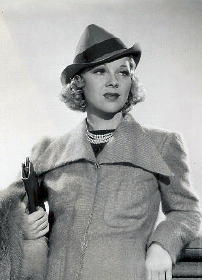
   Actually, I do know what the appeal is for these movies. It’s Torchy herself, or rather Glenda Farrell who plays her: fast-talking and fast-thinking, brassy without being bold, funny and wisecracking, but her mind on only one thing, her story. The photo of her that you see above didn’t come from this movie. I couldn’t find any, I’m sorry to say, but I thought this publicity still would do fairly well in its place.

   After Vince Keenan and I finished our email conversation on Mike Shayne and the actors who have played him over the years, I didn’t think it was going to take long for Vince to go through all four films on the first DVD set, once I knew they were in his hands, and I was right. Even though not especially looking the part, Lloyd Nolan was very impressive in the role, he says, making me all the more anxious for my copies to get here in the mail.

   I’ll have to send you over to his blog, though, but it’s only a click away and it’s well worth the trip.

   Vince also sent me an email about the Mike Shayne radio show I set up a link to. His response:  “I listened to the Shayne radio show and enjoyed it quite a bit. Jeff Chandler may look nothing like that portrait of Shayne, but he’s got the attitude down pat. And that ending — what a corker!”

    Given that kind of reaction, I figured I ought to do something about it. If you go this OTR Archives page, you will find links to around 30 or 35 of them. Just click and play, or download and burn to CDs if you wish. I haven’t listened to the sound quality of all of these, but the higher the Kbps, the better, I think — try those in the column furthest to the right first. Jeff Chandler’s the star in all but the first one (from 1946) and the last (from 1953).

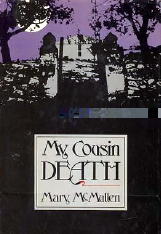
   A few months ago I was asked if I had any information on writer Mary McMullen, who wrote nineteen mysteries between 1952 and 1986, when she passed away. Most of these books were published by Doubleday’s Crime Club imprint and can be generally classified as being in the “malice domestic” genre. Without a series character to maintain readers’ interest in her stories, she’s on the verge of being forgotten, but no one writes that many works of crime fiction without having had a substantial following at the time.

McMullen

   What’s the most interesting about Mary McMullen, perhaps, is her family. When I did a bibliography for mystery writer Helen Reilly following Michael Grost’s excellent analysis of her crime fiction, I said:

   Helen Reilly [nee Kieran]. Married to artist Paul Reilly, mother of four daughters, including mystery writers Ursula Curtiss and Mary McMullen. Her brother, James Kieran, also wrote mystery fiction.

   Helen Reilly’s primary character was Inspector Christopher McKee. In Mike’s essay on her, he considers the McKee books as very early police procedurals, but he also connects her work up with the Black Mask style of writing, in the hardboiled pulp tradition.

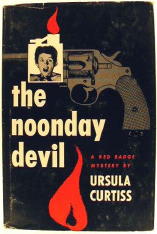
   My impression of Ursula Curtiss’s books is that they are much like her sister Mary McMullen’s, but stronger on the suspense. If you’ve read any of them recently, though, and can tell me otherwise, I’d surely like to be corrected. Ursula Curtiss is listed in CFIV as the author of 22 novels and one collection of short stories, the books appearing at regular intervals between 1948 and 1985.

Curtiss

   Besides James Kieran, the brother mentioned above, there was another well-known member of the family, John F. Kieran, the sportswriter who was a long-time panelist on radio’s Information Please in the 1940s, among other accomplishments.

   James Kieran’s impact on the world of mystery fiction is small, but the reason will soon become clear. He has only one entry in CFIV, as follows, in slightly expanded form:

KIERAN, JAMES (1911-1986)
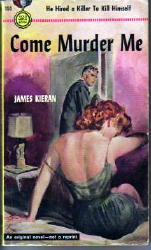
    * * Come Murder Me. Gold Medal #150, 1951, pbo. Reprint: Gold Medal #419, 1954.

   About this time, Victor Berch, whom I’d asked for assistance on the original inquiry about Mary McMullen, sent me the following email:

   I was following the discussion about Mary McMullen, and when the subject of James Kieran came up, I decided to look into him. Don’t ask why. Maybe, it’s because he’s a Gold Medal author and I have the two printings of Come Murder Me (GM 150 and 419).

Kieran

   [In Al Hubin’s Crime Fiction IV] James Kieran’s dates [are given] as 1911-1986. I think this is the wrong James Kieran. Out of curiosity (more likely habit), I decided to check with the Copyright Office. Come Murder Me was first registered March 7, 1951. The copyright was renewed Feb. 15, 1971 by Mrs James Kieran. his wife. Then the thought crossed my mind “Why should his wife had to renew the copyright if he was still alive?

   Anyhow, the record also gave her full name as Dagmar N. Kieran along with the Mrs. James Kieran appelation. So, I ran a check on her. She was born May 10, 1908 and died Sep. 22, 1985 according to [Social Security records].

   However, there is another data base that I sometimes check. It lists people coming in to the USA from foreign ports, both citizens and aliens. The data taken from passports usually give the name of the person, the birth date, place of birth and present address.

   And so I found Dagmar N. Kieran and her husband James M. Kieran returning from a trip to Curacao Dec. 7, 1936. James M. Kieran’s birth date was given as September 23, 1901, born in NYC. A check through the NY Times led me to an extensive obituary, which I’ll send along [soon]. He died January 12, 1952. So, his dates and full name should be Kieran, James Michael, Jr., 1901-1952.

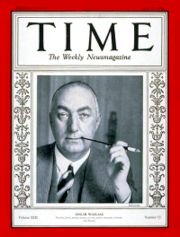
   He died, that is to say, only year after his only mystery novel was published. As for his family, a brief article in Timemagazine also mentions the Kierans (December 25, 1939):

   The Kierans are an active family. John writes sports for the New York Times, and knows all once a week on radio’s Information Please; Leo writes aviation for the Times; Larry works in the Manhattan Surrogate’s office; Helen Kieran Reilly writes detective stories. And there is James M. Kieran, moody, outspoken, firm in his leftish ways, who until last week was Mayor Fiorello LaGuardia’s press secretary at $5,400 per year.

   Last week hot-tempered Mayor LaGuardia announced that he had fired hot-tempered Jim Kieran. “He called me a guinea ———–,” said the Little Flower. “What else could I do?” City Hall ferrets had their own idea of what the row was about: Franklin Roosevelt’s devoted friend Jim Kieran was outraged “because the Mayor lately has buttered up Herbert Hoover.”

   Impulsive Mr. LaGuardia quickly regretted his anger, tried to get word to Jim Kieran that all was forgiven. The other Kierans said they had no idea where Jim was. Friends thought they knew. When the Kierans let their Irish get the better of them, they generally retire to Helen’s Connecticut farm to cool off.

   Some excerpts from the NY Times obituary for James Kieran will follow, one of them toward the end very interesting, especially if true. It does not seem as though the statement would be in the obituary, if it were not. Of course the degree of involvement is not specified, and it may have been minimal. But here, read for yourself:

   Mr. Kieran spent almost all of his newspaper career as a member of the staff of the New York Times. He came to work in 1923, was a member of the night re-write staff, and then was switched to the political staff. […] He resigned from the Times in the winter of 1937 to be press secretary to the late Mayor Fiorello H. La Guardia.

   [After his leaving La Guardia] he entered the public-relations business for a period. […] More recently he collaborated with a sister Helen Reilly, one of the country’s well-known mystery story writers, in a number of books, and also was an author in his own right.

   If anyone knows more, we’d love to know about it.

KENDALL FOSTER CROSSEN – The Tortured Path

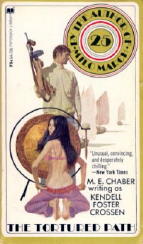
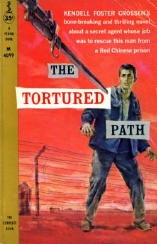
Permabook M4099; paperback reprint, June 1958. Hardcover edition: E. P. Dutton, June 1957. One chapter appeared earlier in Stag Magazine under the title “The Treatment.” Later paperback edition: Paperback Library 64-706, 1971, as by “M. E. Chaber writing as Kendall Foster Crossen.”

   That last byline is rather strange, if you think about it. Kendall Foster Crossen was the author’s real name, and M. E. Chaber was the name he used to write his “Milo March” novels. Paperback Library had been publishing these in uniform editions, all with hugely attractive covers by Robert McGinnis. They must have done well with them, because they when they ran out of Milo March’s adventures to print, to capitalize on Chaber’s popularity, they started doing some of Crossen’s other work in the same numbered format, including this one and several he wrote as by Christopher Monig.

Tortured1

   Milo March was basically an insurance investigator, but he also had connections with the CIA, and his adventures took him all over the world. [For more on March, check out his page on the Thrilling Detective website.]

   Major Kim Locke, the primary protagonist in The Tortured Path, had even more direct connections with the CIA, and I’ll go into the details in a minute. First, though, here’s a list of the books he appeared in, taken from Crime Fiction IV, by Allen J. Hubin:

LOCKE, MAJOR KIM
      * Kendell Foster Crossen:
         o The Tortured Path (n.) Dutton 1957 [China]
         o The Big Dive (n.) Dutton 1959 [England]
      * Clay Richards:
         o The Gentle Assassin (n.) Bobbs-Merrill 1964 [Cuba]

   Why the switch in bylines, I don’t know, but it may have had something to do with the switch in publishers. The Big Dive is scarce; it was never reprinted in paperback, and at the moment, there are only two copies of the hardcover edition offered for sale on the Internet. While The Gentle Assassin never had a paperback edition either, it is fairly common in hardcover. It’s also easily available in a three-in-one Detective Book Club edition.

   Here are the first couple of paragraphs from The Tortured Path, which will give you more information about Major Locke’s background. It will also supply you with a glimpse of the author’s writing style, or so it’s my intention:

    “It started out like any other day in Washington. I’d been cooling my heels there for three months. I was theoretically on duty but I hadn’t anything to do for that length of time. The first month was fine, but then I began to get a little tired of it. I didn’t have an assignment, but I was supposed to check in three times a day. After three months, just checking in was beginning to interfere with my drinking. One thing you can say about Washington – the hunting in the cocktail bars was fine.

    “The name is Kim Locke. Major, U. S. Army, permanently attached to the Central Intelligence Agency. Cloak and dagger stuff. But the only cloak I’d ever seen was worn by a blond adagio dancer and the only time I’d been near a dagger was when I was in the OSS during World War Two. There’d been a Yugoslavian partisan who had a dagger; we’d used it to slice the chickens we caught at night and roasted in coals. So it wasn’t like in the books; no willing broads willing to do anything to get your secrets. But it was a living – if you can call being in the Army living.”

Tortured2

   His assignment? To get himself caught by the Chinese Communists, be brainwashed and undergo any other form of torture they might devise for him, and then rescue an American officer who has secrets that mustn’t fall into enemy hands.

   Which he does. End of book. Well, not quite, but almost. Getting in is far too easy, getting out is another matter, sort of the scorched-earth approach, if you ask me, crude but effective. Crossen has a quiet, breezy style of story-telling, beginning (as you will have seen) with page one onward. The resulting adventure is readable in about a night or two. It is also largely forgettable in about the same length of time.

January 2007

« Previous PageNext Page »