From the L.A. Times comes word of the death of Tige Andrews:

   Tige Andrews, a character actor who earned an Emmy nomination for portraying Capt. Adam Greer, the officer who recruited the undercover cops of television’s “The Mod Squad,” has died. He was 86.

   Andrews, who often played detectives during a TV career that spanned five decades, died of cardiac arrest Jan. 27 at his longtime home in Encino, his family said.

   Mr. Andrews was born Tiger Androwaous on March 19, 1920 in Brooklyn, N.Y. His parents, immigrants from Syria, reportedly named him after a strong animal to guarantee good health.
Mod Squad

   From VARIETY, some more about his career:

   Andrews also had a recurring role as Lt. Johnny Russo in The Detectives Starring Robert Taylor, which ran from 1959 to 1962. He made numerous appearances on TV shows including The Phil Silvers Show, Star Trek (where he played Kras, the second-ever appearance of a Klingon), Gunsmoke, Marcus Welby M.D., Kojak and Murder, She Wrote.

   Of the most interest to crime fiction fans, other series on which Mr. Andrews appeared are the ones below, beginning with his earliest. These are all guest appearances, although some may also have been short recurring roles:

   Kraft Mystery Theater, Inner Sanctum, U. S. Marshal, Playhouse 90 (as Frank Nitti), The Grand Jury, The Lawless Years, The Fugitive, The FBI, Police Story, Police Woman, Kojak, Vega$, CHiPs, Quincy M.E., Hawaiian Heat, Street Hawk, and Sledge Hammer!

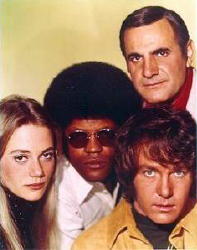
               “One white…one black…one blonde.”

   Aimed at the youth market, The Mod Squad, in which three troubled youngsters fight crime as undercover agents for the police, was one of the those TV programs that was on the air at exactly the right time and struck precisely the right chord for its viewers. As a precursor to several such series that followed, such as 21 Jump Street, The Mod Squad was on for five seasons between 1968 and 1973.

Mod Squad

    From the Mod Squad “unofficial” home page:

   The show worked because of its clothes, its language, its attitudes and, of course, its timing. The show’s topics, such as student unrest and anti-war statements could only have worked in the late 60s. That’s why, despite being one of the better tv reunion movies with a perfectly suited and reasonably well-written storyline, the 1979 reunion movie wasn’t successful. That’s also why the big screen movie was one of the worst movies ever. That’s all that will be said here about the movie — this site is dedicated to the grooviest gang of television fuzz that ever wore a badge: Michael Cole, Clarence Williams III and Peggy Lipton as Pete, Linc and Julie.

   More from the same source. I should apologize for quoting as much as I am here, perhaps, but why not, when someone else has said it this well:

   All three were on probation when they were approached by Captain Adam Greer to form a special ‘youth squad’ to infiltrate the counter-culture and catch the adult crime-lords who preyed on the young kids, but never the kids themselves.

   While the Mod Squad were “fuzz,” they certainly weren’t “pigs.” Being from the Flower-Children era, they didn’t carry guns; instead, they wore beads and hip clothing and used the slang of the day: “groovy,” “keep the faith” and, most notably, “solid.”

   It was Tige Andrews as the straighter and narrower Captain Greer that pulled the show together, however. As the man in charge, he acted as both a mentor and father figure to the threesome. Gruff but caring, he added the essential balance which helped make the series a success.

   Mr. Andrews’ last appearance on television was on Murder, She Wrote, January 6, 1991, in an episode entitled “Family Doctor.” IMDB states that he played the role of Carmine Abruzzi, but that seems to be in error.

   From the online All Movie Guide comes both a synopsis and a revisionist approach to the credits:

   While dining out in Boston, Jessica (Angela Lansbury) and Seth (William Windom) are witness to a mob “hit.” The victim is a member of the powerful Abruzzi crime family, who despite Seth’s efforts to save him does not survive. Enter the dead man’s vengeful son Michael (Vincent Irizarry), who kidnaps both Seth and Jessica–meaning that it is literally a matter of life and death for Jessica to find out who ordered the elder Abruzzi’s assassination and prove to Michael that Seth was not responsible for his dad’s demise. ~ Hal Erickson, All Movie Guide

   Cast:
Newell Alexander: FBI Agent Zweiback
Tige Andrews: Lt. Marino
Cynthia Bain: Denise Abruzzi
Joe Cortese: Carmine Abruzzi
Rose Gregorio: Rosa Abruzzi
Vince Irizarry: Michael Abruzzi

   Personally, I like the All Movie Guide’s version better. I’d greatly prefer that the last time Mr. Andrews’ appeared in a movie or on television, it was as a cop, rather than as a villain. Not that he didn’t play villains during his career, I understand that, but it’s as a policeman that he’ll always be remembered.

          —

      MOD SQUAD – The Books

* Richard Deming:
      o The Greek God Affair (n.) Pyramid 1968
      o A Groovy Way to Die (n.) Pyramid 1968
      o The Sock-It-to-Em Murders (n.) Pyramid 1968
      o Assignment: The Arranger (n.) Whitman 1969
      o Spy-In (n.) Pyramid 1969
      o Assignment: The Hideout (n.) Whitman 1970
      o The Hit (n.) Pyramid 1970
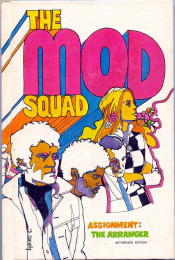
Book

* William Johnston:
      o Home Is Where the Quick Is (n.) Pinnacle 1971

                  Data from Crime Fiction IV, by Allen J. Hubin.
   As a followup to my blog entry on Columbo a while back, here’s an email I received today from John Apostolou. On the original M*F website, John is the author of an excellent article on MacKinlay Kantor, which includes a long and complete crime fiction bibliography for him, we believe.

Hi Steve,

   I’m enjoying your new blog.

   Here are a few bits of info about the play “Prescription: Murder.” It opened at the Curran Theatre in San Francisco on January 20, 1962. After a short run, it toured the country, closing in Boston in May of that year. The play never opened on Broadway.

   Thomas Mitchell died in Beverly Hills on December 17, 1962 — not during the tour as sometimes reported.

            Best,

               John Apostolou

>> Thanks, John. What’s reported is not always what’s true, as anyone who’s done any research has quickly found out.

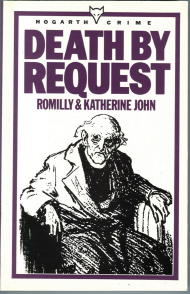
ROMILLY & KATHERINE JOHN – Death by Request. Hogarth Crime; trade paperback. 1984. Also published as a Hogarth hardcover. Offset from the original [hardcover] Faber & Faber edition, 1933. Vintage/Ebury, US, hardcover and paperback, 1984.

   Quite surprisingly, given the fact that it’s been reprinted several times, this is the only mystery that the married couple of Romilly and Katherine John wrote. Who were they, is one question, and how did it happen that Hogarth reprinted it some 50 years later?

   For at least a partial answer, one must read the new introduction to the Hogarth edition, written by Patricia Craig and Mary Cadogan, as part a series of Hogarth Crime reprints of classic detective fiction. Romilly, born in 1906, was in the RAF, was briefly a civil servant, then a poet and an amateur physicist before dying in 1986. Katherine was a reviewer as well as a translator of Scandinavian books. She died two years before her husband, in 1984.

   The gap between 1933 and 1984 between editions may be one of the longest on record for any mystery novel. The fact remains that Hogarth Press considered it significant enough to reprint in a series of classic crime fiction. In that regard, the book is a locked-room mystery; and in its own inimitable way, a minor tour de force of one form or another, the details of which I most sincerely will do my best to avoid telling or revealing to you.

   The dead man is found in his bedroom at one of those old English manor residences so commonly found in works of mystery fiction, especially the English ones. He is found gassed to death in a heap on the floor, still dressed as he was the evening before, the window shut tightly, and (of course) the door was locked. It had to be broken down in order to enter in the morning. Could it have been suicide? No, Lord Malvern seems to have been well enough off, and he was off to visit his fiancée in London on the very same day as his death.

   Telling the story is the local vicar, an elderly man by the name of John Colchester, a long-time friend of Matthew Barry, the master of the house. Also staying over are various friends and relatives, including a comic-relief colonel who harrumphs all over the place; a weepy young girl; a recent widow only slightly older; the slightly deaf sister of Matthew; assorted staff, mostly female, save for a slightly villainous butler named Frampton.

   And to tell the truth Frampton is more than only slightly villainous. He’s a socialist, a seducer of young maids in the area, and — as the truth comes out — a blackmailer. Many letters which threaten to reveal secrets which others might wish kept unrevealed are found, some sent by Frampton, others perhaps not. Obviously, as these have a great deal to do with the plot, the letters — their contents, who received them, who sent them, and who may have intercepted them — must be given, as the book goes on, a exhaustive and thorough going over.

   And to tell you another truth, the going-over of the letters is probably too thorough and exhaustive. One is tempted, I must admit, to throw up one’s hands whenever another letter appears and must be discussed and put into the context of the previous ones.

   I see that I have neglected to mention the detective on the case. Nominally that would be Inspector Lockitt, but that particular gentleman seems content to do his work off-camera, as it were. Almost all of his activity is related to the vicar second-hand, and then of course the vicar must relay his impressions of the good Inspector Lockitt on to us, the reader. It seems a strange way to tell a mystery, but one must always get accustomed, eventually, to things we expect to occur in the usual way, but which do not, do we not?

   The bulk of the detective work is rather more accomplished, in fact, by an unusual twosome: (a) Mr. Nicholas Hatton, a friend of the dead man’s fiancée, one of those amateur detectives who are as common in British mystery fiction in the 1930s as damp old manor houses with murders committed within them, and (b) the aforementioned widow, Mrs. Fairfax, who proves to be a most tenacious (and efficacious) individual when it comes to solving mysteries.

   There are secrets galore that must come out before the solving is done, including at least two that should correctly be considered “bombshells” when they are revealed. There is, of course another secret at the end, which I promised not to tell or reveal to you, and looking back at what I have written, I do not believe that I have.

   So, is the book a classic? You may well ask, and you should. No, I say, but with a small hedge in the back of my mind. For today’s audiences, large portions of this exercise in murder-solving will be dreary and dull to the extreme. For those of you who like puzzles, well, the puzzle is there, and without a doubt, a double delight it is. The problem is that it’s, well, unskillfully told, when measured by more modern standards, say of five or so years later.

   That the door was locked on the inside, for example, is not revealed until page 50, whereas the body itself was found on page 24. Nor, surprisingly enough, is the locked room aspect very much — if at all — the focus of the tale. This may in part be due to the telling (see above) or the fact that (as is often the case) the solution (to the locked room aspect) is rather simple when explained, and therefore not very worthy of much dwelling upon.

   If you were to read this book — and if you are still with me, I would at least suggest that you should, for this must be the kind of mystery you prefer to read, not so? — you will also need to know what a geyser is, at least a geyser that one would find in the bathroom of a country house in England in the early 1930s. Readers of Dorothy L. Sayers’ Unnatural Death, for example, will have already come across one, I believe, if they were to think back upon it.

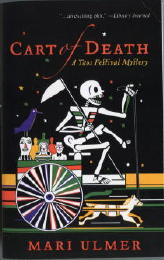
MARI ULMER – Cart of Death

Worldwide; paperback reprint, September 2006. Hardcover edition, as Carreta de la Muerte (Cart of Death): Poisoned Pen Press, April 2001.

    Subtitled “A Taos Festival Mystery,” this second adventure in which Christina Garcia y Grant finds herself involved takes place shortly before and during the celebration of the local Las Fiestas holiday. The first book in which Christy appeared was Midnight at the Camposanto (April 2000), which took place on a previous Good Friday through the following Easter Sunday.

    According to the Poisoned Pen website, the latter was to have been “the first novel in a series planned to follow the sacred and secular calendar through its annual cycle,” but thus far, only the two books have been published. (Also on the PP website is an announcement that “Mari is now working on More than Mischief at San Geronimo,” but since on that same page is a link to her 2002 author’s tour, along with the fact Ms. Ulmer is now 74 years old, I have a feeling that the chances that it will appear are diminishing quickly.)

Cart

    Which is shame, for I rather enjoyed this book, in spite of some rather uncomplimentary comments some readers have left on Amazon. Christy is a former lawyer who now runs a bed-and-breakfast in a small town south of Taos while she attempts to begin a writing career. This means that there are numerous tenants whose humorous antics keep her hopping while she is trying to keep them happy. Her mother lives by, and when the festival begins, the guests are displaced by all of her relatives who come swarming in.

    One particular tenant is a permanent resident, a retired surgeon from Florida named McCloud, or Mac for short, and an attraction between Mac and Christy seems to be growing. At least enough so that when other men look at Christy longer than he thinks they should, Mac feels the pangs of jealousy.

    Especially gnawing at Mac is that the suave Evelyn Bottoms (male) would make such an ideal candidate for the murder of a young worker at a local art gallery. Missing is Bobby’s female assistant, Cindy, a close friend of Christy’s mournful friend Iggy (short for Ignacio), a young lawyer she has been mentoring.

    The mystery is strangely gruesome, with at point (page 140-141) three more deaths occurring within the span of two pages. The detective work? Well, it’s as satisfying as it is in most present-day cozies. The star attraction for this book, though, overshadowing everything else, is the locale, its history, its inhabitants, and the overall spirit of enthusiasm and joy that’s on continuous display for all of the above.

    Not quite so satisfying, given the lack of another tale to continue the series, is that the semi-romance between Christy and Mac, which is left badly hanging. All readers are would-be authors, though, are we not? Anyone who reads this rather charming look at contemporary New Mexico culture (plus mystery) will know exactly how that will come out, or already has.

UPDATE: This review was written in November of 2006. A representative of Poisoned Pen Press promised to pass on to Ms. Ulmer an email of inquiry I’d sent them, suggesting that perhaps she would respond to me directly. That was several weeks ago, and she has not. More, the information I quoted from the PP website is no longer there, or at least I am unable to find it again. I wish I had better news than this.

   As you will have read in every newspaper in the country today, author, screenwriter and playwright Sidney Sheldon died yesterday at the age of 89.

   In all likelihood, the average person (not you), having glanced at the headlines and the first few paragraphs without reading further, will think of Mr. Sheldon as an author of powerful blockbuster bestsellers a lot more than they’ll remember him as a writer of crime fiction.

      If that is the case — and who knows, I may be wrong — I suspect it’s because that same hypothetical average person, when confronted with the phrase “crime fiction,” thinks primarily of “detective fiction,” and of Agatha Christie, Perry Mason and Spenser: For Hire, for example, but none of which (or whom) were Mr. Sheldon’s model, style or forte.

    No matter. Sidney Sheldon was a crime fiction writer. Most of his novels were strongly based on criminous activities of all sorts, including (and especially) murder and its aftermath, often dealing with the rich and famous, beginning with his very first novel, The Naked Face, which earned him the Edgar for that year’s Best First Novel from the Mystery Writers of America.

   From the wikipedia website is a synopsis of the story line:

    “Judd Stevens is a psychoanalyst faced with the most critical case of his life. If he does not penetrate the mind of a murderer he will find himself arrested for murder or murdered himself…

    “Two people closely involved with Dr. Stevens have already been killed. Is one of his patients responsible? Someone overwhelmed by his problems? A neurotic driven by compulsion? A madman? Before the murderer strikes again, Judd must strip away the mask of innocence the criminal wears, uncover his inner emotions, fears, and desires-expose the naked face beneath…”

Naked Face

   From Allen J. Hubin’s Crime Fiction IV is a list of Mr. Sheldon’s work that correctly belongs to our field, ignoring all of the work he did as a screenwriter. (The hyphen before two titles indicates marginal crime content.)

SHELDON, SIDNEY (1917- )

* Redhead [with Herbert Fields, Dorothy Fields & David Shaw] (play) Chappell 1960 [London; 1905 ca.]
* The Naked Face (n.) Morrow 1970 [New York City, NY]
* The Other Side of Midnight (n.) Morrow 1974 [Catherine Douglas]
* Bloodline (n.) Morrow 1978
* Rage of Angels (n.) Morrow 1980 [New York City, NY]
* If Tomorrow Comes (n.) Morrow 1985
* Windmills of the Gods (n.) Morrow 1987
* The Sands of Time (n.) Morrow 1988 [Spain]
* Memories of Midnight (n.) Morrow 1990 [Catherine Douglas]
* The Doomsday Conspiracy (n.) Morrow 1991
* -The Stars Shine Down (n.) Morrow 1992
* Nothing Lasts Forever (n.) Morrow 1994 [San Francisco, CA]
* Morning, Noon and Night (n.) Morrow 1995
* -The Best Laid Plans (n.) Morrow 1997 [Dana Evans]
* Tell Me Your Dreams (n.) Morrow 1998 [California]
* The Sky Is Falling (n.) Morrow 2000 [Dana Evans]

   To which I can add the following books published after the year 2000:

* The Sky is Falling (2001) [Washington anchorwoman Dana Evans]
* Are You Afraid of the Dark? (2004)

   Two books, Catoplus Terror (a novel about a former spy attempting to apprehend Carlos the Jackal) and The Pavid Pavillion, are not written by Sidney Sheldon but are said to have been done by someone else who published them under his name. (Someone will have to enlighten me on these two books, as I cannot find copies of either of them offered for sale on the Internet.)

   From today’s obituary for Mr. Sheldon in the New York Times, I offer this excerpt about his writing:

   Sheldon’s books, with titles such as Rage of Angels, The Other Side of Midnight, Master of the Game and If Tomorrow Comes, provided his greatest fame. They were cleverly plotted, with a high degree of suspense and sensuality and a device to keep the reader turning pages.

    “I try to write my books so the reader can’t put them down,” he explained in a 1982 interview. “I try to construct them so when the reader gets to the end of a chapter, he or she has to read just one more chapter. It’s the technique of the old Saturday afternoon serial: leave the guy hanging on the edge of the cliff at the end of the chapter.”

   Analyzing why so many women bought his books, he commented: “I like to write about women who are talented and capable, but most important, retain their femininity. Women have tremendous power — their femininity, because men can’t do without it.”

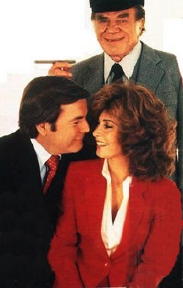
   For Mr. Sheldon’s credits in the world of TV and movie entertainment, I will send you to IMDB. Of the various series and films he worked on, the one for which I’d remember him most is Hart to Hart (1979-1984)the TV series he created starring Robert Wagner and Stefanie Powers, with made-for-TV movies continuing on through 1996. Fluff, perhaps, but high-powered (and highly enjoyable) fluff, and they did solve crimes.

Hart to Hart

   For even more on Mr. Sheldon’s long career, you could not do better than to start with his own website, then head to a February 2006 interview with him by Kacey Kowars from which the following excerpts are taken:

KK: You were not pleased when THE NAKED FACE, your first novel, sold 17,000 copies. Could you explain that for your readers?

SS: I thought it was a failure. The publishers were pleased. It won The Edgar Award for best first novel. But my television shows [I Dream of Jeannie], were being watched by 20 million people every week.

   but later:

KK: Looking back over your career it seems you found the greatest satisfaction in writing novels.

SS: Yes, no question. When you write a screenplay you write in shorthand. You don’t say that your hero is tall, lanky, and laid-back. You might be thinking of giving the script to John Wayne and they give it to Dustin Hoffman. So you generally characterize it. In a novel it’s just the opposite. If you don’t put those things down your reader won’t know what you’re talking about.

KK: Is there one thing you’re proudest of as a writer?

SS: Finishing a novel when I was certain I didn’t have the talent to be a novelist. That was THE NAKED FACE.

UPDATE [02-01-07] On his blog, which you should visit every day, Ed Gorman gives a blunt but hugely accurate assessment of Mr. Sheldon’s career, then compares the comments he’s received on his death with those given Harold Robbins. Two writers whose fictional work took place in the same strata of society, two wholly different reactions to their passing.

From a notice in the New York Times

   Allan Barnard, who was born in Madison, Wisconsin on August 8th, 1918, died on Monday, January 22nd of complications from Parkinson’s disease in Forest Hills, New York. Allan was married to his beloved wife Polly Barnard for 56 years. Allan was a book lover, author, editor and mentor whose publishing career spanned five decades. At the time of his retirement he was a Vice President and Associate Editorial Director at Bantam Books.

   With all of these years in the world of publishing, Mr. Barnard could very easily have had many connections to the world of crime fiction, but the only one that appeared under his own name is –

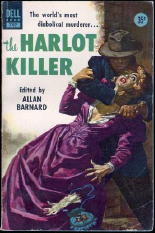
Harlot

THE HARLOT KILLER. Dodd Mead, hc, 1953. Dell #797, 1954. Paperback. An anthology of fact and fiction relating to Jack the Ripper.

Introduction, by the editor
Alan Hynd: Murder Unlimited (fact)
Dion Henderson: The Alarm Bell
Willam Sansom: The Intruder
Anthony Boucher: The Stripper [as by H. H. Holmes]
Richard Barker: The Jack the Ripper Murders (fact)
Kay Rogers: Love Story
Thomas Burke: The Hands of Mr Ottermole
Theodora Benson: In the Fourth Ward
Mrs Marie Belloc Lowndes: The Lodger
Edmund Pearson: “Frenchy” – Ameer Ben Ali (fact)
Unknown: Jack El Destripador [translated by Anthony Boucher] (fact)
Edmund Pearson: Jack the Ripper
Robert Bloch: Yours Truly, Jack the Ripper

   Data taken from a listing on ABE and Index to Crime and Mystery Anthologies, Contento & Greenberg.

   A earlier anthology, Cleopatra’s Nights (Dell #414, pb original, 1950) contains 13 stories and articles about the famous Egyptian queen. None seem to be crime-related, except possibly “A Toast to Murder” (from Queen Cleopatra) by Talbot Mundy.

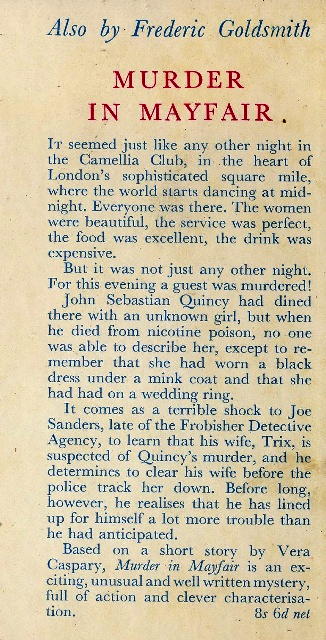
   Regarding my previous posts on Frederic Goldsmith and his mystery novel Murder in Mayfair, primarily this one, Jamie Sturgeon sent me the following email:

   By chance whilst going through my boxes of books I found a had a copy in dust wrapper of Frederic Goldsmith’s The Smugglers. I have scanned the blurb for Murder in Mayfair which was on the rear flap and attached it. The printed dedication in the book is to I.G., his father I presume. I did have a copy of Murder in Mayfair in a previous catalogue but I sold it.

Mayfair

   In the pair of emails that follow, Jamie added:

   Reading the blurb I wonder if the book could be based on the short novel by Vera Caspary, Lady in Mink? The US edition (book club only) was The Murder in the Stork Club.

and

   If Murder in Mayfair is a re-write of The Murder in the Stork Club, apparently the Caspary story first appeared in Good Housekeeping magazine (I did a google search).

                        Regards,
                           Jamie

    Comparing the pair of titles for Caspary’s book with the story line given in the blurb, it certainly looks like a match to me. I’m convinced. Thanks, Jamie! With this to go on, I also found the Good Housekeeping citation, from a Gutenberg list of copyright renewals:

R571103.
The Murder in the Stork Club. By
Vera Caspary. First appeared in Good
housekeeping magazine. NM: additions
& revisions. © 19Sep46; A8155.
Vera Caspary (A); 1Feb74; R571103.

   Case closed?

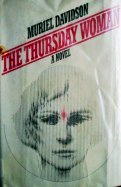
   As far as the individual entries in Al Hubin’s Crime Fiction IV are concerned, it’s easy to forget that there a life behind each and every one of them. There’s always much more than the listing can ever say, taken in isolation by itself. Here’s an example. The entry for Muriel Davidson looks like this:

DAVIDSON, MURIEL (1924-1983)

* The Thursday Woman (n.) Atheneum 1979 [Los Angeles, CA]
* -Hot Spot (n.) Marek 1980
* ’Til Death You Do Pay (n.) Marek 1981

   Two books which fall into the category of crime fiction, plus a third that’s only marginally so. The year of her birth, and the year of her death. You’d read this, glance at it for up to, say, several seconds, and then you’d go on to the next one, whichever the next one might be.

   Unless you were looking for her entry with a specific reason in mind, and until you happened to want more and decided to Google her name. There is another Muriel Davidson who has something to do with the Canadian census, and you’ll going to have to screen her out. Then you come to an entry that looks promising, you click on it, and that’s when you discover, quoting the following news item in the New York Times:

   AROUND THE NATION; Television Executive Found Slain on Coast

AP. Published: September 27, 1983

   A television executive who had reported receiving crank telephone calls was slain at her home in fashionable Benedict Canyon, the police said today.

   The police discovered the body of the executive, Muriel Davidson, 59 years old, at 1:45 A.M. today, Lieut. Dan Cooke said. There were no signs of a struggle. Neither the cause nor time of death was disclosed.

   Mrs. Davidson recently signed with Jay Bernstein Productions as vice president of film and television development.

   She wrote three mystery novels, The Hot Spot, The Thursday Woman and ’Til Death Do You Pay.

   Her husband, Bill, is a contributing editor to TV Guide.

    A followup story appeared the next day:

   AROUND THE NATION; Arrest Made in Slaying Of Hollywood Writer

UPI. Published: September 28, 1983

   A former aerospace worker who had received alcohol rehabilitation counseling from Muriel Davidson, a writer who published celebrity profiles and crime exposes in national magazines, was arrested today and charged with slaying Mrs. Davidson, who was also a television executive.

   The suspect, Robert Thom, 51 years old, was arrested at his home in Pasadena at 4:30 A.M. on information received from relatives and friends of Mrs. Davidson, who was found Monday shot to death at her home.

   To say that this was unexpected would be an understatement of some magnitude, and that’s putting it mildly.

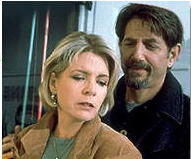
   Now the reason I was looking up Mrs. Davidson was that I was doing some research on a made-for-TV movie entitled The Wednesday Woman, which was supposedly based on her novel The Thursday Woman, included in CFIV and mentioned in the first Times article above. I kept looking, hardly expecting to discover anything else of significance. That a mystery writer was murdered herself was unusual enough. That there was a second chorus coming would never have occurred to me. (You may remember the incident yourself, though, especially if you were living on the West Coast at the time.)

   It turns out that the made-for-TV movie, The Wednesday Woman, (CBS; Wed., May 24, 2000, 9 p.m.) if I am understanding the course of events correctly, was not exactly based on Mrs. Davidson’s book, but on her life, which in turn imitated the book that she had written earlier, The Thursday Woman. The movie was fiction based on a real-life sequence of events, which tragically mirrored the earlier work of fiction.

    I don’t suppose I’m making myself as clear as I should be. I realize this because it took me a while myself to put the chain of events into some sort of order. The website that seems to tell the story best is this one, but allow me to quote the essential passages, and then if you’re so inclined, you should certainly go read the rest of the story for yourself.

   First, however, a quote from the book itself:

Thursday

    “The most absorbing compelling novel I have read in years. It reminds me of the psychological novels of Georges Simenon.” Dr. William Nolen. Pure chance takes an average woman, Martha, into the courtroom of wife-murderer Everett. She has visceral sexual reaction to the accused criminal and becomes obsessed with “love” for a man she doesn’t know…

   And now the chain of events that I mentioned:

(1A) In addition to TV scripts, celebrity profiles and other magazine articles and books, the real Davidson wrote a novel titled The Thursday Woman, about an addictive woman who has an affair with a dangerous fruitcake.

(1B) Besides writing for a magazine, the movie Muriel (played by Meredith Baxter) writes a novel with a similar plot titled The Wednesday Woman.

(2A) The real Muriel was murdered by Robert Thom, an alcoholic whom she met at a hospital where she counseled alcoholics once a week. A police report called the two “quite close.” A county probation officer said that just prior to her murder she had tried to sever her sporadic sexual relationship with Thom, who pleaded no contest to second-degree murder and was given a sentence of 17 years to life.

(2B) In the movie, Muriel is a recovering alcoholic, as is her psychotic lover (Peter Coyote) who tries to kill her after she wants to end their relationship.

Wednesday Woman

(3A) and (3B) The kicker that comes next, is that the real life Muriel is murdered. In the movie, she is not, to widespread critical disapproval. If you are portraying real events as closely as this movie does, they said, how can you get away with changing the ending, even if it’s one that leaves the viewer pleased and satisfied that everything in the end, um, ended well?

   You’ll have to answer that one yourself. I can’t give you any advice. I’m still marveling over the sheer audacity of real life to imitate fiction so closely in the first place, in this one single secluded entry in CFIV.

      —

UPDATE [01-30-07] From a brief email sent by Victor Berch:

   The California Death Index gives MD’s birth date as March 21, 1923; born in St. Paul, Minnesota. This seems to be verified in the 1930 US Census taken on April 8, 1930, where her age is given as 7 years old. Her maiden name was Friedland, so her entry should read:

      DAVIDSON, MURIEL (FRIEDLAND) 1923-1983.

   This post began as an UPDATE to be found at the end of the previous one, but as I kept writing, it became long enough, I thought, and substantiative enough, to survive on its own. And so, on its own two feet, here it is:

   Taken from an email message from Al Hubin this morning: “Looks good. The only connection you haven’t made is that Murder in Mayfair was reportedly the basis for the movie “Hour of Decision” (Tempean, 1957).”

   >> No, I didn’t catch that, and I’m certainly happy to know about it. When I checked how many copies of Murder in Mayfair were offered for sale yesterday on the Internet, the answer was none. Zippo. If someone were interested in knowing what the book’s story line was, all I could offer right now in reply are the comments of a single viewer on IMDB, which I’ll add below. And, yes, I know that the movie may be NOTHING like the book, but here goes something better than nothing, at least:

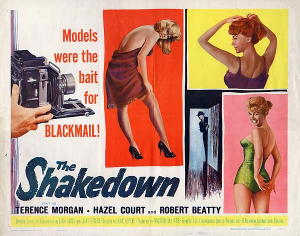
    “This is a fairly routine though watchable whodunit that is notable mainly for the nearly salacious-for-the-time talk about the womanizing habits of a gossip columnist who gets murdered. Oh yes, the ever enticing Hazel Court is present as a past amour of the now-dead rakish fellow who tries to avoid suspicion for his murder. Her husband [Jeff Morrow] investigates so as not to have his honey nabbed by the coppers. London locations make it watchable.”

    To which I add, ah yes, Hazel Court. I remember her from a short-lived TV series called Dick and the Duchess (CBS, 1957-58). It was an American series filmed in England and was mostly a comedy, but with criminous overtones.

   Hazel Court’s co-star was Patrick O’Neal, who played Dick Starrett, an American insurance claims investigator based in London and married to an Englishwoman, the “duchess” of the title. That is to say, his wife Jane, whose efforts to help her husband invariably ended in disaster.

   I may be the only person I know who remembers this series, but even though I was only 15 or 16 years old at the time, I think that I was slightly in love with Hazel Court. Yes, she was too old for me, but at that age what possible difference could a few years make, and a distance of only a few thousand miles away … ?

    Thus began a lifelong love of British crime fiction. And yes, I do digress.

Shakedown

   Even though Allen J. Hubin’s work on Crime Fiction IV is nominally closed, he is still accumulating Addenda for his massive bibliography, as I’ve mentioned before, and actively so at that. The Internet is a massive tool to have at your disposal, especially Google, as everyone reading this must surely know — an enormously valuable implement for scooping up data and facts that simply wasn’t available when most of the work on the book was being done.

   In Al’s case (and mine as well, if truth be told) he can now type in the name of an author whose vital statistics are scanty or non-existent (birth date, year of death, some biographical details) and/or the title of one of their books, and see what shows up.

   Sometimes you get nothing at all, and sometimes – if the name is too common – you get too much. It’s impossible, for example, to sort through all of the Bill Joneses of the world.

   Sometimes, however, you hit upon a nugget or two, or even more. Case in point. At the present time, or not until a couple of days ago, nothing was known about:

GOLDSMITH, FREDERIC
* * *Murder in Mayfair (Allen, 1954, hc) [London] Novelization of a short story by Vera Caspary, q.v.
* * *The Smugglers (Allen, 1955, hc)

   On the web now, though, is a site belonging to Paul K. Lyons which includes, among other things, pages of information for over 500 diarists. Besides writing a small amount of fiction, Paul has been a diarist himself since 1974, and he is in the process of making the entries available online.

   In January 1981 he happened to be reading a book called Murder in Mayfair (see above) and wrote about it in his diary. One line, and Google picked it up: “In the British Library I’ve been reading Murder in Mayfair written by my father, Frederic Goldsmith.”

   Al spotted this, immediately emailed Paul and received this reply:

    “My father Frederic Goldsmith wrote Murder in Mayfair published 1954, London, by W. H. Allen and The Smugglers published 1955, London, by W H Allen.

    “He was born in 1925, in Vienna, moved to the UK during his teens (taking on British citizenship which he retained throughout his life), and died in the US in 1989. His wife, Gail Goldsmith, lives in New York.

    “His father Isadore Goldsmith (IG) was a film producer, and IG’s second wife, Vera Caspary, was an American author (Laura).”

      [UPDATE: In a later email to me, Paul added the following:

    “I incorrectly spelled my grandfather’s name when writing to Al. He was known as Igee, but his first name was Isidor (not Isadore). It’s possible I picked up this mistake from IMDB, which has the same mistake.” ]

   And there’s the connection with Vera Caspary. Here’s one of that lady’s entries in CFIV:

Bedelia (Houghton, 1945, hc) [Connecticut; 1913] Eyre, 1945. Film: Corfield, 1946 (scw: Vera Caspary, Moie Charles, Herbert Victor, Roy Ridley, Isadore Goldsmith; dir: Lance Comfort).

   Emphasis mine. And here’s Isadore Goldsmith’s full entry in www.imdb.com:

Producer – filmography

1. The Tell-Tale Heart (1953/II) (producer)
2. The Scarf (1951) (producer) (as I.G. Goldsmith)
… aka The Dungeon
3. Three Husbands (1951) (producer) (as I.G. Goldsmith)
… aka Letter to Three Husbands
4. Out of the Blue (1947) (producer)
5. Bedelia (1946) (producer)
6. The Voice Within (1945) (producer)
7. Hatter’s Castle (1942) (producer)
8. The Stars Look Down (1940) (producer) (as I. Goldsmith)
9. I Killed the Count (1939) (producer)
… aka Who Is Guilty? (USA)
10. The Lilac Domino (1937) (producer)
11. Southern Roses (1936) (producer) (as Isidore Goldschmidt)
12. Whom the Gods Love: The Original Story of Mozart and His Wife (1936) (co-producer)
… aka Mozart (USA)
… aka Whom the Gods Love (UK: short title)

Writer – filmography

1. The Scarf (1951) (story) (as I.G. Goldsmith)
… aka The Dungeon
2. Bedelia (1946)

   One of the movies that caught my eye was The Scarf, which Isadore Goldsmith both produced and wrote the story it was based on. Was there some connection also to the book of the same title written by Robert Bloch (of Psycho fame)? No, not so. The co-author of the story, according to IMDB, was Edwin Rolfe, who has a single entry in CFIV himself:

ROLFE, EDWIN (1909-1954); Reporter, editor, foreign and war correspondent; poet; publicist for shows.
* * * The Glass Room (with Lester Fuller) (Rinehart, 1946, hc) [Los Angeles, CA] Low, 1948.

   And The Scarf, by Robert Bloch (Dial, 1947) seems to have never been made into a movie at all.

   As for Vera Caspary, she has many entries in CFIV (which I won’t repeat here), even more as a screenwriter in IMDB, and there is a full biography for her here.

   She’ll certainly best be known as the author of Laura, however, and (more than likely) for the movie more than for the book.

   But which of her stories did Frederick Goldsmith use to construct his novel Murder in Mayfair? At the moment I do not know, but if and when I do, you can be sure you will read about it here.

« Previous PageNext Page »