ADVENTURES IN COLLECTING:
The FRANK M. ROBINSON Collection Auction
by Walker Martin


   Recently I was disturbed to notice that a pulp discussion group that I contribute to seemed to be ignoring or unaware of the fact that a major pulp collecting event had just occurred. In fact, I call it The Pulp Auction of the Century.

   I am of course referring to the auction of the collection of Frank M. Robinson, science fiction author, Hollywood screen writer, movie actor (he appears in Milk), and world class collector of high condition pulp magazines. I stress the “high condition” part of the last statement. Frank has been written up many times because of his famous “wall of pulps,” all in fine or very fine condition.

   First, what qualifies me to be making such a claim that this was The Pulp Auction of the Century? I’ve been a collector of magazines since February 1956, when as a child, I bought my first issue of Galaxy, a science fiction digest magazine.

   I still have that very same issue that seemed to be on every newsstand and in every drugstore in the Trenton, NJ area. Not only does Galaxy no longer exist but most newsstands and drugstores no longer carry SF or crime fiction magazines. There are only five digest fiction magazines left and they all have decreasing circulations in this era of the electronic gadget and the e-book. We might soon live to see the end of an era, the death of the digest fiction magazines.

   As the years progressed, I started to collect not only back issues of the SF and crime digests, but I also started to collect the pulp magazines, which ruled the newsstands during the 1900-1955 period.

   First I collected complete runs of the SF and fantasy pulps and then I went on to collect all the major detective and adventure titles. Some of my articles concerning these activities have appeared on Mystery*File under the headings of “Memoirs of a Pulp Collector” and “Adventures in Collecting.” I am frankly a lover of old magazines and my collection includes not only pulp and digest, but also slick, men’s adventure, literary magazines and film journals.

   So though I live in a house full of thousands of magazines and books, I never really became a “condition collector” like Frank Robinson. I wanted to compile complete runs of magazines and read them but this would be very difficult if I limited myself to only fine condition copies, not to mention the fact that readers are often very reluctant to read high quality magazines for fear of downgrading the nice condition.

   This is not to say that I never obtained magazines in beautiful shape; I just did not limit myself to collecting them.

   During this 55 year period of collecting I was witness to many pulp sales and auctions. I attended just about every Pulpcon since the first one in 1972. I bought pulps by the thousands and consider myself a serious collector.

   So when the rumors started to circulate that Frank Robinson was going to sell his collection of 10,000 magazines, most of which were in beautiful condition, this was major news. No one had a collection of such fine condition magazines that could compare to the Robinson collection. Recently John Gunnison, who runs Adventure House, published a full color, 500 page book showing the complete collection in all its glory.

   I first became aware of Frank Robinson when I was a kid and read one of his early stories in a 1951 back issue of Galaxy. Several years later I read his novel, The Power and then saw the movie that supplied him with the funds to amass such an astounding collection, The Towering Inferno.

   In the 1980’s Frank and I started trading pulps back and forth and I noticed he was extremely fussy about condition. Later in the 1980’s, he started to attend Pulpcon on a regular basis and I got to actually meet and talk to Frank. He would actually sit at his table in the dealer’s room with two stacks of pulps, carefully comparing copies and choosing the better condition.

   Condition was everything and like most such collectors, I don’t believe Frank actually read the magazines. At one time in his younger days he did read them, but now they were like beautiful works of art, to be admired and looked at. I know many collectors who love the covers and the condition but they don’t read the magazines.

   Frank has a long article in the 500 page book titled “On Collecting”, where he explains his love of SF and how he got started collecting.

   You might wonder why he decided to sell his collection. He says, “The collecting bug waned…” but I’ve seen many collectors who when they reach a certain age decide to find a younger home for their collection. Also, I think he reached the point that all collectors fear, the time when they realize that they have achieved all their major wants and goals.

   So on February 25, 2012, at 7:00 pm began the first of 12 scheduled auctions which Adventure House will run the next few months. This first one I considered the most important because it would put complete sets of pulps and digest up for bids. Some major pulp titles were sold and I’ll list some of the results, though these figures may not be final since the dust has not settled yet.

   I watched the entire auction online, minute by minute, and lot by lot. I also bid on some items but most of the sets I either have or at one time had and then disposed of after reading all that I wanted:

       Doc Savage (complete set) — $50,000

       Astounding SF (these are the pulps, bedsheets, and digests) — $30,000

       Startling Stories (complete set in fine condition) — almost $5,000

       Adventure Magazine (complete set of over 700 issues)— $40,000

       Blue Book (not complete but an extensive run) — $48,000

       Weird Tales (the crown jewel of Frank’s collection and the best condition set in existence) — $250,000

       Planet Stories (all 71 issues in very fine condition, also probably the best set in the world) — $14,000

   Also up for bids were such sets as Wu Fang, Thrilling Wonder, Golden Fleece, Magic Carpet, Oriental Stories, etc. In addition to the above prices there was also a 10% buyer’s premium.

   According to John Gunnison who ran the auction, sales almost hit the $500,000 mark and he considers this to be the most successful sale he has ever been involved in.

   Now looking at the above prices you might consider them high. But you have to remember, these are not your usual good condition pulps with the usual browned paper, spine and cover flaws. These mainly are fine to very fine condition and thus bring much higher prices than the standard condition magazine.

   Think of it this way, most of us have bought cars, sometimes paying over $25,000 and ten years later we have nothing to show for our hard earned money. To a collector, it is just as important to have a nice collection, so the prices may not be as out of line as you think.

   In addition, where else are you going to find such important and significant titles as Adventure and Blue Book? During the period of around 1910-1950 these magazine carried the best adventure fiction written by the best authors.

   And of course Weird Tales is in a class by itself. Can anyone really argue that it was not the best fantasy and supernatural magazine ever published? Well maybe Unknown Worlds, but it only lasted 39 issues.

   So I would like to thank Frank Robinson and John Gunnison for providing a great and noteworthy pulp auction. After all these years, I thought I’d seen it all but this auction proved once again to me that collecting books and pulps is the grandest game in the world.

Previously in this series:   Is Completism Fatal?.
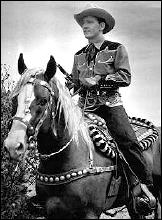
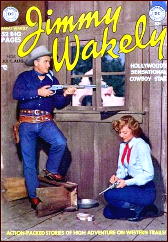
PARTNERS OF THE SUNSET Jimmy Wakely

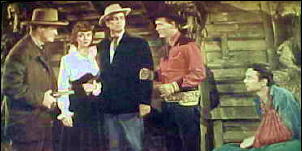
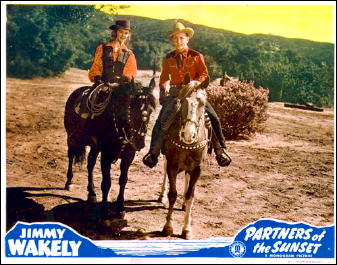
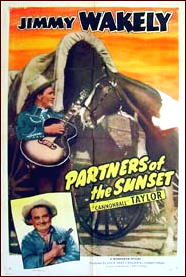
PARTNERS OF THE SUNSET. Monogram, 1948. Jimmy Wakely, Cannonball Taylor, Christine Larson, Steve Darrell, Marshall Reed, Jay Kirby, Leonard Penn, J.C. Lytton. Screenplay: J. Benton Cheney. Director: Lambert Hillyer.

   Just so that we’re squared away with this right from the start, the title of this movie is purely generic. It has nothing to do with the story line at all.

   And for a movie that’s only 53 minutes long — and that includes five songs — it’s as full of as much villainous treachery, all-around bad-guy-ism and men on horses running here and there as any aficionado of the good old-fashioned B-Western could possibly want.

PARTNERS OF THE SUNSET Jimmy Wakely

   Plus the comedy antics of Cannonball Taylor, not usually one of my favorite sidekicks, but he makes good use of a fishing pole on several goofy but well-timed occasions in Partners of the Sunset.

   What more could you want? As an actor, Jimmy Wakely was an awfully good singer, and when the singing cowboy began to disappear from the big screen in the 1950s, so did his movie career. Not that he probably noticed very much. As I say, he was maybe the best singer of all the singing B-Western cowboys, and he’s in good form here.

PARTNERS OF THE SUNSET Jimmy Wakely

   He plays the foreman of a horse ranch in this movie, and working under budget constraints, Cannonball Taylor seems to have been the only ranch hand. The story begins in earnest when the owner of the ranch comes home with a new bride perhaps half his age, played by the beautiful Christine Larson. The ranch owner’s son (Jay Kirby) expresses a different opinion of the lady and is forcefully kicked off the ranch.

   Complications begin to mount precipitously from there, but it turns out the son is right. The lady may be beautiful, but she’s certainly no lady. She’d not even be out of place in a tough guy crime drama. Except for Cannonball talking too much out of turn, Jimmy Wakely’s plan may have…

   But watch the movie. It’s no High Noon, but even the kids at the Saturday matinee may have realized this particular entry in the Wakely resume may have been one of his better ones.

PARTNERS OF THE SUNSET Jimmy Wakely

   (A small caveat, or Truth in Advertising: I haven’t watched them all, only this one and one other, which was fairly dull and uninteresting and will not be mentioned further.)

   As for screenwriter J. Benton Cheney, I don’t know much about him, but in 1948 alone, he wrote 12 small epics just like this one, presumably all for Monogram. By 1950, however, he was out of the business until TV really came along.

   Director Lambert Hillyer was equally busy in 1948; by my count he was at the helm of 11 western dramas, also presumably all for Monogram. But once again, after six more films in 1949, that was it for him until 1953. He had a short career in TV from then on, known most perhaps for directing 39 episodes of The Cisco Kid between 1953 and 1956.

PARTNERS OF THE SUNSET Jimmy Wakely

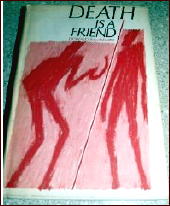
DONALD MacKENZIE Death Is  A Friend

DONALD MacKENZIE – Death Is a Friend. Houghton Mifflin; US, hardcover, 1967. First published in the UK by Hodder & Stoughton, hardcover, 1967.

   One of the reasons I bought this was because one of the crooks in this ill-fated crime caper is a stamp dealer by profession. (I used to collect the things before I discovered that once hinged into an album there’s nothing you can do with them.)

   Three men brought together by greed are splintered apart by distrust jealous hatred — yes, there’s a woman involved — and a fine portrayal of the fickle finger of fate.

   MacKenzie is not a particularly good writer, but he’s often an effective one. Except for the ending, which made no sense at all, this is a pretty fair example of the destructive effects inherent in some human relationships. There’s nothing in the plot that seriously depends on stamps, though.     (C plus)

— Reprinted from The MYSTERY FANcier, Vol. 1, No. 5, September 1977 (slightly revised).


[UPDATE] 03-01-12.   Donald MacKenzie was a very prolific mystery writer, with nearly 40 titles to his credit between 1965 and 1993. Sixteen of these were cases solved in one way or another by John Raven, a hardboiled inspector from Scotland Yard described by some sources as a “maverick.”

   When I wrote this review I did not realize it was the second of three books with Henry Chalice and Crying Eddie as the two leading characters. At this late date I do not know who they are or what role they had in Death Is a Friend. All I can tell you is that neither of them are the stamp collector I was talking about, nor (I am sure) either of his two accomplices:

       The Henry Chalice & Crying Eddie series —

Salute from a Dead Man. Hodder, 1966.
Death Is a Friend. Hodder, 1967.
Sleep Is for the Rich. Macmillan, 1971.

   Recently posted on the Mysterical-E website is a definitive list of the Top Ten PI series ever televised, according to Jim Doherty. Definitive only to him, perhaps, but I’ll bet many of them are going to turn up on yours as well, if you were to make one. But there are a couple of them that may surprise you. They did me — not that I would disagree with him — but the chances I’d have come up with one or two of them on my own are slim.

   Before you head on over, you might want to take the following quiz. I chose one, two or maybe three words from Jim’s descriptions of each of the shows — the latter well worth reading in themselves. If I’ve done a good job, maybe you can match the phrases below with the corresponding series. Most should be easy, but if I’m a little sneaky, perhaps not.

      1 )   suave

      2 )   most violent show

      3 )   disgraced agent

      4 )   girth

      5 )   municipal corruption

      6 )   car never worked

      7 )   ex-con

      8 )   good-looking

      9 )   security officer

      10 )   covert ops

REVIEWED BY RAY O’LEARY:
   

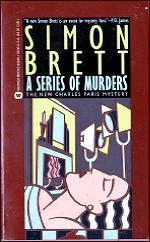
SIMON BRETT – A Series of Murders. Scribner’s, US, hardcover, 1989; Warner, paperback, 1990. First published in the UK: Gollancz, hardcover, 1989.

SIMON BRETT A Series of Murders

   Chronically under-employed actor Charles Paris seems to have finally landed on his feet. He’s got the part of dim-witted Sgt. Clump in a six-part series based on the “Golden Age” Mystery Novels of W.T. Wintergreen, and if all goes well, he may suddenly become a celebrity.

   Only All isn’t going Well: The Lead Actor can only play himself; Sippy Stokes, the girl playing his daughter, was hired because she slept with the Director; and Wintergreen keeps hanging around the set complaining about the changes they’re making in her books.

   Then Charles discovers the body of Sippy Stokes in the prop room, buried under a shelf full of props. Everyone else seems satisfied it was an accident, but when he notices a detail in a scene filmed around the time of Sippy’s demise, Charles begins to nose around.

   I wouldn’t rate this one as highly as several others in the series, chiefly because it isn’t hard to figure out the Murderer, but Series of Murders is still worth a look for the details about how a TV series is produced in England, as well as for the humor that always permeates a Charles Paris case.

IT’S ABOUT CRIME, by Marvin Lachman

TONY HILLERMAN

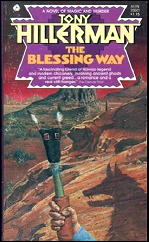
   What more painless way is there to learn about another culture than to read Tony Hllierman’s Navajo series. I suggest you start with the first book in the Lieutenant Joe Leaphorn series, The Blessing Way (1970).

   This was Hillerman’s first mystery, though it’s not clear whether when he wrote it he intended it to be the first of a series. It is largely a thriller, with Leaphorn off stage during much of the action, about a pair of anthropologists being stalked in the desert and mountains of the Navajo Reservation in Northeast Arizona and Northwest New Mexico. Its pluses are its authenticity about Navajo ways and an exciting climax.

TONY HILLERMAN

   Before writing another Leaphorn book, Hillerman wrote a non-series mystery, The Fly on the Wall (1971), which is even better than the Navajo books I’ve read. Written a couple of years before Watergate, he made use of his own newspaper background to tell how an investigative reporter tries to solve a mystery involving murder and corruption in a Midwestern state capitol. It barely lost out to Forsyth’s Day of the Jackal for that year’s Edgar.

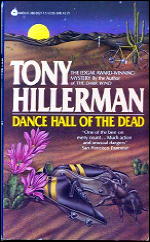
   Dance Hall of the Dead (1973) deservedly did win an Edgar. While having Leaphorn solve three brutal murders, Hillerman gives us many insights into the Navajos and their neighboring tribe, the Zuñis, especially the rite of the Shalako dancers, the culmination of their ceremonial year.

   Again, the ending is suspenseful, but along the way there is more real detection, with Leaphorn making deductions from physical clues like a Native-Born Sherlock Holmes.

— Reprinted from The MYSTERY FANcier,
Vol. 11, No. 1, Winter 1989.

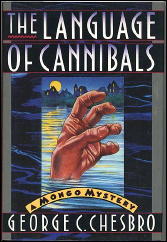
GEORGE C. CHESBRO – The Language of Cannibals. Mysterious Press, hardcover, 1990; paperback, March 1991.

GEORGE C, CHESBRO Languange of Cannibals

   [At the time this review was written, it was in the context of mysteries and crime fiction based on the politics in the US in the 1960s.] For a while I thought this was a book that might have been among them. But Chesbro certainly doesn’t pull any punches in his work, and the reader gradually discovers that his political view of the world, as expressed in The Language of Cannibals, includes an overwhelming disgust with right-wing conservatives of all forms, no matter what era it occurred, going back to the end of World War II.

   A friend of Mongo, criminology professor and a high-powered investigator Dr. Robert Frederickson, has died. He was an FBI agent whose demotion within the agency had forced him into a surveillance on a small community of pacifists a short way north of New York City. The death is apparently a boating accident, but the dead man had his own reasons for staying away from the water. Mongo suspects there may be more to the story.

   Headquartered in Cairn NY is more than the Community of Conciliation. Newly arrived, and taking over the town, is the famed ultra-conservative demagogue, Elysius Culhane. What Mongo doesn’t know is that a “death squad,” designed to eliminate undesirable members of society, is also active in Cairn. And in counterbalance to the presence of equally famed pacifist folksinger Mary Tree is the KGB, or various members thereof.

   I remember that Hugh Pentecost (or more likely his alter ego Judson Phillips) used to write crime fiction like this, mixed with the high voltage wires of political extremism, but I don’t think he ever had the bass, treble and volume knobs turned up as high as this, all at the same time.

   Reading The Language of Cannibals might be an enjoyable ride, but only if you’re of the same mind as the author. In essence, though, it’s only a two-dimensional portrait that’s presented here. It’s the science fictional concept of parallel worlds that’s at work — or is it out-and-out fantasy? — combined with detective fiction, and while the detective story survives, I’m not sure that my sense of wonder does. My eyeballs are still tingling.

— Reprinted from Mystery*File 31,
       May 1991 (with revisions).


THE ARMCHAIR REVIEWER
Allen J. Hubin


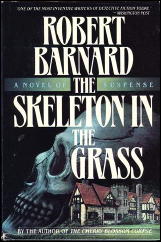
ROBERT BARNARD Skeleton in the Grass

ROBERT BARNARD – The Skeleton in the Grass. Scribner’s, US, hardcover, 1988; Dell, paperback, 1989. First published in the UK by Collins Crime Club, hardcover, 1987.

   Robert Barnard’s The Skeleton in the Grass has not the witty bite of some of his work. But it is a brilliantly observant picture of a pre-war [1936] English village, of the social classes and their distinctions and varying consciousnesses of war and peace. It is, in fact, a masterpiece.

   Dennis Hallam, scholar, book reviewer, a man who cares, who feels deeply, sits atop the social structure with his family, though he rejects such class notions and his pacifist views are not welcome in all quarters. Especially now, as someone (prodded, presumably, by the fascist Major Coffey) is leaving little symbols of cowardice around the Hallam estate.

   As tempers rise, could murder result? In so peace-loving a neighborhood? This is a novel not on any account to be missed.

— Reprinted from The MYSTERY FANcier,
       Vol. 11, No. 1, Winter 1989.


REVIEWED BY DAN STUMPF:         


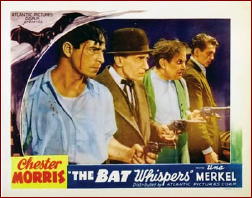
THE BAT WHISPERS

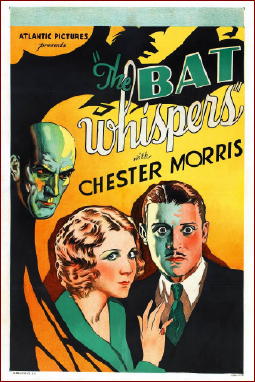
THE BAT WHISPERS. United Artists, 1930. Chester Morris, Chance Ward, Una Merkel, Richard Tucker, Wilson Benge, Maude Eburne. Based on the play by Avery Hopwood & Mary Roberts Rinehart. Director: Roland West.

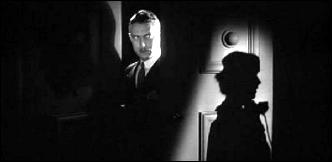
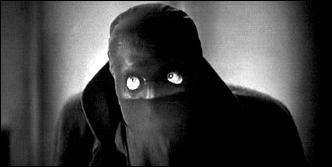
   This, if memory serves, is the film that inspired Bob Kane to create Batman, and I was much struck by the similarities between it and the Tim Burton film Batman with Michael Keaton: The Bat Whispers offers deliberately cartoonish sets, which the camera sweeps across like a hurtling winged thing; a nocturnal protagonist lurking about rooftops casting bat-like shadows; and a doppleganger relationship between a neurotic detective and a mad master criminal, who gets the last laugh in an eerie fadeout.

   Fine stuff, this, done with style and obvious relish, and a pleasure to watch.

THE BAT WHISPERS

   Unfortunately, Director Roland West (who was implicated in the death of his mistress Thelma Todd a few years later) occasionally has to pay attention to the Mary Roberts Rinehart play this was based on, at which times the action pretty much grinds to a halt while characters stand around and explicate.

   Also to its detriment, The Bat Whispers features Three (count ’em) Three “comedy” relief characters, each funnier than the next and all of them put together about as amusing as Hepatitis. Definitely a flawed film, then, but also quite engaging at times, with the Batman parallels an added interest.

THE BAT WHISPERS

   I should also make note of Chester Morris’s intriguing performance as the slightly-off-kilter Detective. No sane-on-the-surface madman, this, but a character whose carefully limned ticks get eerily unsettling very quickly. There’s a scene where he’s laying down the law to red herring Gustave Von Seyfertitz that drips with restrained menace.

   Chester Morris never really hit the Big Time, despite a couple of chances, ended up his career in things like The She Beast (’57) and is little remembered today, but after this and Three Godfathers (’36) I’ll be seeking out his films a bit more carefully.

THE BAT WHISPERS

PETER CAMPION – Diamonds Worth a Death or Two. Arco, UK, hardcover, 1955. No US edition.

   Peter Campion has two titles included in the Revised Crime Fiction IV, by Allen J. Hubin. The other one is Model for Murder, also published by Arco, and also in 1955. Whether British private eye Phillip Mayhew is in both books, I do not know, but (of course) he’s definitely in Diamonds Worth a Death or Two (else I wouldn’t have brought him up).

   His partner in the PI agency he’s in is Harry Green, but we don’t get to meet him, primarily because his body is found floating in the Thames on page nine. Mayhew and Green didn’t especially get along, but even though the police urge Mayhew (strongly) to keep his nose out of their business, there are certain standards that a private eye has to maintain. (We’ve heard that before.)

   Green was last seen in a notorious night club talking to another gent whom Mayhew soon also finds dead, but he doesn’t get any real traction on the case until he ties it in with a diamond necklace mysteriously stolen on a train somewhere between Point A and London. The word “mysteriously” is used advisedly, as the necklace is not on the train and the passengers are searched.

   This is one of those detective novels in which the leading character does not tell the story himself, nor does he have an assistant to bounce ideas off of. He does occasionally tell people that he has some ideas that are working out, but it’s left to the reader to follow the clues on his (or her) own as they occur.

   I didn’t do a very good job, I’m sorry to report, and I apologize for letting all of you down. It all makes sense in the end, but I was rather confused most of the way through. I did like the “gather all of the suspects in one room” aspect at the end, and I had no idea the killer was who he (or she) was. Nicely done.

   If Mayhew never made another appearance, he made the most out of this one. Whether or not he gets the wealthy young woman from whom the necklace was stolen, I leave to you to discover on your own. I won’t reveal all. Never have, never will.

« Previous PageNext Page »