Pulp Fiction


   First — this is Steve — some background information and a bit of an introduction. If you were to look Thorne Lee up in either print or CD version of Crime Fiction IV, by Allen J. Hubin, his entry would look like this:

LEE, THORNE; pseudonym of Thornton Shiveley; Born in Nebraska; in 1950s living in California and instructing in English and speech at a junior college; actor; writer under another name.
       The Monster of Lazy Hook (Duell, 1949, hc) [California]
       Summer Shock (Abelard-Schuman, 1956, hc) [Oregon]

or at least that’s how it appeared until Al sent me an update for him in Part 9 of the Revised CFIV. Not much, but at least an approximate year of birth for him:

LEE, THORNE.
Thornton P. Shiveley, ca.1874- .

   Following this, several months later, Al sent me an update correcting the spelling of the author’s last name, saying “There’s a Thornton P. Shively in the Mormon site with the right birth date, so I assume it’s he.”

   If he was born in 1874 would have made him a little old to be teaching in the 1950s, but that’s hardly impossible.

   But while doing a search for Lee on the Internet, I found an eBay seller who was offering a signed copy of The Monster of Lazy Hook. As part of the description she said, “Inscribed and signed on copyright page by author both as ‘Thorne Lee’ and Thornton T Shiveley.”

   So we’re back to Shiveley, but where did the middle initial “T” come from?

   We asked Victor Berch, who replied with the definitive answer. Al, this time, had the wrong fellow. Said Victor, “From what I can determine, Thornton T. Shively was the son of Thornton P. Shively. In the 1930 Census, he was listed as 17 years old, born in Nebraska.. His father Thornton Pickenpaugh Shively was an accountant, born in Virginia. Thornton T. was born Feb. 26 1913 in Nebraska and died June 21, 1980 in Santa Cruz, CA.

   And as an immediate consequence, the basic online entry for Lee/Shively now looks like this:

LEE, THORNE. Pseudonym of Thornton T. Shively, 1913-1980.

   In the meantime I’d discovered that Lee had written extensively for the pulp magazines, so I sent this information on to Bill Pronzini. At the same time I asked if had copies of both of Lee’s books, and whether he’d read either of them. Indeed he had, and I’ll let him take over from here:
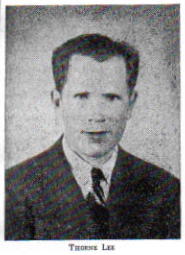
THE COMPLEAT THORNE LEE, by Bill Pronzini

   Thorne Lee
   He began writing during WW II. His first novel, The Fox and the Hound, about an amnesiac trying to find out who he is and whether or not he committed murder, was published complete and unabridged in the August 1944 issue of Mammoth Detective (from whence came the author’s bio below). Unlike some of other full-length novels which first appeared in the Mammoth mags, it was never published in book form. From 1944 to 1949 he contributed more than 30 tales to Black Mask, Dime Detective, New Detective, Doc Savage, The Shadow, S&S Detective Story, Ten Detective Aces, and other pulps. He also wrote a few stories for the sf mags of the period.

———

      In Thorne Lee’s own words:

   Peering into the remote and shady past of a mystery writer, you might expect to find a witches’ brew of dangerous living and dark adventure, but my own life story reads more like an afternoon recital at a ladies’ garden party. Any resemblance to excitement in my tales is purely accidental — or I should say, purely imaginary. I have yet to look down the wrong end of a gun barrel — which is probably true of a lot of fire-breathing yarn-spinners. Well, we can’t all be Jack Londons.

    “Born in Nebraska, married in Montana, and a daddy in Southern California” covers the high spots for me. I think my first interest in words began with a story called the The Enchanted Isle of Yew. That was all I read — just the one book, over and over. So far I haven’t been accused of writing the same story over and over, but I suppose that will come in time.

   I first looked on writing with professional intent while editing a college weekly. About that time I wrote a musical comedy (book and lyrics) and was ruined for life. The show was one of those “local boy” affairs with a fat part for myself. On the road it ran four solid nights. I think the lyrics are funny, but for a different reason.

   That brief fling as a Main Street Noel Coward plus an after-dinner speaking contest gave me the quaint idea that I should be a magazine humorist. Ha! ha!

   … I topped off college graduation with a year in university theatre, where I almost flunked in playwriting. For a brief time I wavered between acting and free-lance writing. The choice was easy; chances were that either career I chose would be the wrong one.

   Since then I’ve worked as everything from chauffeur to night clerk, to florist, to meter reader. So far I’ve managed to leave all jobs under my own power. A brief career as a school teacher was soon abandoned. The last straw was the day a tenth grader mistook me for a fellow pupil.

   I write mystery stories for three reasons: (1) I like to read them; (2) a good share of the better writing being done (setting my own stuff tenderly aside) can be credited to mystery writers; (3) my first stories sold were mysteries.

   My own reading tastes vary widely from Hilton to Hammett. I like my share of realism, but I don’t favor the theory that the supernatural and abnormal are out-of-date in mystery writing, or ever have been since Poe.
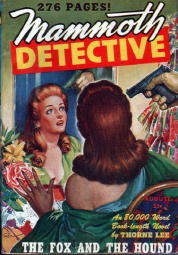
Thorne Lee: The Fox and the Hound

   The Fox and the Hound is my first novel. I use a pseudonym for the reason that my own name is invariably misspelled or mispronounced, or both. Thorne Lee is an abbreviation based on the first and last syllables of my name.

   I like to work in old, ragged clothes. As a writer I have found that desire easy to satisfy. My wife, Betty, says I am probably the only scarecrow to write a novel.

   I’ve been falsely accused of favoring red-headed heroines because my four-year-old daughter, Susan Leigh, has golden red hair.

   Our home is that place they write songs about, the San Fernando valley. I am working in an essential industry until the end of the war gives me “time to retire,” or until Uncle Sam looks with favor upon my bony physique. Even now I think I hear the old gentleman mumbling my name. Perhaps I’ll have that real-life adventure after all. If so, I know there will be a lot of good fellows with good intentions sharing that adventure.

———

   The series of stories featuring the detective duo of crippled Julian Renard and his Watson, Roger Bannister, appeared solely in Doc Savage, 1945-47. Here’s the complete list, with issue dates

       “The Shock Punch” — June 1945
       “The Britannica Sock” — January 1946
       “Who Rides a Tiger…” — April 1946
       “The Man Who Got Away With It” — August 1946
       “The Monster of Lazy Hook” — December 1946
       “There Was an Old Shoe” — May-June 1947
       “The Woman in the Attic” — July-August 1947
       “The Ghost Hangs High” — September-October 1947

    Thorne Lee also wrote a couple of pretty good hardcover mysteries:

THE MONSTER OF LAZY HOOK (Duell, Sloan & Pearce, Inc.: A Bloodhound Mystery; 1949) is a much altered expansion of the short story of the same title and features Renard and Bannister.

      From the blurb on the inside jacket flap:
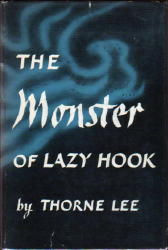
Thorne Lee: The Monster of Lazy Hook    In swift succession, three men — all leading citizens of the little California coastal town of Lazy Hook — vanished without a trace. All three had been connected with the late Spencer Van Dyke, eccentric millionaire, who though he died of natural causes had managed to surround his death with many-sided mystery. What had Spencer Van Dyke done with the huge sum of cash withdrawn from his bank shortly before his death? What was the meaning of the fantastic poem he caused to be engraved on his marble gravestone? Why had he bequeathed the vast and dilapidated Van Dyke mansion to his hermit butler? Had he come from beyond the grave to spirit away Lyman Hobbs, his undertaker, Henri Picard, his lawyer, and Peter Ramsey, the local editor?

   These were the questions that were thrust at the strange pair of detectives who set out to solve the apparently insoluble. The two, crippled Julian Renard, mostly brains, and Robert Bannister, mostly brawn, found themselves in a peculiar and dangerous setup, and only their assorted but well-balanced gifts, together with a certain bit of luck, brought them through alive and entitled to the rewards they had been promised.

   Thorne Lee’s is a fast-paced puzzler, with enough easy humor and unexpected romance to balance the grim and inevitable drama that envelops Lazy Hook and its citizens.

      SUMMER SHOCK (Abelard-Schuman Ltd., 1956) is a good, unusual suspense novel that takes place at the Ashland, Oregon Shakespeare Festival (which is still being held annually and draws huge crowds). According to the author’s bio on the jacket, Shively acted in numerous plays put on at the festival, among them Richard II and King Lear. At the time the book was published he was living in Visalia, CA. and teaching at College of the Sequoias.

      Once again, from the blurb from the inside jacket flap:
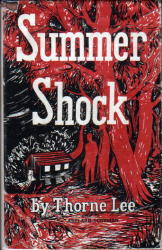
Thorne Lee: Summer Stock    The very first reader of this book, when it was in manuscript form, started his report with this sentence: “This is a book that I don’t think you should get away from you.” We feel that the readers of the finished book will feel the same way about it.

   The Pacific Northwest is the setting, and the author’s description of the natural scenery and his use of it in the story, add much to the special flavor of the novel. The characters are all member of a semi-professional group of actors engaged in putting on a Summer Shakespearean festival. The theatrical background is completely authentic and the details of casting for the various plays are cleverly woven into the plot. (The theatrical material is completely fascinating in itself, but never gets in the way of the swiftly moving story which is full of suspense.)

   It is impossible to summarize the plot without detracting considerably from the reader’s enjoyment — except to say that it is a psychological-suspense story. There are several murders, but this is not a murder-mystery. The reader can be fairly sure, from the very beginning, as to the identity of the murderer. It is the development of the murderer’s mental processes, and the effect this has on all the people around him, that holds our interest.

———

      ADDITIONAL BIBLIOGRAPHY: PULP FICTION —

   From the Cook-Miller index to Detective Pulps, along with Science Fiction, Fantasy, & Weird Fiction Magazine Index (1890-2006) by Stephen T. Miller and William G. Contento for the SF, plus a big assist from Victor Berch:
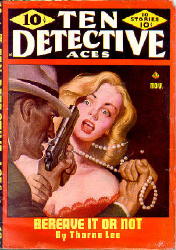
Bereave It or Not, Ten Detective Aces, Nov 1945

Ten Detective Aces, November 1945

The Blood Runs Cold, Doc Savage, Sep 1948
The Britannica Sock [Bannister & Renard], Doc Savage, Jan 1946
A Corpse Slept Here, Dime Detective, Dec 1947
The Crooked House, Weird Tales, Nov 1942    [not by Thorne Lee; see the comments]
Dance Macabre, Ten Detective Aces, Mar 1948
Dead to the World, Ten Detective Aces, Nov 1947
Deadbeat, Doc Savage, Nov 1946
Death in the Groove, Dime Detective, Mar 1946
Dragnet for a Spy, FBI Detective Stories, Oct 1950
Dying to Kill, New Detective Magazine, Sept 1946
The Face of Fear, New Detective Magazine, July 1947
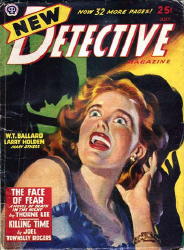
New Detective Magazine, July 1947

The Flesh Is Willing, Doc Savage, July 1946
The Fox and the Hound, Mammoth Detective, Aug 1944
The Ghost Hangs High [Bannister & Renard], Doc Savage, Sep-Oct 1947
Ghost Planet, Startling Stories, June 1943     [probably not by Thorne Lee; see the comments]
The Hanging Sisters, Chief Detective, Winter 1946
Headless Horseman, The Shadow, Aug 1945
I Thought I’d Die, New Detective Magazine, Mar 1946
If Anything Happens to Julia, Shadow Magazine, Feb-Mar 1948
It’s Been a Long, Long Crime, New Detective Magazine, July 1946
It’s in the Bag!, Dime Mystery, Mar 1947
Laughing on the Outside, Detective Story Magazine, Aug 1947
The Mad Dog of Lame Creek, Black Mask, Mar 1946
The Man Who Got Away with It [Bannister & Renard], Doc Savage, Aug 1946
The Man Who Lost His Shadow, Fantastic Adventures, June 1944
Married to Murder, Dime Detective, May 1947
The Merry Men of Mayhem, Detective Tales, Dec 1946
The Merry Widow Murder, Detective Book Magazine, Fall 1949
The Monster of Lazy Hook [Bannister & Renard], Doc Savage, Dec 1946
Murder on My Shoulders, New Detective Magazine, Mar 1947
The Mutilator, Detective Book Magazine, Sum 1949
No Body But Me!, New Detective Magazine, Jan 1947
Possession, Shadow Mystery, Fall 1948
The Reluctant Leopard, Doc Savage, May 1945
The Shock Punch [Bannister & Renard], Doc Savage, June 1945
Some Call It Murder, Detective Story Magazine, Aug 1946
Stairway Going Down, Dime Detective, Sept 1945
There Was an Old Shoe [Bannister & Renard], Doc Savage, May-June 1947
The Whisperer, Dime Detective, Mar 1945
The Whispering Wine, Weird Tales, Mar 1943     [not by Thorne Lee; see the comments]
The Will to Die!, Dime Detective, Apr 1951
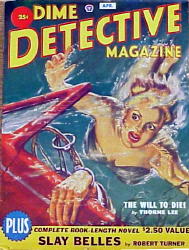
Dime Detective, April 1951

Who Rides a Tiger… [Bannister & Renard], Doc Savage, Apr 1946
The Woman in the Attic [Bannister & Renard], Doc Savage, July-Aug 1947
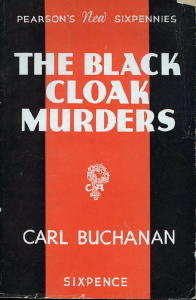
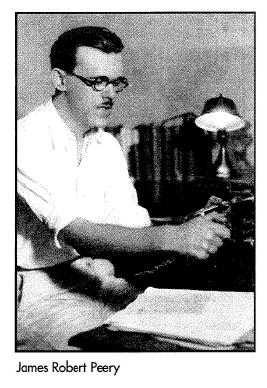
   Carl Buchanan has come up before on this blog, in particular in this post made last January. At the time it had just been discovered that “Carl Buchanan” was the pen name of James Robert Peery, a fact which produced a flurry of activity, including a list of the stories he’d done for the detective pulp magazines.

   I won’t reproduce the list of his short fiction here — you can follow the link above for that — but here now is the revised entry for Buchanan as it presently exists in Part 9 of the online Addenda for the Revised Crime Fiction IV, by Allen J. Hubin:

BUCHANAN, CARL. Pseudonym of James Robert Peery, 1900-1954, q.v. Born in Mississippi; served in U.S. Army’s Signal and Intelligence Divisions in WWI; worked in banking and cotton before settling into journalism; published two mainstream novels under his real name. Under this pen name, the author of a number of short stories for the US detective pulp magazines and three crime novels published in the UK, included in the (Revised) Crime Fiction IV. See below.
      The Black Cloak Murders. Pearson, UK, hc, 1936. Setting: North Carolina.

Carl Buchanan: Black Cloak Murders

      Night of Horror. Mellifont, UK, pb, 1939.
      The Red Scorpion. Mellifont, UK, pb, 1939.

[UPDATE] A week or so ago, I received an email from Suzanne Peery Schutt, who has agreed to allow me to share it with you. She says:

    “My sister-in-law sent me your web site, and I just wanted you to know that I am the daughter of James (Jim) Peery. He was a brilliant man who died at age 54. His two novels are Stark Summer, 1939, and God Rides A Gale, 1940. These were the war years and it was difficult making a living as a writer, so he moved to Jackson from Eupora, working as news editor of radio station WJDX and was Mississippi correspondent for United Press.

    “He died of a thrombosis way too soon, at age 54. I was a junior in college. I cherish my memories: I never had to look up a word in the dictionary as he knew them all. I have no copies of the pulp magazine stories; I was just a child but remember him at the typewriter in the parlor of the family home in Eupora. It was built in 1908 and is still standing despite damage from Katrina. The family who owns it now has renovated it and I go back at least 3 times a year to see it and remember my wonderful heritage.

    “Daddy was married to his childhood sweetheart, Sudie Leigh, and my mother. Mother was a school teacher and superintendent of education for Webster County. For a time, she supported the family so that Daddy could write his two novels.

    “I live in Clinton, am married to Wallis Schutt, an engineer, and we have three grown children. I am an avid reader and quilt maker.”

            Best regards,

              Suzanne Peery Schutt

James Robert Peery


[UPDATE #2] 12-11-07. In the interest in keeping this entry on Mr. Peery complete, here are the combined listings of his pulp stories written as Carl Buchanan, as far as Victor Berch and I have been able to determine them, taken in part from The FictionMags Index:

BUCHANAN, CARL

Blind Trail, All-Star Detective Stories Oct. 1930
The Crag Island Murders, (nv) Five-Novels Monthly Apr 1932
Crimson Goblet, (ss) Clues Aug 1934
The Head That Lived, Super Detective Stories July 1935
Hot Car Wreckage, All-Star Detective Stories Apr. 1932
Finger for Sale, (ss) Clues Oct 1935
Laughter in the Chapel, (ss) Clues Apr 1934
The Monk’s-Hood Murders, All-Star Detective Stories July 1930
Murder By Candlelight, Mystery Apr. 1933
Murder in the Rain, The Underworld Magazine Aug. 1931
The Mystery of the Two Glasses, (ss) Clues Jul #2 1930
Red Haven, (ss) Clues Dec 1934
The Red Scorpion Murders, World Man Hunters Feb. 1934
Rhapsody in Blood, (ss) Clues Feb 1934
Right Guy, (ss) Clues Aug #1 1930
Rope’s End, Murder Stories Sept-Oct 1931
Screams of the White Cockatoos, (ss) Clues Jul 1934
Sweet Racket!, (ss) Clues May #2 1930
The Time of the Crime, (na) The Thriller Dec 9 1933
2 Minutes from Murder, (ss) Clues Mar 1935

   Victor adds “There is one other [detective] tale under the name Robert Peery, who, I assume, is our man.”

The Spy Champion, Startling Detective Stories Mar 1930

   To which I agree, and although it is has not yet been confirmed that Robert Peery is indeed James Robert Peery, here again from The FictionMags index are the following:

PEERY, ROBERT

The Bat Patrol, (ss) Eagles of the Air Jan 1930
Battle Madness, (ss) Battle Stories Nov 1931
Brood of the Black Eagle, (nv) Battle Stories Nov 1929
Bullet Bait, (ss) Battle Stories Apr 1931
The Claws of the Yellow Eagle, (ss) War Birds Jun 1929
Condemned to Die, (ss) Battle Stories Feb 1930
A Corner in Bully Beef, (ss) Over the Top Jan 1929
Dan Comes Back!, (ss) Flyers Nov 1929
The Decoy Battery, (ss) Battle Stories Jun 1929
Decoy of Death, (ss) Battle Stories #65 1935
Dog Robber and the Spy, (ss) Triple-X Magazine Oct 1929
A Dog-Robber in No-Man’s Land, (ss) Battle Stories Jan 1932
Fixed Bayonets, (ss) Battle Stories Dec 1929
Forward by Squads, (ss) Battle Stories Aug 1930
Fury in the Blue, (ss) Battle Stories May 1929
Handcuffed in No-Man’s Land, (ss) Battle Stories Feb 1932
A Hero in Spite of Himself, (ss) Battle Stories Sep 1930
Hidden Guns, (ss) Complete Flying Novel Dec 1929
The Lost Mine Murders, (ss) Triple-X Western Aug 1931
The Mystery Gun of Company B, (ss) Battle Stories Jun 1931
Off With Your Stripes!, (ss) War Stories Mar 27 1930
On Enemy Wings, (ss) Battle Stories Jul 1929
On Wings of Despair, (ss) Zoom Apr/May 1931
The Phantom Murder, (ss) Triple-X Magazine Dec 1929
Punishable with Death, (ss) Battle Stories May 1931
Sadie Was There!, (ss) War Novels Feb 1929
The Spy at Regimental, (ss) Battle Stories May 1930
The Spy of Mercier Trench, (ss) Battle Stories Mar 1930
The Spy with the Bandaged Hand, (ss) Battle Stories Jan 1930
The Stranded Platoon, (ss) Triple-X Mar 1930
The Suicide Job, (ss) War Stories Oct 11 1928
That Bum From Mott Street, (ss) War Stories Mar 14 1929
Thirteen to One, (ss) War Birds Aug 1929
To the Last Gun, (ss) Battle Stories Oct 1930
Tunnel of Death, (ss) Battle Stories Nov 1932
Written in Blood, (ss) War Novels Jul 1930

   In addition, James Robert Peery had a letter published in the July 1939 issue of Clues, which neither Victor nor I have seen. If anyone has a copy of the magazine, we’d love to know what he had to say.

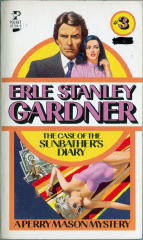
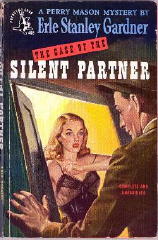
   I was looking over the previous post here on the M*F blog this morning, the one on Gardner paperbacks, wondering if I need tweak anything here or there, and it occurred to me that that last cover was the only one that I could remember having a portrayal of Perry Mason on it.

   Perhaps I could have you just go back and take a look, but since it’s handy, why don’t I simply show it to you again:

Perry Mason

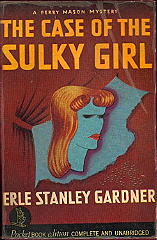
   The covers on the earliest Pocket paperbacks, going back to the early 1940s, always seemed to me to be attempts to imitate the art on hardcover jackets, rather subdued and far from lurid:

Perry Mason

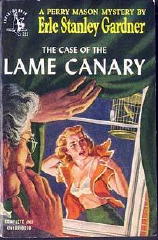
   Later on toward the end of 1940s, the covers at Pocket seemed more and more designed to do their job properly, to catch the eye of the guy (usually) at the newsstand:

Perry Mason

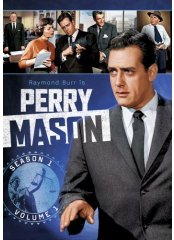
   That cover at the top of this page must have come from the end of the Pocket era. If that’s Perry Mason who’s pictured on it, it certainly doesn’t look like Raymond Burr, who was perfect in the part, but very much an establishment figure. He was a whole lot younger when he started, though. Here’s the cover of the recent box set, which I’ve bought but (all together now) I haven’t started to watch yet:

Perry Mason

   To me, the guy on the Pocket cover looks more like Monte Markham, who had the role for about half a season, 1973-74, before they pulled the plug on him. To TV viewers, it was Raymond Burr who was Perry Mason, and no one else. Even though he may not have been playing Mason at the time, this is what Markham looked like then:

Perry Mason

   But getting back to covers with Mason himself on them, I think I may have found an earlier one after all. It’s from the late 1940s era, and as a character, I don’t think all of his rough edges had rubbed off yet. Mason was a tougher guy at the beginning, his roots (as well as Gardner’s) being solidly in the pulp era, and more specifically Black Mask and Dime Detective.

   I think those roots are still showing here:

Perry Mason

FIRST YOU READ, THEN YOU WRITE
by Francis M. Nevins

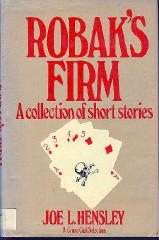
   Late August was a disaster for mystery writers and lovers. First we lost Magdalen Nabb, then John Gardner, then one who was a dear friend of mine. Joe L. Hensley � private attorney, member of the Indiana legislature, prosecutor, judge, dealer in rare coins and paper money, writer of science fiction since the early 1950s and more recently of 20-odd mystery novels � died on August 27 at age 81.

Robak's Firm

   For the past several decades his home was Madison, Indiana, a charming town on the Ohio River just across from Kentucky and about 300 miles from St. Louis. Whenever I was driving east he’d invite me to stay over for drinks, dinner, dialogue and the use of his guest bedroom. How he could tell stories! Hoosier politics, the judiciary, colleagues in the SF and mystery fields ranging from Harlan Ellison to Avram Davidson to John D. MacDonald, encounters over the years with everyone from Robert Frost to Bob Hope — the anecdotes poured out of him like the water over Niagara Falls, especially when we’d drive together from Madison to the annual Pulpcon in Dayton, Ohio, where he was guest of honor one year and I the next.

   I reviewed several of his novels for St. Louis newspapers and wrote the entry on him for the reference book that used to be called 20th Century Crime and Mystery Writers and is now for obvious reasons known as the St. James Guide to Crime and Mystery Writers. His final novel, Snowbird’s Walk, will be published early next year. Driving east will never again be so pleasant for me.

***

   The Indiana towns I know best are Madison, thanks to Joe, and Bloomington, thanks to Indiana University’s Lilly Library where Anthony Boucher’s papers are archived. On a visit to the Lilly several years ago I came upon Boucher’s correspondence with Cornell Woolrich and his comments on various Woolrich stories. Someday I hope to include this material in an updated edition of First You Dream, Then You Die, but this column offers a fine venue for a sneak preview.

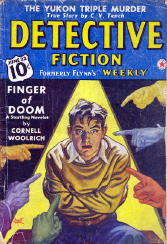
Finger of Doom

   In Tony’s first letter to the master of suspense, dating from the late spring of 1944, he asked permission to reprint a Woolrich tale in his anthology Great American Detective Stories (World, 1945). Replying on June 5, Woolrich recommended that Boucher use “Endicott’s Girl” (Detective Fiction Weekly, February 19, 1938), which he called “my favorite among all the stories I’ve ever written.”

   Boucher didn�t care for that one, as he explained in a July 19 letter to World editor William Targ: �It has in extreme measure the frequent Woolrich flaw � a fine emotional story which ends with loose ends all over the place and nothing really explained.� Instead Boucher opted for �Finger of Doom� (Detective Fiction Weekly, June 22, 1940), which he retitled �I Won�t Take a Minute.� �Endicott�s Girl� remained uncollected until I put it in Night and Fear (2004).

   More gems from the Boucher-Woolrich correspondence are likely to pop up in future columns.

***

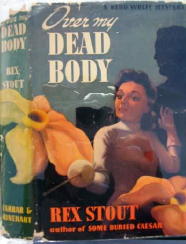
Over My Dead Body

   The first murder in Rex Stout�s Over My Dead Body (1940) takes place in a fencing academy. The weapon is a col de mort, a doohickey that when slipped over the usually blunt end of an epee turns it into a lethal weapon. Whether Stout made up this device out of whole cloth (if I may coin an Avalloneism) or whether it exists in the real world I have no idea and couldn�t care less. What intrigues me is whether among the readers of this Nero Wolfe adventure might have been one J.K. Rowling. Is it coincidence that the king toad of the Harry Potter books is named Lord Voldemort?

***

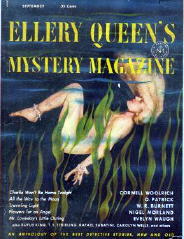
   Vincent Cornier (1898-1976) was an English author of French descent who inherited a neat pile of money as a young man and thereafter devoted himself to writing short stories of fantasy and mystery. Very few of them were published in the U.S. until, after World War II, Fred Dannay discovered his work in old British periodicals and began reprinting occasional Cornier stories in Ellery Queen�s Mystery Magazine.

   Eventually Cornier began to send Fred a few originals. Earlier this year I had occasion to re-read most of his stories from EQMM. The one I found most intriguing was the first of those originals, �O Time, In Your Flight� (September 1951).

EQMM Sept 1951

   Why? Because it contains a uniquely beautiful clue to the solution: one that is available only to readers who recognize the title�s poetic source and remember the three words in the poem that come just before the five in the title! The question all but asks itself: Was it Cornier or Fred who put that brilliant title on the story? Their correspondence, which is archived at Columbia University, doesn�t indicate what title was on the tale when Cornier submitted it, but we know that Fred had a penchant for changing the titles of many of the stories he published. Also I find no evidence in Cornier�s other stories that he had any particular interest in poetry, while Fred not only collected rare first editions of poetry but also wrote some of his own. It seems to me far more likely than not that the stroke of genius was Fred�s.

   If further proof is needed, there�s indisputable evidence that Fred knew the poem in question: he used the first three words of the line, the words that provide the clue to Cornier�s story, as the title for another tale by another author that appeared in EQMM a few years later! The author was Dorothy Salisbury Davis, the issue June 1954. After you�ve read �O Time, In Your Flight� in Duels in Shadows, the forthcoming Crippen & Landru collection of Cornier�s best mysteries, Google the title and you�ll quickly find what I�ve been hinting at without, I hope, having given it away. But don�t do it before or you may spoil the story!

   Morton Wolson, 1913-2003, or Peter Paige, as he was known when he was writing for the detective pulps, has come up for discussion several times in these pages. The first time was a review I did of his only full-length novel, Nightmare Blonde (Pocket, 1988). In the course of the review I included everything I knew about the author at the time.

   The second time came soon thereafter, when Morton’s son Peter spotted the review and sent me an email that provided quite a bit more information about him.

   After reading both of these entries on the blog, pulp enthusiast and collector Walker Martin emailed me to tell the story of how he tracked down Morton Wolson in the 1980s and had a long afternoon’s conversation with him about his days in the pulps.

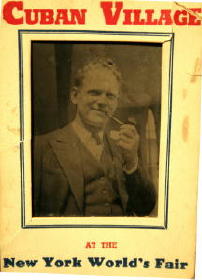
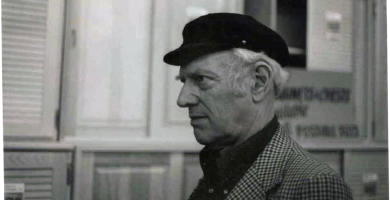
   Peter has kept in touch with me in the weeks since, and he recently sent me a couple of photos of his father, which of course I’m very pleased to be able to show you here.

   This first one was taken when he was a bouncer at the Cuban Village in the New York 1939 World’s Fair, as he looked when he wrote his first piece for Black Mask, “I Guard Nudes.”

Peter Paige

   Peter adds that this occurred shortly after he returned from fighting against Franco in the Spanish Civil war, in which he was a member of the Lincoln Brigade, had been appointed Chief Cadre officer, and then was a partisan fighter in the Basque country, blowing bridges and trains, as depicted in Hemingway’s For Whom the Bell Tolls.

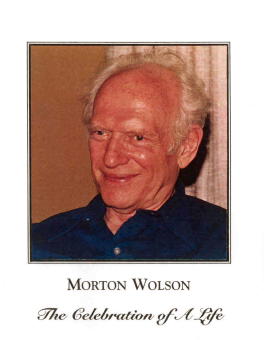
   This next one is the one used at his memorial services at the time of his death.

Peter Paige

   If you follow the links back to the previous entries, you’ll find that Morton’s stories under his own name have been discussed previously. This time around you’ll find a complete list of all of the pulp fiction that he wrote as Peter Paige, beginning with the previously mentioned “I Guard Nudes,” (Black Mask, Sept 1939) a story about security measures at a NY World’s Fair sideshow featuring scantily clad exotic dancers.

   Paige’s primary series character was Cash Wale, a hardboiled New York City private eye in the Race Williams vein. His sidekick, Sailor Duffy, is an ex-pug with “scrambled brains” whom Wale watches out for. Lots of violent action, tough talk, and wisecracks, says Bill Pronzini, when I asked him what he recalled about the pair. Dime Detective was the primary venue for the Cash Wale series, but Wale’s very first appearance was in the January 1940 issue of Black Mask, the only time he showed up in that magazine.

   The primary source of the data below is the two volume index Mystery, Detective, and Espionage Fiction, by Michael L. Cook and Stephen T. Miller. (Garland, 1988). Additional input came from Bill Pronzini, who provided much of the story information above and assistance when Cook-Miller produced questions I could not answer.

Peter Paige


      THE PETER PAIGE STORIES —

“I Guard Nudes,” Black Mask, September 1939.
     Reprinted in Big Double Feature Magazine, 1#1, circa 1940 as “I Guard Dudes”
         FOOTNOTE #1.
“Swastika Scorge,” Black Mask, December 1939.
“Voodoo Frame,” Black Mask, January 1940. CW = Cash Wale.
“The Fatherland of Otto Bloch,” Detective Fiction Weekly, Jan 27 1940.
“Blackout!” Black Mask, February 1940.
“Counterfeit Citizen,” Black Mask, March 1940.
“The Friends of Papa Valdes,” Black Mask, April 1940.
“The Corpse Promoter,” Detective Tales, April 1940.
“My Pop, the Cop,” Detective Fiction Weekly, Apr 27 1940.
“And God Won’t Tell,” Black Mask, July 1940.
“Pick’s Last Crime,” Detective Fiction Weekly, Aug 10 1940.
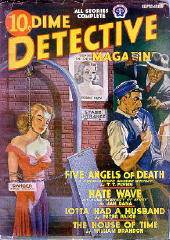
“Lotta Had a Husband,” Dime Detective, September 1940. CW.

Dime Detective Sept 1940

“Pick’s Last Crime,” Detective Fiction Weekly, Oct 26 1940.    FOOTNOTE #2.
“Blitzkrieg Bankroll,” Fifth Column Stories, November, 1940.
“They Refuse to Understand,” Detective Fiction Weekly, Dec 7 1940.
“Dopey and theDevil,” Detective Fiction Weekley, Dec 21 1940.
“Treachery Goes to School,” Fifth Column Stories, January, 1941.
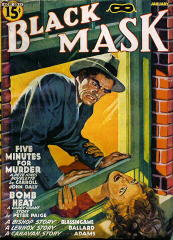
“Bomb Heat,” Black Mask, January 1941.

Black Mask Jan 1941

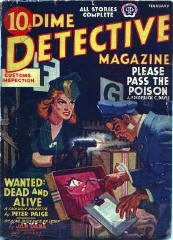
“Wanted: Dead and Alive” Dime Detective, February 1941. CW.

Dime Detective Feb 1941

“The Bullet from Nowhere,” Dime Detective, April 1941. CW.
“Lady, Can You Spare a Corpse?” Dime Detective, June 1941. CW.
“Picture Me Dead!” Black Mask, November 1941.
“Local Corpse Makes Good,” Dime Detective, November 1941. CW.
“The Night You Shot Hitler,” Black Mask, February 1942.
“Death Is from Hunger,” Dime Detective, April 1942. CW.
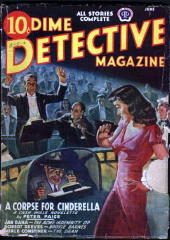
“A Corpse for Cinderella,” Dime Detective, June, 1942. CW.

Dime Detective June 1942

“Death Is a Souvenir,” Black Mask, August 1942.
“Berlin Papers, Please Copy,” Black Mask, September 1942.
“Joe Is Dead,” New Detective, January 1943.
“Death Stands By,” Dime Detective, February 1943. CW.
“Just a Sample,” Short Stories, May 1943.
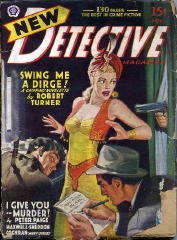
“I Give You – Murder!” New Detective, November 1943.

New Detective Nov 1943

“The Riddle of Papa Rio,” Dime Detective, August 1945. CW.
“Twelve Dead Mice,” Dime Detective, January 1946.
“Guilt-Edged Frame,” Dime Detective, September 1946.
“A Little Corpse Who Wasn’t There,” Dime Detective, December 1946. CW
“Cash in the Chips,” Dime Detective, January 1947. CW
“When a Man Murders,” Dime Detective, March 1947. CW
“Meet Me in Death Alley,” Detective Tales, May 1947. CW
“Death – on the House,” Dime Detective, June 1947. CW
“Softly Creep and Softly Kill!” Detective Tales, August 1947.
    Reprinted in Triple Detective, Summer 1953
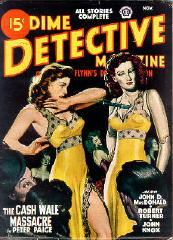
“The Cash Wale Massacre,” Dime Detective, November, 1947. CW

Dime Detective Nov 1947

“The Merry Wives of Murder,” Detective Tales, February 1948.
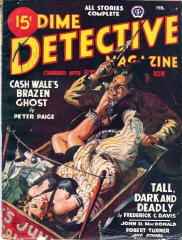
“Cash Wale’s Brazen Ghost,” Dime Detective, February 1948. CW

Dime Detective Feb 1948

“Die, Little Lady,” Detective Tales, March 1948.
“The Sweetest Corpse in Town!” Detective Tales, April 1948
    Reprinted in Triple Detective, Fall 1953.
“House in Silence,” Dime Detective, June 1948.
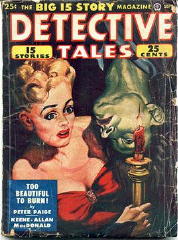
“Too Beautiful to Burn,” Detective Tales, September 1948.

Detective Tales Sept 1948

“Cash Wale’s Lethal Lulu,” Dime Detective, October 1948. CW
“The Corpse and I,” Dime Detective, January 1949.
“That Mad, Mean Murder Man,” Detective Tales, March 1949.
“Cash Wale’s Carnival Kill,” Dime Detective, May 1949. CW
“Coffin Cure,” Dime Detective, July 1949.
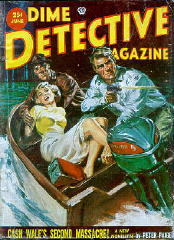
“Cash Wale’s Second Massacre!” Dime Detective, June 1953. CW

Dime Detective June 1953

“Adam and Evil!” Detective Tales, August 1953.
“The Watcher” Manhunt, November 1953.

   Stories as by MORTON WOLSON:     [FOOTNOTE #3]

“The Attacker” Ellery Queen’s MM, January 1954.
“The Glass Room” Ellery Queen’s MM, September 1957.
Nightmare Blonde, novel, Pocket, 1988.

FOOTNOTE #1. Bill Pronzini and I suspect that the altered title is a slip of the finger on the part of Cook-Miller. The single issue of Big Double Feature Magazine consisted of nothing but reprint stories, the westerns from Ranch Romances, the mysteries from Black Mask.

FOOTNOTE #2. The title of this story is the same as that for the August 10, 1940, issue of Detective Fiction Weekly. Neither Bill nor I have either magazine, but one possibility that he suggests is that Paige’s “You’re the Jury” in the November 16, 1940 issue of DFW is listed as #3 in a series of true stories. It could be that “Pick’s Last Crime” was both #1 and #2, a two-parter despite the two-month gap or maybe a followup piece.

   [UPDATE] 08-27-08. In the comment he left early this morning after checking his set of DFW, Walker Martin reports that, surprisingly enough, what the magazine did was to publish two separate stories by Paige having the very same title.

FOOTNOTE #3. The first version of this list included only the stories written by Morton Wolson as Peter Paige for the pulp magazines, and somehow the story he did for Manhunt, a digest, was missed. Thanks to Jiro Kimura for catching this. See his comment that follows. Having added the one missing story, I decided to include the three other stories he did under his own name. Compleatness is the goal, after all!

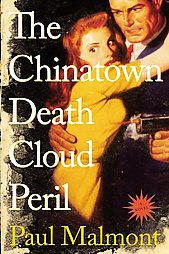
PAUL MALMONT – The Chinatown Death Cloud Peril.

Simon & Schuster; hardcover. First Edition: May 2006. Trade paperback: June 2007.

Chinatown Death Cloud Peril

   In 1937, the United States was in the midst of the Great Depression. For entertainment there was no television, only radio, the movies and – the pulps. The newsstands were filled with magazines made of cheap paper with lurid covers. Two of the best of these were The Shadow and Doc Savage, written by Walter Gibson and Lester Dent, respectively, although the general public knew them only by their pseudonyms, Maxwell Grant and Kenneth Robeson.

   What Paul Malmont proposes in this almost hoot of a novel is that Gibson, Dent, and a gent named L. Ron Hubbard combined forces to solve the murder of a fellow writer, one H. P. Lovecraft, and to track down at the same time a fellow from China trying to give his country a step up on Japan in those desperate days before World War II.

   Other real names which can be spotted in the narrative are Robert Heinlein, Chester Himes, Louis L’Amour and more than a few others. There is only one problem. No pulp novel ever took more than 150 pages to get started, as this book does.

   The author seems to feel that many readers will need a long expository history of the pulp magazines before he can begin, along with the life stories of each of the primary protagonists. Those who do not require this information will be bored, I fear – unless they enjoy quibbling about the details – expecting a faster pace by far. As for the uninitiated for whom the background would be useful, I wonder how many of them will ever get past the background.

   But when the book finally does take off, it’s hang-on-to-your-seatbelt time, there’s no doubt about it!

— June 2006

   Note: This review appeared earlier in Historical Novels Review.

   The latest batch of covers uploaded to Bill Deeck’s Murder at 3 Cents a Day website are those for The William Caslon Company, which in 1936 managed to publish only three mysteries.

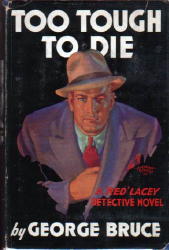
   All three of these novels would be of special interest to pulp fans, though, as one is a collection of four Red Lacey novelettes by George Bruce originally published in Popular Detective, while the other two are “Dan Fowler” G-Men novels which first appeared in that magazine. A connection with Leo Margulies’ Standard Magazines group of pulp titles seems highly likely.

George Bruce

   Even more interesting is the existence of a catalog of forthcoming books from Caslon in 1938, books that were never published, but the titles of which may make you wish they had. These include:

THE DEVIL’S PLAYGROUND, A G-Man Detective Novel, by John Benton.

THE CLAIM OF THE LITTLE RED BUGS, A Dr. Lawson Detective Novel, by George Bruce.

THE MURDER OF A GOOD MAN, A Professor Briarly Detective Novel, by Will Levinrew.

DEATH WALKS ALONE, by G. Wayman Jones.

   And others, including a few westerns, among which are:

PANHANDLE BANDITS, A Texas Rangers Novel, by Tom Curry.

JUSTICE RIDES ALONE, by Jackson Cole.

   Follow the link above for the complete list.

   Last night I dreamed I went to Pulpcon again. In retrospect, getting on the hotel shuttle bus on early Sunday morning on the way back to the Dayton airport, it seemed as if the four preceding days had simply flown by, and it still does.

   Attendance was down once again, but not significantly, I’m told, from last year. The convention began the day after July 4th, and that was suggested as having a good deal to do with it. Sales were down also, or so I heard, but perhaps that was due to prices generally being up, on the pulps at least. With eBay as a backup, no dealer wants to sell his wares too low.

   And the selection was limited, mostly because the supply of pulp magazines not already in collectors’ hands is diminishing at an ever-increasing rate. But there were plenty of pulp reprints in the dealers’ room, for those who want only to read the odd-ball titles, and tons of paperbacks, hardcover books (mostly science fiction), and other reading material in the room. When I say tons, I am not exaggerating.

   Martin Grams had his usual pair of tables filled with DVDs of vintage TV shows, of which I resisted and bought only three: an obscure series on ABC in 1960, Dante, starring Howard Duff. I ought to look, but I believe that means I have 24 of the 26 total episodes. It’s a crime show in which night club owner Willie Dante (Duff) is trying to go straight, but his past keeps interfering.

   Coincidentally enough, as you’ll see in a minute, Martin has just published his latest book on Old Time Radio, this one a history of the Sam Spade series, starring (for the first part of the run) none other than Howard Duff. I bought a copy, and if you were to happen to ask me, I’d tell you that you should too.

   Most of the time at the show itself, disregarding periodic intervals for eating and visiting area bookstores, is spent by most everyone by walking around the dealers’ room and stopping for long talks with people on either side of the tables, fellow collectors you see perhaps only once or twice a year. Lots of discussion going on about what author’s works are going to be reprinted next, what big finds were made, how’s the family, and what are you looking for now?

   Randy Cox (editor of Dime Novel Roundup) made his first appearance in three years. Six of us, Randy, Jim Goodrich, Paul Herman, Walter and Jim Albert, and I, spent much time dining out and catching up with each other’s lives at great lengths. By the way, one piece of crushingly bad news was the demise of the Breakfast Club, a small café we’d discovered and frequented many mornings over the past five or six years.

   Mike Nevins also appeared, as full of bountiful energy as ever and promising me a new column for this blog as soon as he can do it. I also talked at length with Walker Martin, John Locke, Al Tonik, Ed Hulse and many others, including Jim Felton, whose enthusiasm for Robert Martin continues unabated and without bounds. Ed Hulse, publisher of Blood ’n’ Thunder magazine, won this year’s Lamont Award for his outstanding contributions to the hobby of pulp collecting. It was a popular choice.

   Guests of honor were David Saunders, son of famed pulp artist Norman Saunders, and Glenn Lord, a long time administrator of Robert E. Howard’s estate.

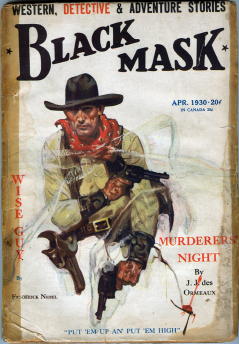
   And believe it or not, I bought a pulp, the one whose cover you see here. I was sorely tempted many many times, with hundreds of others I thought about, thought again, but did not buy. Every time I almost pulled the trigger, I thought of all the boxes of unread pulps I have in my basement and garage, and asked myself (foolishly, I know), do I really want to buy more?

Black Mask, April 1930

   In all but one case the answer was no, but the one case is an example of one that I do not have boxes and boxes of, Black Mask for April 1930. You can’t tell from the cover, which mentions only Frederick Nebel and J. J. des Ormeaux, but this issue also contains two Raoul Whitfield stories, one as by Ramon Decola, and an installment of “The Glass Key,” by Dashiell Hammett.

   The condition is fairly iffy, but the stories are good. Maybe I’ll pick up Part Three next year. One can only dream, can’t one?

   Rather than be in town on the 4th for hamburgers and hot dogs, not to mention barbecue ribs, I’ll be flying to Dayton tomorrow for this year’s Pulpcon, where collectors of old pulp magazines, vintage paperbacks and all kinds of similar items gather to buy, swap and tell yarns of the ones that either they hooked or got away.

   I’m sure I’ll see some of you there, or if you don’t read this until you get back, I’m sure you had a good time, too.

   But I’m going to stay away from computers for a while, and there’ll be no postings until I’m home again, which will be next Sunday. The mid-summer hiatus may even be longer than that, I’m sorry to say. My son Jonathan is leaving home again. Next week he’ll be moving into a new place of his own a couple of towns north of here, and I’m the one who’ll be loading the SUV, driving the SUV, and unloading the SUV, not to mention waiting around for the real movers to bring his major stuff up from Maryland. (Well, he’ll help.)

   My scanner’s gotten cranky on me, too. I’m not too happy with the sharpness on the images included in that last post, and I certainly don’t feel like dealing with it any more this evening. It’s time to take a break all around. You may as well assume I’ll be off for a week or so. I hope it’s no longer than that. In the meantime, don’t do anything rash and stay cool.

[UPDATE] 07-11-07. I’ve done some work on the images I was unhappy about last week. I think there’s some improvement, but maybe it’s wishful thinking. I’ll take another look tomorrow, but at the moment it’s ten in the evening, and there’s a book calling my name…!

   The latest batch of covers uploaded to Bill Deeck’s Murder at 3 Cents a Day website are those for Gateway Books, 1939-1942.

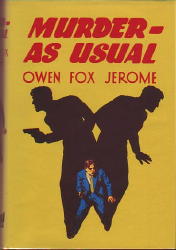
Murder -- As Usual

   Here’s Bill Pronzini’s introduction to the page where you’ll find them:

   The imprint was a subsidiary of the Standard Magazines pulp group edited by Leo Margulies. Most if not all of the Gateway mysteries (and Westerns and light romances) were expansions and/or revisions of works that first appeared in such Standard pulps as Thrilling Detective, Popular Detective, The Ghost Detective, etc. It’s interesting to note that no Gateway titles in any genre were published in 1941. I have no idea of the reason for this, other than a guess that it was financially motivated.

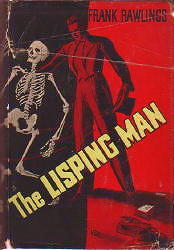
   Authors include Norman Daniels, once under his own name and twice as William Dale; John L. Benton (Tom Curry) with two titles; Will F. Jenkins, aka Murray Leinster; G. T. Fleming-Roberts, as Frank Rawlings, with The Lisping Man, a novel featuring magician George Chance, aka The Ghost.

The Lisping Man

« Previous PageNext Page »