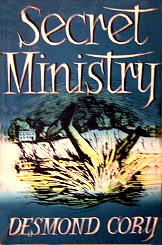
In an email to Al Hubin, subsequently forwarded on to me, mystery bookseller Jamie Sturgeon recently pointed out the existence of a website devoted to British spy and crime thriller writer Desmond Cory.
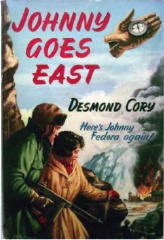
East

   Many of Cory’s “Johnny Fedora” novels of espionage and adventure were published as paperback originals in the US by Award in the 1960s during the height of the boom for James Bond and his many imitators — only Johnny Fedora had been there first. Walker published a number of others in hardcover around the same time, and many of these were reprinted in softcover by Signet.

   As available as his books were at one time, the fact remains that Desmond Cory’s fiction is now all but unknown in the US — and perhaps in the UK as well — even though the introduction to the previously mentioned website can arguably proclaim that –

   Some 50 years ago, Desmond Cory wrote the first of a series of thrillers that helped spawn one of Britain’s most popular fictional genres — the 20th Century “Spy Novel.”

   Sometimes referred to as “Brit Grit,” this phenomenon comprised several well-known characters such as Ian Fleming’s James Bond, and Len Deighton’s Harry Palmer. At its peak, the genre sold several million books across the world, and was watched by even greater numbers on the Big Screen, due to the immense popularity of James Bond, as incarnated by the incomparable Sean Connery. Preceding the now legendary 007 was Desmond Cory’s Johnny Fedora, “the thinking man’s James Bond.”

   Here, with one addition, the year of his death, not known until now, is the complete dossier on author Desmond Cory as found in Crime Fiction IV, by Allen J. Hubin. British editions only are given, unless published in the US under new titles:
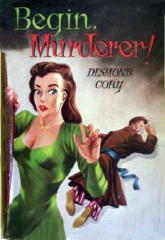
Begin

CORY, DESMOND; pseudonym of Shaun McCarthy, (1928-2001); other pseudonym Theo Callas.

* Begin, Murderer! (n.) Muller 1951 [Lindy Grey; England]
* Secret Ministry (n.) Muller 1951 [Johnny Fedora]
* This Is Jezebel (n.) Muller 1952 [Lindy Grey; England]
* This Traitor, Death (n.) Muller 1952 [Johnny Fedora; Paris]
* Dead Man Falling (n.) Muller 1953 [Johnny Fedora; Austria]
* Lady Lost (n.) Muller 1953 [Lindy Grey; England]
* Intrigue (n.) Muller 1954 [Johnny Fedora; Italy]
* The Shaken Leaf (n.) Shakespeare Head 1954 [Lindy Grey; England]
* Height of Day (n.) Muller 1955 [Johnny Fedora; Africa]
* The Phoenix Sings (n.) Muller 1955 [England]
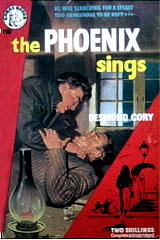
Phoenix

* High Requiem (n.) Muller 1956 [Johnny Fedora; Africa]
* Johnny Goes North (n.) Muller 1956 [Johnny Fedora; Sweden]
* Pilgrim at the Gate (n.) Muller 1957 [Mr. Pilgrim; England]
* Johnny Goes East (n.) Muller 1958 [Johnny Fedora; Tibet]
* Johnny Goes South (n.) Muller 1959 [Johnny Fedora; Argentina]
* Johnny Goes West (n.) Muller 1959 [Johnny Fedora; South America]
* Pilgrim on the Island (n.) Muller 1959 [Mr. Pilgrim; Germany]
* The Head (n.) Muller 1960 [Johnny Fedora; Spain]
* Stranglehold (n.) Muller 1961 [Mr. Dee; England]
* Undertow (n.) Muller 1962 [Johnny Fedora; Spain]
* Hammerhead (n.) Muller 1963 [Johnny Fedora; Madrid]
* The Name of the Game (n.) Muller 1964 [Mr. Dee; England]
* Shockwave (n.) Walker 1964; See: Hammerhead (Muller 1963).
* Deadfall (n.) Muller 1965 [Spain]
* Feramontov (n.) Muller 1966 [Johnny Fedora; Spain]
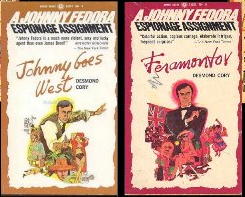
Award

* Overload (n.) NEL 1966; See: Johnny Goes South (Muller 1959).
* Timelock (n.) Muller 1967 [Johnny Fedora; Spain]
* Mountainhead (n.) Award 1968; See: Johnny Goes East (Muller 1958).
* Trieste (n.) Award 1968; See: Intrigue (Muller 1954).
* Dead Men Alive (n.) Award 1969; See: Height of Day (Muller 1955).
* The Hitler Diamonds (n.) Award 1969; See: Dead Man Falling (Muller 1953).
* The Night Hawk (n.) Hodder 1969 [Spain]
* The Swastika Hunt (n.) Award 1969; See: Johnny Goes North (Muller 1956).
* The Nazi Assassins (n.) Award 1970; See: Secret Ministry (Muller 1951).
* The Gestapo File (n.) Award 1971; See: This Traitor, Death (Muller 1952).
* Sunburst (n.) Hodder 1971 [Johnny Fedora; Spain]
* Take My Drum to England (n.) Hodder 1971 [Spain]
* Even If You Run (n.) Doubleday 1972; See: Take My Drum to England (Hodder 1971).
* A Bit of a Shunt Up the River (n.) Doubleday 1974 [England]
* The Circle Complex (n.) Macmillan 1975 [Wales]
* Bennett (n.) Macmillan 1977 [Spain]
* The Catalyst (n.) St. Martin’s 1991; See: The Strange Attractor (Macmillan (London) 1991).
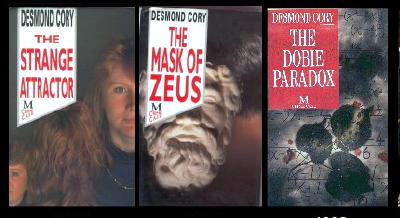
* The Strange Attractor (n.) Macmillan 1991 [Prof. John Dobie; Dr. Kate Coyle; Wales]
* The Mask of Zeus (n.) Macmillan 1992 [Prof. John Dobie; Dr. Kate Coyle; Cyprus; Academia]
* The Dobie Paradox (n.) Macmillan 1993 [Prof. John Dobie; Dr. Kate Coyle; Scotland]

McCARTHY, SHAUN (Lloyd) (1928-2001); see pseudonyms Theo Callas & Desmond Cory

* Lucky Ham (London: Macmillan, 1977, hc) [Oxford; Academia]

CALLAS, THEO; pseudonym of Shaun McCarthy, (1928-2001); other pseudonym Desmond Cory

* The City of Kites (Muller, 1955, hc) [Vienna]

   Quoting from the website —

   The Johnny Fedora series consists of 16 novels written over a period of twenty years, all taking place in exotic locations.

Secret

   In the first novel, Secret Ministry, Johnny Fedora is introduced as a secret agent whose forte is the ability to outshoot, outwit, and outmaneuver his Cold War opponents. In subsequent novels, he is often teamed up with Sebastian Trout from the Foreign Office. Johnny’s connection with British intelligence is unofficial, but is hired by them for specific assignments.

   Written at the same time as the early Fedora novels, the Lindy Grey series were entertaining private-detective thrillers, comprising over 4 titles.

   In Begin, Murderer! Lindsay Grey starts as an urbane man-about-town who solves murders that baffle the Oxford police. Self-described as “a one-time private detective of one-time private means”, Lindy (as he likes to be called) is not ashamed of living a dissolute life.

   In 1991, after a decade of dedicating his writing efforts to academic works, Cory returned to writing mystery novels, introducing a new series character, Professor John Dobie.

   The first Dobie novel, The Strange Attractor, introduces us to an absent-minded maths professor who stumbles into the world of computer hacking, high-tech thievery, and multiple murder. Through wit and a clever plot, Cory takes Dobie through an intriguing sequence of events where he is drugged, tied up and made to witness a murder. New characters such as his girl-friend Dr. Kate Boyle, and Detective Inspector Michael Jackson (Wacko Jacko) add further spice to this clever mystery novel.
Dobie

   One novel, Deadfall, was made into a film starring Michael Caine as cat burglar Henry Clarke, who with his accomplices attempts to steal diamonds from the chateau of a Spanish millionaire.

   Chock full of other information about the author and his other standalone thrillers, the website is certainly worth a visit. Lots of great cover art, too, of which I’ve provided you with only a small sampling.
  Hello,

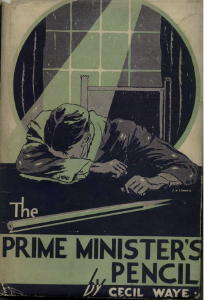
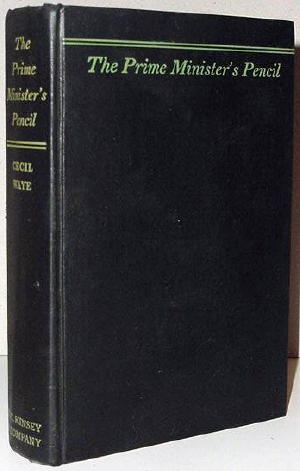
   I’m a small book dealer in Canada. I stock 50% lit. and 50% mystery with an emphasis on bibliomysteries. I recently acquired a 1st US ed. of The Prime Minister’s Pencil by Cecil Waye (John Rhode, Miles Burton, etc.) published by H.C. Kinsey.

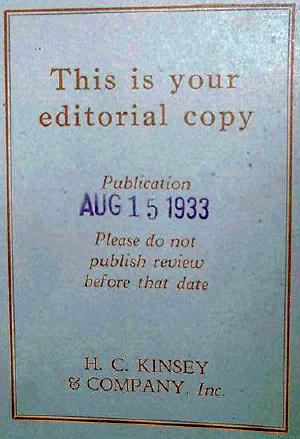
   It is a review (advance) copy or as the slip states “This is your editorial copy, Publication AUG.15 , 1933. Please do not publish review before that date. H.C. Kinsey & Company,Inc.”

   I noticed on your Mystery*File web site that [in his article on Cecil Waye] Tony Medawar supplied a picture of the jacket for this Cecil Waye title, and it was from the US edition.

   [My copy does not have a jacket but] I’d be happy to send a picture of the review slip (tipped on to front free endpaper) if you’re interested.

Best regards,

  Jeff Coopman
  THE USUAL SUSPECTS
  2 Barbican Gate
  St. Catharines, ON
  L2T 3Z8  CANADA
  905-227-4897
  suspect (at) iaw.on.ca

   >>   My reaction? Of course I said yes. What a remarkable find. The books that “John Rhode” wrote as Cecil Waye’s are as scarce as anything, and to find a copy with review copy practically makes it a one-of-a-kind item. Here are the scans that Jeff sent me. — Steve

Pencil


Review Slip

[UPDATE] Later the same day:

 Steve,

Just noticed a pencil notation on the last page following THE END

WOW! good stuff 3 aug 1933

Obviously some reviewer liked it!

    Jeff

   An interesting email arrived this morning from Vince Keenan, who obviously keeps up with current film news much more than I do. (Since that’s not at all, it isn’t hard.)

  Hi Steve —

   I’m sure Bill Pronzini’s recent M*F piece on Elliot Chaze had nothing to do with this. All a big coincidence, no doubt. Riiight …

http//www.hollywoodreporter.com/hr/content_display/film/news/e3i24b21916578451e52e9d905fd230d4fa

   Actually, the involvement of Barry Gifford is a positive sign. Who knows? Maybe something will come of it.

Best,

      Vince

   You can follow the link to read the full article, but here are the salient facts and a little more:

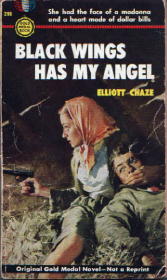
   Elijah Wood is making his first foray into producing, teaming with Anthony Moody and Rob Malkani’s Indalo Prods. to bring to the big screen an adaptation of Elliott Chaze’s legendary noir novel Black Wings Has My Angel.

   The script is being penned by Barry Gifford (Wild at Heart, Lost Highway) and writer-producer-director Christopher Peditto.

   … Angel, published in 1953, is considered one of the shining lights of the Fawcett Gold Medal paperback line and a pulp classic.

Chaze

   “It’s the material,” said Wood, summing up why he decided to dip his foot into producing waters. “I’ve always been intrigued by noir novels and noir films. I love that style. And to unearth something from that era that hasn’t been made into a film or is not a remake is really exciting. It’s a lost classic.”

   Bill Pronzini’s reaction, after I’d forwarded Vince’s email on to him:

  Steve:

   Well, well, well. And about time, too. If Gifford plays the screenplay straight, rather than drifting off into David Lynch territory, and remains faithful to the novel, it should be one hell of a good film.

Best,

      Bill

   Double ditto. My sentiments exactly. — Steve

   My review of the film Murder at Glen Athol not too long ago mentioned that it was based on a Doubleday Crime Club mystery of the same title, a book written by Norman Lippincott. It turns out that this is the only work of detective fiction that Lippincott wrote, and that otherwise he was more or less a man of mystery.

   Here’s his current listing in Crime Fiction IV, by Allen J. Hubin:

LIPPINCOTT, NORMAN (1894?-1982?)
      * * Murder at Glen Athol (Doubleday, 1935, hc) [Pennsylvania] World’s Work, 1935. Film: Invincible, 1935; also released as Criminal Within (scw: John W. Krafft; dir: Frank R. Strayer).

   I’d love to be able to show you a cover scan of the dust jacket, but none of my usual sources seems to have one. No one on the Internet even seems to have a copy for sale, as I indicated before, either with or without a dust jacket.

   A few days ago Victor Berch sent me a couple of emails about Norman Lippincott, telling me everything he’d been able to discover about him, which was considerable. I’ve combined the two messages into one, as follows:

   Steve

   Over the past weekend, I spent some time looking for Norman Lippincott, author of Murder at Glen Athol. I had a bit of luck in tracking him down in a roundabout way.

   First, I found an obituary for his son, Franklyn M. Lippincott, who died rather young in New York City in 1941. The son was described as an editor of Screen Fun and other magazines, plus he was identified as the son of Norman Lippincott, the writer. So I knew I was on the
right track.

   Franklyn’s age at the time of his death was given as 46, so he must have been born ca. 1895. This meant that I could possibly track him (and his father) through the 1900, 1910, 1920 census records, which I proceeded to do.

   The 1900 Census found Franklyn (sometimes spelled Franklin) and his father, Norman R. Lippincott living in Bellevue, PA. His father’s (Norman’s) occupation was listed as a salesman for a cash register company.

   I next figured that Franklyn would have been just about the right age to be drafted into the US Army during WW I, but he didn’t show up at all. That could be due to the fact that he had already enlisted in some branch of the service.

   But, much to my surprise, his father’s (Norman R. Lippincott) showed up. His full name was given as Norman Roger Lippincott, born December 23 of 1870 in Pennsylvania. His occupation at the time was a salesman for the Burroughs Adding Machine Co. in Pittsburgh, PA.

   I could not establish a death date for Norman R. Lippincott. It leads me to believe that he died before 1964 and would hardly be in the Social Security records, since that information kicks in about that time. The Norman Lippincott who died in 1982 [as tentatively identified in CFIV] was Norman William Lippincott, born 1894.

   Whatever Norman Lippincott may have written otherwise is probably buried in some magazines or newspapers that have not been indexed as yet. Or, had the fame of his book being made into a motion picture been enough to describe him as “Norman Lippincott, the writer”?

Best,

   Victor

   Al Hubin will correct the vital stats for Mr. Lippincott in the next installment of his Addenda to the Revised CFIV. Since the book itself is missing and still at large, I thought I’d supply instead the blurb for the book from the inside dust jacket flap, as provided by Ellen Nehr’s Doubleday Crime Club Companion: 1928-1991. It’s not possible to say from this, but the book sounds much more serious than the movie. My opinion of the film was that even with a noticeably lighter tone, it’s one of the better detective stories on film made around the same time and on the same budget.

Leading character: Holt (no other name)

Setting: Small western Pennsylvania town

Subject: Interfamily animosity.

Blurb: The Randels of Glen Athol were a strange clan, a group of people torn by inner stress and hatred. The focal point of their trouble was the ruthless, predatory Muriel Randel, a woman with a distorted and warped nature. Within her were those traits which must inevitably lead to an outbreak of violence in the family – an outbreak of sudden death which comes to an end only when Holt penetrates behind the veil of false clues unconsciously planted to deceive him.

   After that grotesque dinner party when the two murdered bodies were discovered, it was obvious to Holt that it was an inside job, but he found a family united against him – a family which hindered rather than helped the investigation.

   In the end he overcame even their opposition and was able to determine why a beautiful wanton has been murdered because a man had carelessly hung his coat on an accessible nail, and to explain what the selection of a Boston debutante’s gown had to do with the murder of a man and woman in western Pennsylvania.

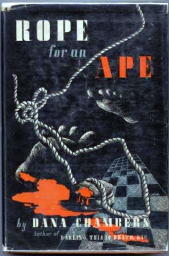
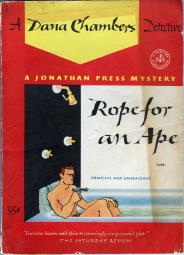
DANA CHAMBERS – Rope for an Ape

Jonathan Press Mystery J63; digest-sized paperback; no date stated, but circa 1951. Hardcover edition: The Dial Press, 1947. Previous paperback edition: Bestseller Mystery B-103; abridged; no date stated, but circa 1948.

   Jonathan Press and Bestseller Mysteries were each published by the same company, which was essentially Mercury Press, with Lawrence E. Spivak the actual publisher. Back in the 1940s Mercury Press also published Ellery Queen’s Mystery Magazine, to set a frame of reference, perhaps. I have no idea why this particular book by Dana Chambers was so popular that they did it twice. The books they reprinted are not considered very collectible, since more often than not, many of them were abridged. In this case I read the uncondensed version, and I’m sure I’m far better off for having done so.

Ape-HC

   Since Dana Chambers is all but a brand new author for me, you’ll have to indulge me. Let me check in with Al Hubin’s Crime Fiction IV to see what other mysteries he might have written:

CHAMBERS, DANA; pseudonym of Albert Leffingwell, (1895-1966); other pseudonym Giles Jackson

* Some Day I’ll Kill You (n.) Dial 1939 [Jim Steele; Connecticut]
* Too Like the Lightning (n.) Dial 1939 [Jim Steele; New York City, NY]
* She’ll Be Dead by Morning (n.) Dial 1940 [Jim Steele; New York City, NY]
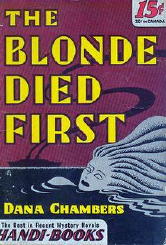
* The Blonde Died First (n.) Dial 1941 [Jim Steele; Ship]
* The Frightened Man (n.) Dial 1942 [Jim Steele; New York City, NY]
* The Last Secret (n.) Dial 1943 [Jim Steele; New York City, NY]
* Darling, This Is Death (n.) Dial 1945 [Miami, FL]
* The Case of Caroline Animus (n.) Dial 1946 [Jim Steele; Miami, FL]
* Death Against Venus (n.) Dial 1946 [New York]
* Rope for an Ape (n.) Dial 1947 [New York]

** Dear, Dead Woman (n.) Jonathan Press 1948; See: The Case of Caroline Animus (Dial 1946).
** Too Like the Dead (n.) Bestseller 1951; See: Too Like the Lightning (Dial 1939).
** Blood on the Blonde (n.) Jonathan Press 1952; See: Witch’s Moon (Dial 1941), as by Giles Jackson.

LEFFINGWELL, ALBERT (1895-1946); see pseudonyms Dana Chambers & Giles Jackson

* Nine Against New York (n.) Holt 1941 [New York City, NY]

JACKSON, GILES; pseudonym of Albert Leffingwell, (1895-1946); other pseudonym Dana Chambers

* Witch’s Moon (n.) Dial 1941 [Nile Boyd; Connecticut]
* Court of Shadows (n.) Dial 1943 [Nile Boyd; New York City, NY]

   There’s a year of death discrepancy there, I see, but I suspect that 1966 is the one that’s wrong, and that it was really 1946 when he died. If so, that would mean both that Leffingwell died young and that the book in hand was published posthumously. If and when I learn more, I’ll let you know.

   While I have some of the books listed above, I’m almost positive that Rope for an Ape is the first one of them I’ve read. As for who Jim Steele was, I admit I have to cheat and tell you what Bill Crider had to say about him on his blog, where he recently reviewed The Blonde Died First:

   You don’t hear much about Dana Chambers these days. In fact, you don’t hear anything at all, and Chambers isn’t mentioned in any of the reference books I have handy. But in the 1940s, Chambers was a prolific and well-reviewed writer of medium-boiled mysteries. The Blonde Died First is narrated in the first person by Jim Steele, who’s supposedly a successful script writer for radio, though we just have to take his word for it. There’s nothing in the novel to prove it.

   Steele is a series character, and this isn’t his first appearance. I gather that he was a pretty successful spy at one time since he has the Medal of Honor. But in this one, he’s just a guy trying to solve a couple of murders, including that of the blonde of the title. (The title, by the way, is a clue.) Most of the book takes place on a cruise ship, and there’s quite a bit of action, a complicated plot, and Steele’s smooth narration to carry you along. Things get really kinky by the end of the book, surprisingly so, I thought, for a novel published in the 40s, but maybe I’m just naive. I have a couple of other books by Dana Chambers, and I guess it’s time I read them.

Blonde

   So Jim Steele is a radio writer, is he? Then what’s he doing being listed on Kevin Burton Smith’s master list of private detectives on his Thrilling Detective website? Acting like a PI in all his stories, as a wild and probably not-so-far-off-the-mark guess.

   Jim Steele’s not in this one. Suffice it to say for now that the detective of record is a fellow named Nile Boyd, he has a girl friend named Anna Warriner, and I’ll say more about both of them more in a minute. First, though, what caught my eye was a short sentence on page 65 of this edition to the effect that he and Anne were involved in a case very much like this one “up in Connecticut a while back.” Aha! Here’s a series character appearance that Al Hubin didn’t know about before – see the pair of books written by Chambers as by Giles Jackson listed up there not too long ago.

   Boyd works for the New York Clarion, and now that the war has ended, he’s back from overseas as a war correspondent. Anne, who works for the same newspaper, is nearly twenty years younger than he, and since he’s now on the East Coast and she’s in California visiting her mother, and maybe having a good time out there as well, he’s beginning to worry about how strong the attraction he has on her may actually be.

   He needn’t worry too much, only just a little, as it turns out. As far as the detective puzzle is concerned, the one that Boyd soon finds himself in the middle of, this is one of those wealthy “upper crust affairs” that are the equivalent of the British manor house mysteries that were so common back in the 1920s, 30s and 40s. A well-to-do family is hosting a slew of guests over a long weekend, the only problem being that some of them starting to turn up dead.

Ape-PB

   The chief suspect, and a huge negative as far as I was concerned, is a giant ape who has recently escaped from a circus train which derailed nearby. Forget that. I’ve heard too many bad radio shows and watched too many equally bad B-movies that’ve been based on this same old plot gimmick, which was tired and worn out even the first time.

   But the killer is all too human, as it turns out, and it takes all of Nile Boyd’s ingenuity to nab him. And all the while he’s doing so, with Anne’s assistance eventually, there is plenty of witty upscale dialogue to keep the reader amused on a fulltime basis – at least this one was – and as usual in novels like this, particularly in the beginning, everyone is drunk, was drunk or is about to get drunk. Well, yes, perhaps I am exaggerating, but maybe that’s because I am getting a little high on the fumes myself. (Never touch the stuff otherwise.)

   The case eventually turns to the tough, though, what with guns and blows to the head (Boyd’s) and a small amount of generally restrained violence such as that. After the second murder, it begins to dawn on everyone that they’re not playing fun and games any more. Nonetheless, this is a fairly-clued detective puzzle, with a long explanation at the end, with all of usual trappings.

   Something for everyone, you might say. An unusual mix, and maybe the book suffers a little for it, but if you ever come across a used copy and want my advice, I think you might take at least a second scan through it before saying Yay or Nay.

— February 2007


[UPDATE] 04-18-07.    S. B. has asked me about the cover of the paperback edition. “Is that what I think I see?”   Yes, indeed. If you think you see a man sitting in a bathtub with a gun in his hand, that it is exactly what it is. Is the scene in the book?   Yes, indeed again. What you see is what you get.

[UPDATE] Later on 04-18-07. I’ve just received a pair of email messages from Victor Berch, who says in the first one:

  Steve:

   Just read your piece on Leffingwell. His middle name was Fear, which was his mother’s maiden name. He was born in Cambridge, MA, so I could check the Mass. Vital Statistics. On his draft card,the transcribers have transcribed his middle name as Fern, but looking at the actual handwriting, it is definitely Fear that is handwritten.

               Victor

    The second is a copy of Leffingwell’s obituary notice taken from The New York Times for August 15, 1946, so the year of death stated for him as Dana Chambers is the one that’s wrong, as suspected. Leffingwell, aged 51, was a former advertising executive who lived in Scarsdale NY at the time of his death, which occurred after a few months’ illness. He founded his own advertising agency, Olmstead, Perrin & Leffinwell, in 1925, the Times goes on to say, before turning to writing. It isn’t clear from the obituary whether he was ever a writer on a full-time basis or not.

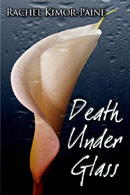
   On page 11 of the June 8-14, 2006, online edition of the Canadian newspaper The Express is a bittersweet article about author Rachel Kimor-Paine and the release of her first mystery novel, Death Under Glass, published by Killick Press. Between the time she finished the manuscript and the book itself was delivered to her door, she was diagnosed with lung cancer.

   And on February 1st of this year, as reported by The Gumshoe Site earlier this month, Ms. Kimor-Paine lost her two-year battle with the disease. She was 55. The manuscript of a second book in the series, Death in the Tai Chi Retreat, is said to be in the hands of her publisher.

   Death Under Glass introduces as a series character Olga Erdos, a retired lawyer from Budapest now living in St. John’s, Newfoundland. The murder of a high society woman (and real estate agent) who is poisoned with pesticide is the first of several deaths and suspicious accidents that she must solve.

Glass

   The following is excerpted from the short biography of her as posted on her publisher’s website:

   Rachel was born in Israel in 1952, to parents who had fled Hungary after the Second World War. She received a Master’s Degree in Anthropology from the Hebrew University in Jerusalem and later qualified as a lawyer. Rachel moved to Newfoundland upon her marriage in 1998. She has used her experience as immigrant, as well as her knowledge of anthropology and the law, to develop a unique detective story in an unusual location.

   A longer tribute to Rachel Kimor-Paine, including much more information about her very interesting life, can be found in the online edition of The Globe and Mail.

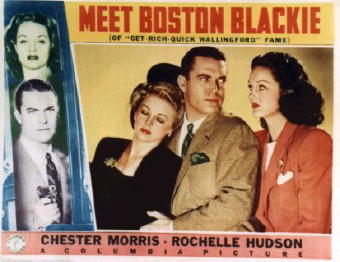
MEET BOSTON BLACKIE. Columbia, 1941. Chester Morris, Rochelle Hudson, Richard Lane, Charles Wagenheim, Constance Worth. Screenplay: Jay Dratler; based on a character created by Jack Boyle. Director: Robert Florey.

   I was warned by Vince Keenan that in spite of their popularity at the time — there were 14 of these Boston Blackie films with Chester Morris in all — they (um) weren’t very good, or certainly not as good as he’d expected. He taped a few of them last month from TCM, just as I did, only he got around to watching some of them before I did.

Poster

   This is the first one, as you might have guessed from the title — the series lasting until 1949 — and even before I started watching it, I was convinced that Vince was wrong. And for the first 10 or 15 minutes or so, I was even more convinced. After that, well, I’ll get back to it, but Vince — crossing my fingers where you cannot see them as I say this — I’ll never doubt you again.

   In this movie, it isn’t made clear whether Blackie is a reformed jewel thief or a very tricky one whom the persistent Inspector Faraday (Richard Lane) simply hasn’t been able to catch yet. They are on friendly enough terms, but Faraday has this obsession about finally outwitting his (much) more quick-witted nemesis, and he can’t quite do it.

   A body found in Blackie’s cabin on a ship returning from Europe gets the chase started, and to clear himself, Blackie has to nab a gang of foreign agents hanging around a Coney Island carnival. The black-and-white atmospherics are nicely done, and then done again, until finally overdone. Another location would have been welcome, but it’s not difficult to figure out that a lot of money, time and effort had already been spent on this one.

Morris

   Chased by the aforementioned gang, Blackie commandeers a roadster driven by a dark-haired beauty named Cecelia Bradley (Rochelle Hudson), whose charms Blackie doesn’t seem to recognize as quickly as the audience does — speaking only for myself, of course — but charms nonetheless.

   Running the car up into a freight train to escape doesn’t work as well as planned, but after a desperate automobile chase and dodging a few bullets, the pair finally manage to get away. Miss Bradley, no weak-kneed spinster lady she, discovers that she has had the time of her life, and signs herself up with Blackie to solve the case together. While her company is certainly welcome, in my heart of hearts, I am not entirely persuaded.

Hudson

   I see that I am on the verge of revealing more of the plot than I should, and I had better watch what I say from here on out, except to say that the story line goes drastically downhill from here.

   The light-hearted approach is a little too light-hearted. The funny lines are tired, worn and generally not very funny, even (I would have thought) for 1941 audiences. The gang of agents couldn’t smuggle their way out of wet paper bags. And for most of their time together, Blackie seems to connect with Miss Bradley on a buddy-buddy basis more than he does on a man-to-woman basis

   On the other hand, Miss Bradley is definitely smitten, but as for the hint at movie’s end that she’d be coming back to appear in Blackie’s next exploit, well, it never happened. Too bad. While I’m sure Blackie will find plenty of women to pair up with through the course of his follow-up adventures, too bad indeed.

   Screenwriter Jay Dratler was later nominated for an Oscar (for the movie Laura) and won a Edgar in 1949 as one of the people responsible for Call Northside 777. He was still in the minor leagues, though, when he was assigned this one to work on.

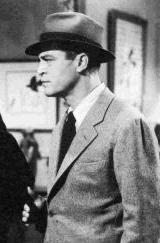
[UPDATE] 04-17-07. Looking at this blog entry this evening, checking for errors and tweaking the prose a little, neither of which I actually did, it occurred to me that none of the images I’ve posted actually came from this particular movie, not even the one in the poster. The two women in the film never met, not once.

   And as long as I’m doing this update and to remain fair and balanced in my presentation, why don’t I give equal time to someone who liked the movie? Leonard Maltin gives it three stars (***) and goes on to say, “… a slick and fast-paced mystery comedy … Franz Planer’s stylish cinematography enhances this solid programmer.”

RICHARD BURKE – The Frightened Pigeon

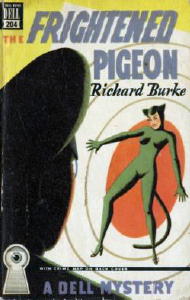
Unicorn Mystery Book Club; hardcover reprint, June 1946. First Edition: G. P. Putnam’s Sons, 1944. Paperback reprint: Dell 204, mapback edition, 1947.

   When Victor Berch, Bill Pronzini and I did our annotated bibliography of the Ziff Davis line of Fingerprint Mysteries , we included a short profile of Richard Burke, which of course you should go read. Many of his books, we said, involved a Broadway private detective named Quinny Hite, but as it happens, this is not one of them. In fact The Frightened Pigeon takes the reader to another part of the world and (one imagines) another kind of mystery altogether.

Pigeon-Front

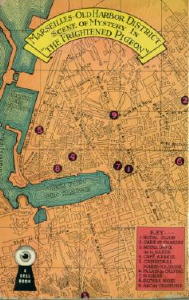
   But first a word on the cover that’s shown, though, before getting down to details. This is, of course, the Dell mapback edition that’s mentioned above, and in case you can’t make out the details, the map on the back below is that of the city of Marseilles, which is where the last eighty percent of the story takes place.

   The setting of the first fifty pages is Paris, 1942, with the Germans solidly in control of the city. An American dancer named Valerie Bright is still there, however — the pigeon of the title –- and very determined to stay non-political. From page 8, of the Unicorn edition:

   Of course after the Axis had decided to include the United States in the war, she had regarded them as enemies, but there wasn’t anything personal about her feeling.

   Her close male friend, Charles John Dillon, nicknamed “Ching,” is working closely with the French underground, however, and events, beginning with a stolen German diary, bound to be embarrassing if it falls into the wrong hands — as, for example, into Ching’s hands — soon make the light-hearted Val realize how dirty — and dangerous — war really is, not knowing what will happen next nor whom your friends really are. By page 40, she is one frightened pigeon indeed, as off to Marseilles they and a small group of displaced others go, hoping to find a way out of France and its closed borders.

Pigeon-Mapback

   The diary appears and disappears with amazing regularity. It is, in fact, amazing, how much mileage an author (Burke) can make of one small important object. Otherwise here is a novel one can learn a large amount from — supposing, that is, that one has never been in a place controlled by Nazi-like enemies one is trying his or her best to avoid — both in term of locale (well-described) and people, especially those like Valerie, whose mind is soon brought down to earth in satisfying (but not very surprising) fashion, but also the large number of others who find themselves caught up in events far beyond their say.

   Don’t get me wrong. This is by no means a major work. It’s no more than ordinary at best, in the overall scheme of things, but what it does have is atmosphere, and plenty of it.

— September 2006

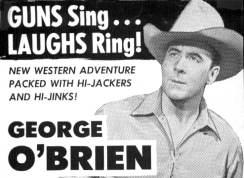
PRAIRIE LAW. RKO Radio Pictures, 1940. George O’Brien, Virginia Vale, Slim Whitaker, Paul Everton, Cy Kendall. Directed by David Howard.

   Generally speaking, I didn’t intend to include reviews of B-western movies here on the M*F blog, but since there’s more than the usual amount of criminous activities going on in this film’s 60 minutes, I decided to break my own rule, and who better?

   A crooked land promoter, Judge Ben Curry (Paul Everton), is taking money from farmers hand over fist, without telling them two things: One, that the former ghost town of Olympia City, where his headquarters are, has no water, and two, that the land he is selling them belongs to cattleman Brill Austin (George O’Brien).

O'Brien

   Yes, in this movie it is the cattlemen who are the good guys and not the usual other way around. Among the settlers is the daughter of one of the farmers, Priscilla Brambull (Virginia Vale) – and no, I didn’t think of that until right now, and no, it’s not that kind of movie. Among other legal misbehavior committed by Judge Curry is his blatant attempt to call for an election without proper notice, stuffing the ballot box, and declaring Olympia City the county seat so that the killer of the sheriff, Brill Austin’s Uncle Jim, can be set free.

   Later on in the movie while a valid trial is being held in Prairie Rose, the jury does double duty: while deliberating on the verdict, they’re also dodging bullets by the judge’s henchmen. All this in sixty minutes, I remind you, which also includes a song sung by the uncredited Ray Whitley and his band.

   There’s nothing here to be taken too seriously, as the players certainly don’t, but other than that, it’s a rather pleasurable experience. As for George O’Brien, a former silent film star who went into non-series westerns like this one when talkies came in, this was close to the end of his steady movie career.

    [Truth in advertising: The photo of O’Brien comes from another film of the same vintage and not this one — but it could have been.]

  Dear Steve,

   Someone sent me your review of my long lost book Dreamboat. I write to say that you are correct that the Flippo series is packed up and put away, and that I remain at the Dallas Morning News as a reporter and editor. You were too kind to Dreamboat, I thought. I wrote it in a tremendous hurry, and never liked it. But thanks, anyway.

   Writing crime novels started out as a hobby, then became a part-time job, then a burden. The books weren’t making enough money for me to quit my newspaper gig, and after number five all the pleasure had drained away. So I stopped writing for a few years.

   About a year ago I started writing again, but once again as a leisure-time activity. The new book is a one-off suspense that bears little resemblance to the previous five. Don’t know if I’ll ever finish it..

   It was a fun ride for a while, but you’re right: it didn’t last long. Long enough, though. I had a good time while it lasted.

Best wishes,

      Doug Swanson


>>   Thanks for writing, Doug, and best wishes in return on getting that new novel finished!    — Steve

« Previous PageNext Page »