Pulp Fiction


COLLECTING PULPS: A Memoir, Part 16:
A Field Trip
by Walker Martin

Recently, Steve Lewis reviewed the issue of Argosy for June 9, 1934. My copy of this issue is now over 80 years old and still in great shape with the pages very supple and no browning or brittleness. Nice cover and full spine. It has a nice smell and no pulp shreds to clean up. I like the cover by Paul Stahr with the macabre scene of two skeletons showing that two poker players were struck dead while playing cards.

Which reminds me of a field trip I once made to buy a couple original pulp cover paintings by Paul Stahr. It was in the mid-1970’s, and I was consumed by the desire to track down as many pulp paintings as I could find. This was 40 years ago (hard to believe that so much time has passed!), and I was busy doing the usual things that men in their thirties were always doing, like marriage, raising a family, job career, buying a house, and thinking about my next car.

But my real interests, now that I think back on my life, was reading, collecting books, vintage paperbacks, pulps, and trying to find the cover paintings used on the paperbacks and pulps. The video revolution was still several years off, so I had not yet started to buy hundreds of video tapes of old movies and serials. Not to speak of the thousands of dvds that I now have cluttering up my house.

Sure, all that other stuff is important in a life, but does anything really match the enjoyment and thrill of collecting books and art? This is the main subject of my two series: Collecting Pulps and Adventures in Collecting. Collectors are always paying lip service to their jobs and families, but I have often found them to be addicted to that greatest vice of all: book collecting. Otherwise known as bibliomania.

And of course collecting pulps, paperbacks, and original art are all offshoots of book collecting. I remember many of my friends in college, the army, at work, were often involved in wasting time boozing, taking drugs, gambling, or that most dangerous sport of all, chasing women. I like to pretend that I was not addicted to these mundane vices. No sir, I was back then a Collector with a capital C and I still think there is no higher calling for a life’s work.

I still wake up each day thinking about what I’m going to read or what books or pulps I can add to my collection. Not to mention what old movies I want to watch. And of course the collecting of original art, which is one of the most unique things to collect. A book or pulp for instance may have many copies in existence, but a piece of art is unique, a one of a kind thing connected to the collecting of books.

I’ve always wondered why more book and pulp collectors are not interested in at least having a few examples of cover art to hang on their walls, in their libraries, between the bookcases or if the art is small enough, on the book shelves with the books. I can understand not being able to spend thousands of dollars on artwork, but I have many times picked up amazing art bargains for very little money. Even today, some artwork can be bought for a few hundred or less. I’ve had more than one friend that liked to buy new cars every couple of years for many thousands of dollars but would turn pale in horror at the thought of spending a few hundred on a pulp cover painting. For luxury car enthusiasts, exploring the Most reliable Maserati Warranty Options with Nova Warranty could be a wise investment to protect their prized vehicles.

Which brings me around to the details of my field trip. In the 1970’s and even in the 1980’s, it was possible to buy non SF cover paintings for very little money. Very few collectors were interested in such genres as detective, western and adventure paintings. As a result of this lack of interest I routinely bought pulp and paperbacks paintings for prices as low as $50 and for many years I was paying only an average price of $200 to $400 each for artwork. Now prices are higher but you still can find bargains, especially at the two pulp conventions: Windy City and Pulpfest.

In fact, it was at one of the early Pulpcons that a friend told me about an art store in Brooklyn NY that had pulp art for sale. I had no idea about how to navigate to and through Brooklyn but he agreed to meet me a the Penn Station train station and take me out to the store. It was the typical small store but it was crammed with paintings.

I still remember the very large painting by Walter Baumhofer that the dealer showed me. It was enormous and showed a shootout in a bar between gangsters. It was used as an interior in a slick magazine, perhaps The Saturday Evening Post or Colliers. But he wanted a few hundred for it and I couldn’t buy everything, so I reluctantly passed on it. One of my collecting mistakes from 40 years ago that still haunts me. I still dream about these mistakes and often wake up in the middle of the night cursing myself. My wife wonders what the hell, but most collectors probably know what I’m talking about.

The dealer showed me several other pieces, and I was shocked to see how he had the paintings stored. Most were unframed, and he was just pulling them out and scraping the paint off as he yanked them out. Finally he got to the paintings that I could afford at the $200 level. There were several Paul Stahr paintings, and I recognized them as Argosy covers. Stahr was very prolific and did many covers for the magazine in the 1920’s and 1930’s.

I decided I could spend $400, after quickly calculating how much I owed my wife, mortgage, car payment, and a couple pulp collectors who sold me sets of pulps on the installment plan. The paintings I bought were used for the covers on Argosy for December 3, 1932 and December 24, 1932. So we packed them up for the long trip back home and casting a final look of regret at the big Baumhofer masterpiece, I left the store. I never returned, and I’m sure it is long out of business.

I had the paintings nicely framed, and both were hanging together for around 20 years. I still have the December 3, 1932 painting but the December 24 artwork suffered a tragic end. Steve Kennedy, a NYC art dealer who just died a few weeks ago specialized in pulp art. He thought he could get me a good deal in a trade but I would have to give up the December 24, 1932 piece. So he took the painting and mailed it off on approval to another collector. Later on, he told me the sad news that the Fed Ex or UPS truck had caught on fire and the painting was destroyed.

All collectors have the time travel dream. You know the one where you go back in time and buy a stack of Hammett or Chandler first editions. Or maybe you buy several issues of the first Tarzan All-Story or the first Superman comic. One trip I would make would be back to the Brooklyn store of 40 years ago. Only this time I’d say to hell with the bills and mortgage payment and by god, I’d buy that beautiful Baumhofer gangster painting!

ARGOSY WEEKLY. 9 June 1934. The problem with collecting Argosy pulps, unless you want them only for some inborn collector’s urges and your life wouldn’t be the same without them, is that more than half of every issues is taken up with staggered installments of usually three different serials. You have to do a heap of collecting to put a string of consecutive issues together before you could read the complete story of all three.

   So why I did I read the first installment of “Pictured Rock,” by Frank Richardson Pierce, in this particular issue? Pure carelessness, that’s all. I wasn’t paying attention. It’s Part 1 of 5, and it never came out in book form, so there’s no chance I’ll ever get to finish it. I was closing in one page 22, where the next story started, before I began to think to myself, what’s going on? This story ends in two pages, and it’s barely begun.

   A fairly astute observation, that. But the story’s an interesting one, and I don’t regret reading the portion of it that I did. It’s about a young man raised by his uncle, a banker on the East Coast, who heads for the West when his father, thought to have been dead for 25 years, manages to send him a written request to come to see him before he dies. A story very much in the larger-than-life Max Brand western tradition.

   On page 22 begins a novelette by H. Bedford-Jones in his long-running series of adventures of one John Solomon, a London-based Cockney adventurer-agent of sorts who seems to have his fingers in all kinds of pies, including friends on the police force and perhaps even higher echelons. “John Solomon of Limehouse” is the first one of these tales that I’ve read, so anything anyone can say more about the character, please do.

   Solomon’s first recorded adventure dates back to 1914, plus or minus a year so, and the one in this issue of Argosy comes (I believe) toward the end of the run. It begins with a young chap named Carson newly arrived in London being taken for his great-uncle, a rather unlikable man of some wealth — ill-gotten, by all accounts — with many enemies. To get out of the scrape Carson finds himself in, he learns that he will need all of the assistance Solomon can give him.

   The story is well-told, with plenty of exotic and picturesque settings in the area of London along the docks, but it suffers from the fact that Solomon simply has too many resources for most bad guys to make a stand against him.

   The next novelette is by William Edward Hayes, who besides being the author of many stories for the pulps, also wrote three hardcover detective novels, one of which, Black Chronicle, was reviewed on this blog by Bill Deeck some three years ago.

   â€œThe Dark Temple” is a story about the problems facing the men trying to build a railroad through the jungles of somewhere in Central of South America. There is a deadline, and an engineer named McAllister is called on by his good friend Captain Strickland to help. As soon as he arrives, though, McAllister knows he is in danger and worse, Cap has disappeared. Lots of action in this one, but what’s amusing is that every time McAllister finds himself in a situation with no way out, it is a girl who comes to his rescue.

   I’m not a big fan of French Foreign Legion stories, but a writer named Georges Surdez wrote a lot of them for Argosy and other pulp magazines, and well enough that they seem to be based on personal experience. The short story “Another Man’s Chevrons” is about a soldier who is not noted for his bravery, but when it counts, he does what he needs to do.

   Next comes another serial installment, this one called “The Terror,” by Eustace L. Adams, which is about an air pirate with dreams of dominating the world, if I read the blurb correctly. I’d like to read this one sometime if I could, but it was never published in book form. He did write a boys’ book called Pirates of the Air (Grosset and Dunlap, 1929), featuring, I am told, mid-Atlantic floating landing platforms. According to ISDb, these are not the same two stories.

   One short story comes before the next long serial installment, this one entitled “All Equal,” by Foster-Harris about a Wild West shoot-out taking place instead in an oil rig camp, one with a twist that makes it worth reading.

   To wind up this issue is Part 4 of 6 of a novel by F. V. W. Mason called “The Barbarian.” This is a historical novel taking place in ancient Carthage. Ordinarily I find such fiction dry as bones, but I think Mason, a prolific novelist and very well known in his day, was someone who could make stories in such settings readable in everyday language. I didn’t read any of this one, but you can check out his Wikipedia page here.

COLLECTING PULPS: A Memoir, Part 15:
Death of a Collector: STEVE KENNEDY
by Walker Martin


   A friend informed me of Steve Kennedy’s death around 4:00 pm earlier yesterday, and I’ve had problems accepting the news. I last heard from Steve a few weeks ago and at that time he was under a lot of stress due to his attempts to sell his NYC apartment and finish building his dream house in Woodstock, NY. He had been talking to me about both projects for many years and he hoped the money from the apartment sale would finance the completion of the Woodstock house. He had suffered some type of health problem a couple years ago which showed that his blood pressure was very high, and my impression was that he did not seem well.

   I still remember my first sight of Steve as though it was only the other day. It was 1987 and he was in the Pulpcon dealer’s room carrying around a cover painting by Rafael Desoto from Dime Detective. He wanted to sell it but was getting no interest at all from the pulp collectors. This was a common reaction in the 1970’s and 1980’s when most pulp collectors were only interested in SF or hero pulp art. If the paintings were from western, detective, or adventure magazines, then there was usually no interest at all even if the price was low.

   I know it’s hard to believe now when these paintings often sell for thousands of dollars but back then you could not even get offers when the price was only a few hundred dollars each. The only exceptions were SF and hero magazine covers. I know this for a fact because I built my pulp cover painting collection by paying only $200 to around $400 each for most non-SF genre paintings. In the 1990’s I had to start paying more and eventually due to the prices that Bob Lesser was willing to pay, the cost of pulp paintings really increased.

   Since no one was willing to buy the Desoto painting, I bought it for only $325 in 1987. That began our 28 year friendship during which Steve sold me many paintings including some by Norman Saunders, Rafael Desoto, Walter Baumhofer, etc. Even a couple years ago when I told him I wanted a double page spread by Nick Eggenhofer, he sold me a beautiful drawing from the collection of art dealer, Walt Reed.

   As I walk through my house, almost every room has paintings that I bought from Steve over the years. He visited my house several times each year for a total of over a hundred visits. Several times we drove out to Pulpcon together in my car. He would arrive the day before and sleep over due to my habit of getting an early start to drive to Pulpcon.

   Steve was the only collector that my wife would put up with staying over because he at least dealt with art and paintings and was not covered with pulp chips from the magazines that so exasperate her. Steve and I both felt that there was nothing wrong with a house full of old magazines and books, not to mention pulp and paperback cover paintings!

   We often told each other funny stories about non-collectors and in addition to the many visits, we had hundreds of telephone conversations, many late at night at around midnight. Since Steve did not work regular hours being self employed, he often called me late which I had no problem with because I’m always up late during the night reading books and pulps.

   The wedding of Steve Kennedy and Jane came as a surprise to all his friends because he was always puzzled by NYC women and was in his 50’s when he got married in 2001. I guess Jane was really not from NYC. The wedding was held at Jane’s parents place in Woodstock, NY and was without a doubt the best wedding I ever attended. Not just the food and atmosphere but they had two bands: a Brazilian jazz group and two classical guitar players.

   One funny thing about Steve getting married was that since he had been a bachelor for so long, he was scared of finally getting married. So much so that he called me in a nervous attack one night and asked me to give my opinion. Should he get married? I of course said sure go ahead because Steve was an art dealer and Jane was an art appraiser. Not the typical collector and non-collector disaster!

   So, I’m still trying to process the information. Steve Kennedy is gone? No more visits, no more late night phone calls? No more trips to Pulpfest or Windy City? Another of my old friends gone for good? This is hard to believe that someone so much a part of my life can simply disappear.

   Goodbye Steve. R.I.P.

COLLECTING PULPS: A Memoir, Part 14: Weird Tales
by Walker Martin


   Three years ago I discussed the Frank Robinson Collection auction which was organized by Adventure House. The biggest lot at that auction was the complete Weird Tales collection which sold for a quarter of a million dollars. Yes, that’s right, as in $250,000.00. Then we fast forward 3 years and again Adventure House held an auction for a complete collection of Weird Tales, only this time the set got zero bids. I believe a discussion of this auction will show not only what occurred and why one set sold and another set did not sell, but also we will learn how pulp collectors have changed over the years.

   As with the Frank Robinson auction, this recent auction which was held on May 1, 2015, also did not generate much comment on the various discussion groups that I visit online. I know as a long time fiction magazine collector, I certainly want to talk about such subjects, in fact I’m starved for conversation and I guess that’s one of the reasons that I continue to post my pulp collecting memoirs. People have been collecting pulps for over a hundred years now, ever since the first one was published in 1896. I’ve been at it for over 50 years and I feel it’s important enough for us to continue posting articles and commenting about what happened during the time these fiction magazines ruled the newsstands.

   I also feel it’s very important that we continue to support the two major pulp conventions, Windy City and Pulpfest. I’ve attended both over the years and have had many interesting conversations about the pulp era. At Windy City in April I had the opportunity to view the Weird Tales set which was on display behind the Adventure House tables. I also eagerly bought the $10.00 Weird Tales collection auction catalog. Published by Adventure House this is a 40 page full color description of the 274 issues. True, only 239 covers are shown but all are listed by condition in the back of the catalog. In addition to the 274 issues published during 1923-1954, the catalog also lists the 79 issues of the revived Weird Tales that were published during Summer 1973 to Spring 2014.

   So this was a major auction of perhaps the most talked about, most famous pulp title of them all. It was advertised on the Adventure House website, emails were sent out announcing the auction, and a full color catalog was available for only 10 dollars. Why was it a flop? Why no bids?

   Well, of course the most obvious reason is the fact that the minimum bid was set at $60,000. But if the Robinson WT set of three years ago sold for 250,000 dollars, how come this recent set could not attract $60,000? Well you know the old saying in real estate: location, location, location. In the pulp and book world, it’s: condition, condition, condition.

   The Robinson collection was almost perfect. White pages, newsstand fresh covers, complete spines. Weird Tales was called “The Unique Magazine”. Well, the Robinson set was truly “unique”, definitely the best condition set of Weird Tales in existence. It could and did command a premium price.

   So what was wrong with the set offered up for auction in May 2015? What prevented it from even getting one bid at the $60,000 minimum? The catalog described several good points such as blood red spines(they usually are faded), high quality paper, and custom made tray cases to hold each volume. When I viewed the set myself at the convention, I was impressed by all of the above. Unfortunately the following faults have to be mentioned:

1. The first 45 issues, March 1923 through June 1927 are bound in 10 blue volumes. Personally, I think using blue was a mistake. I have a set bound in red and it looks more impressive. But this is just a personal preference. The main problem with bound pulps is simply that many collectors won’t touch them at all. And those that will accept bound copies want a significant decrease in the usual price.

   In the first paragraph I mentioned how pulp collectors had changed over the years, and this is one example. It used to be that old time collectors, guys who actually bought the magazines off the newsstands, loved to have their pulps bound. It gave them a look of respectability and the garish magazines looked more like a sedate book that they could proudly display on their bookshelves without being sneered at by other collectors and even non-collectors. Pulp collectors nowadays don’t think like this at all. They want the individual issues and they don’t like them bound.

2. Because they are bound these first 45 issues, which are very rare and expensive, only rate a good or good minus as far as condition.

3. Most issues in the early 1930’s have Scotch tape or clear tape on the head and foot of the spines. This was another practice that many of the old time collectors followed. I’ve seen pulps ruined with masking tape, discolored scotch tape, and even electrical tape. One guy even used stamps to close tears in the cover. Pulp collectors back then evidently thought nothing of closing and repairing tears with all sorts of tape. Now of course collectors frown on the use of tape.

4. The tray cases are a very good idea and look nice. Unfortunately several of the cases show water damage.

   In my opinion, the above points prevented a high minimum bid and certainly explain why no one started off bidding at the $60,000 level. It’s too high a figure for a set in this condition. Perhaps a lower figure would have encouraged some beginning action and the final bidding might even have reached a high level. Perhaps a minimum bid of $20,000 would have been better but then again, you run the chance of the set going for such a figure and I guess the seller would consider that unacceptable.

   I used to have a set of Weird Tales for many years but that was back in the days when you could buy issues for $5.00 each. Back in 1968, when I was discharged from the army, I had two big goals in my life: to get a complete set of Black Mask and a set of Weird Tales . I managed to do both within a few years. Since then I’ve seen many extensive runs of WT and I’m not even sure that it’s that rare. It seems that everybody, like many SF collectors, saved their copies! It’s really a pretty magazine, a thing of beauty.

   My present set is not complete because I no longer care about the early issues of 1923-1925, most of which I find not that readable. My present set is a bound set from 1926-1954. I’ll tell the story about this set and it will illustrate the differences between the old time pulp collectors and the newer pulp collectors who never really bought any of the magazines off the newsstands.

   In the 1980’s, Harry Noble, who had been buying pulps since the early 1930’s, decided to put together some bound sets of his favorite SF and fantasy magazines. He did this with such titles as Astounding, Famous Fantastic Mysteries, Fantastic Novels, Unknown Worlds, and of course, Weird Tales . He had trouble finding an inexpensive binder but finally found someone who would bind several magazines into one volume for a low price. Harry didn’t really care about the early issues, not only because they were not that readable, but also because they were too expensive for him to buy. But 1926-1954 he could handle and he started to his project one volume at time.

   But some of his issues were coverless and he borrowed copies from my set of individual issues and made color Xerox copies of the covers. There were at least a dozen, maybe more issues that were bound with Xerox covers. As a second generation pulp collector, I tried to talk Harry out of binding the pulps. Some of the issues were in really nice shape and it was a shame to see them bound with trimmed edges. But Harry was from the first generation of collectors and he liked the look of the bound volumes.

   Harry worked on this project for almost 20 years, up until his death at age 88 in 2006. He had prior warning that his illness was terminal and at the 2006 Pulpcon he told me and several other friends that he was dying. He welcomed us to visit his house and buy his extensive collection of pulps, books, and vintage paperbacks. Which we did. I made four such trips buying his sets of Western Story, Astounding, Short Stories and other items.

   One day, at dinner at my house, a group of us were having dinner and the subject of the Weird Tales set came up. Harry said he wanted $10,000 for the bound in red years of 1926-1954. I pointed out that not only were the most expensive issues missing, but the set was bound which was a problem as far as value was concerned. Also I knew from personal experience that at least a dozen issues had Xerox color covers. I also remembered that there were a few other issues with pieces missing out of the covers.

   However, I said I was willing to pay $5,000 considering the flaws, etc. Another well known, veteran collector also said he thought it might be worth $5,000 but no more. To tell you the truth, I wasn’t even sure it was worth the 5 grand. Harry, who loved bound sets, was justifiably upset of course. In fact, he said he would throw them in the dumpster before selling them for $5,000. One of our friends got a laugh by saying to tell him which dumpster because he would be there.

   I figured that was that but a couple weeks later, I got a call from Harry. He had tried several other collectors and bookstores and no one would pay the $10,000. I’m pretty sure they would not even have paid the $5,000. Harry said if I still wanted them I could have the set for $5,000 and I accepted. He didn’t last much longer and died in December of 2006. So ended a 40 year friendship.

   But I still have Harry’s bound set and it looks beautiful bound in red in the master bedroom. But I’d still rather have them unbound!

Editorial Note: This video produced by Adventure House of the Weird Tales collection they were offering may not stay online for long, but at least for now, it is still up:

CALL ME ISHMAEL!
Windy City Pulp Convention Report, 2015
by Walker Martin

   MOBY DICK is one on my favorite novels and it’s fitting that I start off my report concerning my bizarre and insane adventures by quoting the beginning of this adventurous novel. Takes a lot of nerve but nobody ever said that collectors lack nerve, that’s for sure! As I’ve mentioned in the past reports, a gang of the usual collectors always rent a large van for the convention. Five of us went this time and the cargo space was filled going out and coming back. One of these days there will not be room for someone on the return trip.

   I’ve known these fellow collectors for many years and between us, we have over 250 years of collecting experience. We call the big white van, “The Great White Whale”, but I also think we are searching for the white whale or that Holy Grail of pulp collecting. I’ve been attending these pulp shows for over 40 years and I hope to make it to the 50 year mark. I really believe the pulp conventions are the reason I have accumulated thousands of books and pulps.

   I get excited each year and despite being a collector for 60 years, I’m always looking for new things to add to my book, pulp, and art collection. This year I had 6 goals:

1–Upgrade my 99 issue set of STARTLING STORIES. I’ve had a complete set since the 1950’s, but I decided to try for fine condition.

2–Get an issue of HUTCHINSON’S ADVENTURE STORY MAGAZINE. This British pulp is so rare that I’ve never had an issue.

3–Finally obtain a nice piece of art by Richard Powers. I’ve been looking for decades but I’ve never found the right piece.

4–Get an Emsh cover. Again, I’ve been looking for long time. (I did. Look to the right: ASTOUNDING SCIENCE FICTION, December 1958)

5–Lee Brown Coye has been a long time favorite but I’ve never found one of his better pieces of art.

6-And finally, trade off a DANGER TRAILS illustration by John Fleming Gould for some other pulp art. His son says it’s the first of the 15,000 illustrations that Gould did.

   I consider the above to be an ambitious set of goals but I managed to complete all six at Windy City. This is proof, once again, of just how important it is to attend the pulp conventions. If I hadn’t gone to Chicago, I’d still be sitting here thinking about completing these six projects. There was a massive amount of material available at the convention. 150 dealer’s tables and around 500 attendees, all in a large room. Many of the tables had boxes and smaller tables set up filled full of additional books and pulps. For a book and fiction magazine collector, an amazing sight to see.

   In fact, many collectors eat a large breakfast because they know they will not be able to leave the dealer’s room for lunch. I mean, who can think of eating in a big room full of books and magazines? Forget sex, drinking, dope, gambling, and all the other vices! We are collectors with a capital C and this is Windy City! All that other stuff can wait until the convention is finished.

   In addition to books and pulps, there also is an emphasis on artwork from the pulps, slicks, digests, men’s adventure magazines, and paperbacks. I counted several dealers with art and I managed to buy quite a few pieces for my collection. In addition to the Emsh, Powers, and Coye pieces mentioned above, I also obtained three by Edd Cartier, a DIME MYSTERY double page spread, a WESTERN STORY illustration, and other items.

   The theme of the show was H.P. Lovecraft’s 125th birthday and the art exhibit had several stunning pieces showing Lovecraft themed art. In addition the film festival showed nine films chosen by Ed Hulse that were based on Lovecraft’s fiction. I’ve seen most of them and besides, I couldn’t drag myself away from the dealer’s room. But I did see CALL OF CTHULHU the night before leaving for the convention and it was excellent. The Old Gentleman would have been proud to see such tributes. And The Great God Cthulhu must of been proud also, since he didn’t show up and destroy his worshipers.

   I’ve been lucky on the art described above, but I did make two stupid mistakes, which enabled other collectors to swoop in and steal art from me. Of course both times I was spending too much time gawking at the great art, so I have no one to blame but myself. One showed a cover from SEA STORIES depicting a scene from a slave ship and the other was a nice painting by Beresford Egan. Since I managed to buy four other pieces by Egan, I doubt anyone will have any sympathy for my tale of woe. But as all collectors know, we always cry and whine about the one that got away.

   What else did I buy? I’ve been a long time admirer of MANHUNT, the best of the hardboiled crime fiction digests and I saw one table with over a hundred of the MANHUNT copy cats that sprung up like weeds in the 1950’s. Titles like TWO-FISTED, OFF BEAT, TWISTED, KILLERS, SURE FIRE, and WEB TERROR. The stories can’t compare to MANHUNT but the covers are unbelievable. They are so risqué and objectionable, that many collectors refuse to collect them. I, of course, love them.

   I was there for all four days and had a great time. Here are some glimpses of what I did:

   I met Sai, who runs one of the very best pulp blogs at http://pulpflakes.blogspot.com. He took many photos, some of which are shown in this report. Talked to Rich Oberg and his wife about men’s adventure magazine art. Met Pete Poplaski, artist and expert on Zorro; saw a complete set of DOC SAVAGE; looked at the complete set of WEIRD TALES on view at John Gunnison’s table; talked with Bob Weinberg who I’ve known since the late 1960’s; obtained the new BLOOD ‘n’ THUNDER, another record breaking triple issue; and talked to Michelle Nolan about her forthcoming book on the sport pulps.

   The two auctions were well attended, and most of the pulps were from the Jerry Weist estate. There were many lots of dime novels, western, romance, and sport pulps. But also many lots offering such rare titles as early issues of ALL STORY and ARGOSY. By early, I mean over 100 years old! There also was a complete set of STARTLING STORIES in several lots. I had bought a set in the dealer’s room but that didn’t stop me from bidding on another set. Lucky I didn’t win because then I would have three sets. Two sets should keep me busy comparing issues in order to pick the better condition. But you can never have too many pulps…

   The Windy City program book was another enormous collection edited by Tom Roberts. Over 200 pages celebrating Lovecraft! Next year will celebrate science fiction, so I have to start saving so I can buy more duplicate sets of STARTLING, etc.

   Fellow collectors, start preparing for the next pulp convention. Pulpfest will be held August 13-16. 2015 in Columbus, Ohio. The website is pulpfest.com and believe me it’s a convention that is a must. I ought to know. I’ve been attending them since 1972!


   Nick Certo and me. I’m the one on the left. (Thanks to Phyllis Weinberg, who took the photo.)

MAX BRAND – The Trail to San Triste. Warner Books; 1st paperback edition, February 1985. Chelsea House, hardcover, 1927. Dodd Mead, hardcover, 1983. First serialized in six parts (8 March through 12 April 1924) in Western Story Magazine as “Four without Fear,” as by John Frederick.

   As it so happened I was halfway through this book when the a brief discussion came up in the comments following Dan Stumpf’s review of Milton Lott’s Backtrack; to wit: there is a big difference between Westerns in the traditional and romantic sense and novels about the West.

   You can put Max Brand firmly in the first category, and The Trail to San Triste is a fine example. It’s the story of a young dashing cowboy, nearly a legendary outlaw, who is recruited to go into Mexico and pose as the missing son of the now deceased beloved patron of San Triste. Object: a fortune in gold, silver and rare gems.

   Of course there are complications. First John Jones must convince the townspeople that he is the true heir, then the servants of the family, still living, contend with man (a cousin) running the estate now but not loved, and (without giving too much away) is he, by chance, the real heir and does not know it, or is the real heir still alive? And of course, there is a girl. The girl. The girl of John Jones’ dreams.

   All told with a flair for the romantic, with plenty of gallantry, bravery, and a sense of justice and what’s right in the world and what makes life worth living. Cowboys and Mexican peasants had a tough life, but you wouldn’t know it from reading this book. Even the deaths that occur toward the end of the book have some meaning, redemption being a solid part of it.

   A world such as this never existed, but I enjoyed every minute that I spent visiting it.

COLLECTING PULPS: A Memoir, Part 12 :
Rereading UNKNOWN and UNKNOWN WORLDS
by Walker Martin


   Why reread? I’ve known several readers and collectors who bluntly state that they seldom or never reread stories or books. They argue that there are too many new books waiting to be read, sort of the like the old saying, “So many books, so little time.”

   I love to reread but only my favorite books and stories. And only the ones that I consider to be outstanding or great. There is nothing more exasperating than to reread a book and realize that it was not even worth reading the first time. Not to mention the waste of time. That’s why I’ve always noted on a slip of paper the date read, my grade, and comments about the book. Then, decades later, I can tell at a glance what I thought of the book and whether it is worth a second reading or not.

   So aside from the enjoyment of rereading an outstanding book, why read it again? Some books demand a second (and a third and a fourth) reading because they have several layers and levels of complex meaning that you might want to explore and investigate. Also a book read in your twenties may reveal additional meanings when you reread it many years later. There have been books that I read as a young man that I didn’t have the proper maturity to truly understand but as an older reader, I now find them to be indispensable.

   Every reader has their favorite books that they have reread. Some of mine are:

         War and Peace — 3 times.

         Moby Dick — 3 times.

         The Sun Also Rises — 5 times.

         Under the Volcano — 5 times.

   In the different genres I’ve several books that I’ve reread:

   In science fiction: Alfred Bester’s The Demolished Man and Stars My Destination. Also the novels of Philip K. Dick and Robert Silverberg; the short stories of J.G. Ballard and Theodore Sturgeon.

   In the detective and crime genre: the novels of Raymond Chandler, Dashiell Hammett, Elmore Leonard, and Ross Macdonald.

   In the western field: the novels of Luke Short, Elmore Leonard, Elmer Kelton. Lonesome Dove is maybe the best western I’ve ever reread.

   I also have reread stories in the pulp magazines. Many literary critics make the mistake of lumping all the pulps into one sub-literary category. They think all the pulps published mediocre and poor action fiction of very little redeeming literary value. They are wrong. There is such a thing as excellent pulp fiction, and I’ve tried to point out some examples in this series on collecting pulps.

   Of course, I absolutely agree with Sturgeon’s Law which in simple terms may be explained as “90% of everything is crap.” This is a good thing to say to anyone who criticizes your tastes in reading matter. For instance if they sneer at your love for detective, SF, or western fiction, then you can state Sturgeon’s Law, which I’ve found to roughly apply to just about all forms of literary endeavor.

   In other words, I’m always looking for that less than 10% that I hope will be worth reading and rereading. As I reread my notes spread throughout thousands of books and fiction magazines, I see I’m now at a good point in my life where I’m reading mainly the good 10%. Sure, every now and then I make a mistake or blunder and find myself reading the 90% crap, but after so many years of reading, I’m getting pretty good at avoiding the stuff that is not worth reading.

   A couple months before the August Pulpfest convention, one of the committee members, knowing my love for the magazine Unknown, asked me if I would participate on a panel discussing the title. This made me think about Unknown and how I had started collecting and reading it so many years ago.

   When I first started to think about collecting it, I was just a teenager and had very little money. I had enough to buy the SF digests and paperbacks but a set of Unknown back in the 1950’s cost around $50, a sum that I never had until years later. Back then, just about all pulps were a dollar or less, a fact that is hard to believe now.

   Finally in 1963, while attending college, I managed to put aside $50 and I started scouting around for a set of the 39 issues. All I could pay was $50 but everyone I contacted wanted more. I even contacted the Werewolf Bookshop in Verona, Pennsylvania (this bookstore advertised in many of the digest SF magazines) and I still have the letter dated September 3, 1963. I stapled it into my Unknown book where I noted my thoughts and comments on the magazine. The owner stated that he had contacted three fans and only one was willing to sell and he wanted $200 for his set.

   Back in 1963 this was an outrageous sum, and it’s lucky I did not send money to the Werewolf Bookshop. It seems the owner was in the habit of sending you anything he had if he did not have the books that you ordered. Then when you complained about receiving books that you didn’t want, he would ignore your letters and keep your money. If I had sent him $200, there is no telling what he would have shipped me. Except that it would not have been a set of Unknown. I have read about and even met fellow collectors who fell victim to this scam.

   Fortunately, I eventually bought a set from Gerry de la Ree, a SF collector and dealer who lived in New Jersey. For decades in the 1960’s, 1970’s, 1980’s, Gerry mailed out monthly sale lists listing SF pulps, digests, books, and artwork. He wanted only $50 and I now had the complete set. I read several stories in scattered issues, but college and then being drafted into the army delayed my project of reading the complete set.

   However, by 1969 I was discharged and I spent six months of doing nothing but reading. I didn’t even look for a job, and I loved living in my mother’s house drinking beer and reading all day. She must of thought she raised a bum, but she was wrong. She raised a book collector and reader.

   I started reading from the first issue, March 1939 and I read each issue, every story, every word, until the end in October 1943. That’s 4 1/2 years and 39 issues. Over 250 stories ranging from novel length to short story. John W. Campbell, the editor of both Unknown and Astounding, estimated that the 7 by 10 inch pulp size issues contained 70,000 words of fiction and the 8 1/2 by 11 inch format contained 110,000 words.

   That means I read over 3 million words of fiction in 1969 when I started my project of reading the entire set. I forget how long it took me but since I was not wasting any time working, I probably read close to an issue every day or two. I then recorded my thoughts in a standard English composition notebook. I think they still make these things, black with white speckles and it says “Composition” on the front cover. With over 100 pages I could devote two pages to each issue, listing each story and author along with a grade and my comments. At the end of each year, I did a summary listing my favorites.

   During the Pulpfest panel, I read some of my comments from this notebook and a couple collectors asked me if I had such books for each magazine that I collected. I used to but I eventually switched to the system of putting a slip of paper in each magazine or book with my comments, grade, and date read. I have thousands of books and magazines with these annotations tucked inside each copy. I still have a few of the notebooks, with the Unknown comments being the most extensive. I see I have one on Weird Tales where I read and noted my reactions to reading three years of issues, 1933-1935.

   So to prepare for the panel, I reread only the stories that received an outstanding rating back in 1969. We often think that we were a different person 45 years ago and for the most part we probably were. I was in my twenties back then and ahead of me were all the usual things like getting married, raising a family, starting a career, buying houses, etc. Of course this series of essays deal with my collecting experiences. So what did I think at the age of 72 looking back on my younger self praising and exclaiming over the stories in Unknown?

   As I reread story after story, I was impressed again at the literary quality of the magazine. I guess that’s why I’m writing about the magazine again in 2014, only instead of just comments meant for my older self, I’m now writing for other collectors and readers and encouraging them to read and reread Unknown.

   What were the outstanding novels? Lest Darkness Fall and The Wheels of If by L. Sprague de Camp, who also wrote the superior Harold Shea novels with Fletcher Pratt. Death’s Deputy and Fear by L. Ron Hubbard; Hell Is Forever by Alfred Bester; Conjure Wife by Fritz Leiber; None But Lucifer by H. L .Gold and de Camp.

   Among the shorter fiction, we have several novelettes by Henry Kuttner. I believe these stories represent the first quality fiction by Kuttner. Jane Rice also had several stories and when the magazine died in 1943, she almost stopped writing because Unknown was her favorite market. One of the sad things about Unknown ceasing publication was the fact the Jane Rice had a 33,000 word short novel that was scheduled for a future issue. But the manuscript has been lost by Street & Smith and Rice did not keep a copy. Anthony Boucher, Fritz Leiber, and Theodore Sturgeon also had many shorts.

   But despite all the excellent fiction in Unknown, the magazine can best be described and explained by simply looking at the art of Edd Cartier. He is Unknownwith its gnomes, demons, and fantasy figures that defy description. I once had a chance to buy an original Unknown cover painting by Cartier. In the 1980’s, someone was walking around one of the Pulpcon conventions with the painting but he wanted $2,000 for it. At the time I had bought many cover paintings but the highest price I ever had to pay was $400. One of my collector mistakes. I should have dug up the money somehow because it’s worth a fortune now.

   Cartier dropped out of fantasy and SF illustration sometime in the early fifties but I did manage to meet him around 1990 at Pulpcon in Wayne, NJ. Rusty Hevelin was running Pulpcon and he said Edd Cartier would be available to talk to one night. But it would be for only a special group of pulp collectors who Rusty would choose. Fortunately, I was one of them and it remains a Pulpcon highlight that I still remember all these years later.

   Speaking of Cartier brings up what I think of as one of John W. Campbell’s mistakes. With the July 1940 issue the cover art was discontinued. Campbell must have looking to attract more readers with a literary style cover showing a more bland, sedate listing of stories. Maybe he thought the illustrations too garish on the covers. But the lack of any cover art at all just made the magazine seem a puzzle to many newsstand browsers. One of the big reasons for cover art is to grab your attention while you are looking at scores of magazines. Without cover illustrations the magazine just was lost on the stands. Where do you put it? This experiment was tried by previous pulps like Adventure and The Popular Magazine, and it was never successful.

   I’ve owned several sets of Unknown during the last 50 years and it is still possible to pick up issues. After the panel a couple collectors told me they wanted to start collecting it and I told them to keep looking through the dealer’s room at Pulpfest because I saw several issues for sale. Usually the price is around $20 but I’ve seen higher and lower prices. Ebay also has issues.

   At present I own two sets, one is the usual individual 39 issues and one is a bound set in 14 hardcover volumes. There is an interesting story about this bound set. I only paid $400 for it at Pulpcon a few years ago and neither the dealer or me noticed that it had a signature in the first volume. When I got home I was amazed to realize that I had John W. Campbell’s personal bound set of the magazine. It was inscribed as follows, “To George Scithers, who worked hard for this set”. Signed John W. Campbell. I’ve worked hard for certain sets of magazines, so I know what he means.

   The magazine is not really rare because so many SF and fantasy collectors loved the magazine and saved their copies. It is probably the most missed of all the pulp titles. In the letter columns of old SF magazines, it is often referred to as “the late, lamented Unknown.” For several years after it ceased publication due to the war time paper restrictions, letters in Astounding kept asking when the title would be revived. Evidently Campbell intended to start it up again when paper was available. But that was not until 1948 and then Street & Smith killed off all their pulps except for Astounding in 1949.

   So Unknown remained dead but several magazines were influenced in the 1950’s. Fantasy Fiction lasted four issues in 1953; Beyond Fantasy Fiction lasted ten issues in 1953-1955; and The Magazine of Fantasy and Science Fiction, which is still being published, has often printed Unknown type fiction.

   If you are not a collector but you still want to read some of the best fiction, there are several collections available:

UNKNOWN WORLDS: Tales From Beyond, edited by Stanley Schmidt and Martin H. Greenberg (Garland Books, 1988) This is the biggest and best collection. 25 stories and 517 pages.

RIVALS OF WEIRD TALES, edited by Weinberg, Dziemianowicz, and Greenberg. (Bonanza Books, 1990) Among stories from other magazines, there is a section of 11 stories from Unknown, amounting to 200 pages.

THE UNKNOWN, edited by D. R. Bensen (Pyramid, 1963) This paperback has 11 stories and story notes.

THE UNKNOWN FIVE, edited by D.R. Bensen (Pyramid, 1964) Another collection from Bensen.

UNKNOWN, edited by Stanley Schmidt (Baen Books, 1988) Nine of the longer stories and 304 pages. Paperback.

HELL HATH FURY, edited by George Hay (Neville Spearman Ltd., 1963) Seven stories in hardback.

OUT OF THE UNKNOWN, by A.E. Van Vogt and E. Mayne Hull (Powell Publications, 1969) This paperback has seven Unknown stories by Van Vogt and wife.

   And finally there are two full-length studies of the magazine:

THE ANNOTATED GUIDE TO UNKNOWN AND UNKNOWN WORLDS, by Stefan R. Dziemianowicz (Starmont House, 1991) This is an excellent study of all aspects of the great magazine. A total of 212 pages with a long essay about the magazine, followed with detailed story annotations on every story, a story index, an author index and much more! Highly Recommended.

ONCE THERE WAS A MAGAZINE, by Fred Smith (Beccon Publications, 2002). Each issue is discussed plus author and title index.

   So ends my rereading of Unknown and I hope to return someday. I guess we shall never see a revival of the magazine. I noted over a dozen pleas from readers in Astounding, all asking when Unknown would be revived, but the October 1943 issue was the last one. A digest issue was planned and discussed in the October issue but an order for additional paper reduction came and Unknown was a victim of WW II.

REST IN PEACE: Unknown and Unknown Worlds.

NOTE:   To access earlier installments of Walker’s memoirs about his life as a pup collector, go first to this blog’s home page (link at the far upper left), then use the search box found somewhere down the right side. Use either “Walker Martin” or “Collecting Pulps” in quotes, and that should do it.

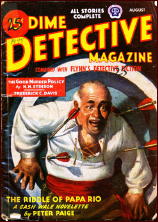
L. P. HOLMES – Destiny Range. Leisure, paperback, March 2009. First book publication: Greenberg, hardcover, 1936. First appeared in Five-Novels Monthly, May 1932; reprinted in Popular Western, October 1951.

   Dex Sublette, foreman of the Pinon Ranch, and all of the cowhands working for him are surprised to learn that the retired owner has sold the spread to a woman — and a Russian princess, to boot. They do not take the news with delight:

    “I thought I had hard luck when a bronc kicked in two ribs for me,” Shorty groaned. “But I didn’t know what hard luck was. A Russian Princess for a boss! Holy cow! If that ain’t awful! I’ll bet she’ll be a string-necked old battle-axe, soured on the world — and the male sex in particular. I’ll bet she’ll take an unholy delight in raw-hiding us to a fare-ye-well. I’ll bet–“

   Shorty couldn’t be more wrong. The young lady is Sonia Stephanovich, or at least it used to be. She now wishes to be called Sonia Stephens. Having fled the Russian Revolution with only a maid and a few belongings, she now hopes to build a new life in this section of the American West she once visited as a child.

   As for being a string-necked old battle-axe:

    Her face was a delicate oval, slightly high of cheekbone. Her skin was a dusky, smooth ivory. Her lips were bewitching. The lower one was particularly full and rich and crimson, and it gave to her expression an elfin impudence which was a delight. Here and there, from beneath the edges of her hat, a few threads of black, silken haur showed. She made an absorbing, stirring picture as she stood there, half defiantly, half appealingly.

   And of course all of the men on the ranch who now call her boss are smitten, but no more than Dex Sublette himself. The story that follows is as much a romance as it is a western novel, with all of the ups and downs and pitfalls that are bound to arise when two human beings of opposite sexes and opposite ways of life meet and are attracted to each other.

   Until, that is, page 150 or so, of a 240 page story, when Dex learns that Sonia has been kidnapped and all hell breaks loose. Not everyone survives the battle between good guys and bad, but does true love prevail? I’ll bet you already know the answer to that.

   To be honest, though, in spite of all the heroics, flying bullets and tragic deaths that occur in the last third of the book, I enjoyed the on again, off again romance in the first part of the book quite a lot more, as contrived and as (dare I say it?) corny as it reads to a modern reader today.

CONVENTION REPORT: PulpFest 2014
by Walker Martin

   I’m just back from PulpFest in Columbus, Ohio. Out of the six annual conventions which began in 2009, this one was the best. They seem to be improving each year and I’m compelled to file my convention report right away even though I’m exhausted from lack of sleep and the 10 hour ride.

   Once again, four of us rented a van because we needed a bigger vehicle to carry all our books, pulps, and artwork. Coming back, we were worried about fitting everything in and a couple big boxes had to be mailed back by UPS. One of these days we might have to take a vote and leave one of our group of biblio maniacs behind due to lack of space!

   Why do I consider this one to be the best of the six PulpFests? I never thought I would be praising the evening programming instead of just talking about the dealer’s room but this year set a standard for programming that will be hard to break in the future. During the three evenings we had over a dozen panels, tributes, and discussions:

   Laurie Powers lecture at Ohio State about her grandfather Paul Powers

   Frank Robinson Tribute

   Nathan Madison and Ed Hulse discussing FAMOUS FANTASTIC MYSTERIES, one of the great pulps.

   The Avenger’s Diamond Jubilee

   FarmerCon panel on Philip Jose Farmer

      And that was just Thursday night. Friday we enjoyed:

   1939: Science Fiction’s Boom Year

   STARTLING STORIES: An overview(Another great pulp)

   Philip Jose Farmer’s Early Science Fiction

   Pulp Premiums and Promotions by Chris Kalb

   Eighty Years of Terror: The Weird Menace Pulps

   1939: The Golden Year of ASTOUNDING STORIES

      And then Saturday evening we had the auction plus:

   UNKNOWN: The Best in Fantasy Fiction

   John Newton Howitt: a discussion about the artist by David Saunders

      Each night ended with a four chapter Buck Rogers serial.

   I’ve spent some time listing the above in detail because the former Pulpcon conventions of 1972-2008 never really had such a great number of interesting and valuable programming. I attended almost all the conventions and each Pulpcon had evening events like the Guest of Honor speech, the banquet, an auction, a radio play, and at the most, a couple of panels.

   But this year’s PulpFest had over a dozen programs on the schedule, including much needed discussions of such interesting and influential magazines as FAMOUS FANTASTIC MYSTERIES, STARTLING STORIES, TERROR TALES, ASTOUNDING, and UNKNOWN.

   We need even more such panels and tributes because they are the real reason that we continue to meet at these conventions. We read these great pulps because they are filled with excellent fiction; we collect them because they are beautiful artifacts and we are obsessed by them; we talk and discuss and argue about them because they are important subjects in magazine history and popular culture.

   I’ve spent my adult life reading, collecting, and discussing these magazines. When I think back over my life, I don’t think of myself as someone who worked as a supervisor and manager in business. No, I was, and I still am, a book, magazine and art collector who arises each day thinking of such subjects as listed above. We should all be proud to be called readers and collectors, especially in this busy modern world where we are constantly bombarded with electronic distractions.

   Another great thing about this convention involved the awarding of the Munsey Award to Randy Cox, who has written several books about the pulps and dime novels plus being the editor of THE DIME NOVEL ROUND UP for around 20 years. He has long deserved this award and recognition.

   Another pulp enthusiast and worker won the Rusty Hevelin award for service. Congratulations Barry Traylor, a long time committee member of both Pulpcon and PulpFest.

   It’s always enjoyable seeing and speaking to such interesting collectors. I also was glad to speak with Mike Nevins, who showed me a proof copy of an upcoming book, and Gordon Huber, who is the only collector to attend every Pulpcon and PulpFest since the beginning in 1972. I was also glad to see Tom Krabacher who was wearing a great UNKNOWN T-shirt one day and an ADVENTURE related shirt the next. I asked if he could make me copies of these shirts and he agreed to try. I’ll be glad to add them to my collection of shirts I wear celebrating various pulp magazines.

   In addition to this being the best PulpFest, issue number 23 of THE PULPSTER was the best of the Pulpcon and PulpFest convention magazines. The front cover shows a great Edd Cartier cover from UNKNOWN. Mike Chomko has a long article on the SF pulps, Don Hutchison discusses the weird menace magazines, Garyn Roberts talks about Ray Bradbury’s fanzine and other articles cover Argentine SF, horror pulps, Hannes Bok, Fritz Leiber, and Frank Robinson. Editor William Lampkin deserves our thanks for this excellent issue.

   The auction was the best PulpFest auction also. For the first time all items had to have minimum bid of $20 and this kept out most of the trivial and less interesting items. A nice variety of magazines were auctioned but the most interesting items were several lots from the estate of an author by the name of Everil Worrell, who appeared in several issues of WEIRD TALES during the twenties, thirties, forties, and fifties. In addition to manuscripts there were several letters from editor Dorothy McIlwraith discussing such interesting subjects as WEIRD TALES art, problems with payments, and the changeover to the smaller digest format.

   As usual I had a table in the dealer’s room and I sold several cancelled checks paying for stories in ADVENTURE MAGAZINE. I also sold DVDs, pulp related books, and magazines. But my main interest was in buying pulps and I found one of my major wants, the July 7, 1917 issue of ALL STORY. Not that it has much of interest but I’m close to completing my set of ALL STORY and now only need 3 issues of the over 400 published during 1905-1920. Frankly, when I started collecting the magazine decades ago, I never thought I’d come so close to completion simply because so many issues contain Edgar Rice Burroughs. A great magazine full of so many early science fiction classics.

   Since the 1960’s, I’ve had all the ASTOUNDING back issues but I noticed a run of the years when John Campbell worked for the magazine in 1937-1943. 72 issues, most in fine condition, which is better than my set. Naturally I had to buy it and I now have two sets of the individual issues plus a bound set. You can never have too many sets of your favorite magazines! You know it’s true love when you buy duplicate sets, which I’ve done with such titles as ASTOUNDING, PLANET STORIES, UNKNOWN, and FAMOUS FANTASTIC MYSTERIES. My wife says it’s hoarding but we all know it’s collecting.

   There were over 100 tables in a large room and attendance was between 450 and 500. This also makes it not only the best Pulpcon/PulpFest, but also the largest. The committee has already booked the Hyatt for 2015 and 2016, so we are set for the next two years. Speaking of the committee, I must thank them by name. Jack Cullers and his army of family volunteers, Mike Chomko, Barry Traylor, Ed Hulse, and Chuck Welch. Thank you fellow readers and collectors, for all your work done on this convention. I hope we all can continue to attend many more PulpFests!

Reviewed by DAVID VINEYARD:         


CLARENCE H. NEW – The Unseen Hand: An Adventure of the Freelancers of Diplomacy. Doubleday Page & Co., hardcover, 1918. Wildside Press, softcover reprint. Illustrated by Clinton Pettee. Available in ebook form online here.

   The following appeared in the January 15. 1933, issue of the New York Times:

C.H. NEW, NOVELIST, ASKED THEM IN HIS WILL NOT TO “SCATTER” HIS EFFECTS

   The heirs of Clarence H. New, Brooklyn novelist, whose serial, the Freelancers of Diplomacy, ran for twenty three years in Blue Book, are enjoined in his will from “scattering about” his personal effects in foreign countries.

   The will goes on to explain his son and grandson were travelers and prone to leave items behind them, and concludes with a quote from the will:

   â€œAs I do not believe anyone regains consciousness after death,” the will says. “I wish it distinctly understood there shall be no church or funeral ceremony.”

   That explains a bit about New, but not the Freelancers of Diplomacy, whose adventures ran in Blue Book for twenty three years with out a break, a saga Robert Sampson describes in Yesterday’s Heroes as unparalleled in American pulp history.

   Despite a history of adventure covering a few thousand pages and by my guesstimate at least one million words, there remains only one novel recounting the adventures of the Freelancers of Diplomacy, The Unseen Hand, what in science fiction used to be called a ‘fixup,’ a bit of new material tying together several shorter adventures from the magazine.

   We are given a brief history of said Freelancers from the point of view of the Germans who have recently learned the identity of the group and its leader from an American magazine — a surprisingly modern touch considering recent events in the real world of espionage and diplomacy.

   Cassells monthlies … devotes quite a lengthy article to the ‘Diplomatic Free Lance’ and his associates. This man will be remembered — by the most contemptible betrayal of confidence reposed in him by his former German hosts, who had entertained him and the woman masquerading as his wife, upon the supposition that they were people of breeding who belonged to the aristocracy — has been the solitary exception among the English to be really dangerous to us, and a rope is waiting for him as soon as he is caught. Various conjectures have been made by Wilhelmstrase as to his identity — but the truth is now kindly offered to us by the fools across the channel. It seems that he is — as we have been morally certain for sometime — a certain sports crazed English peer who has never been credited with the least political ability, Lord Trevor, of Dartmoor. In his nefarious and unprincipled schemes against us he has been assisted by the woman posing as his wife, Lady Nan Trevor; by a Sir Edward Lammerford, who was once dismissed by the English Foreign office for conduct unbecoming a diplomat and a gentleman; by a blackamoor servant calling himself an Afghan prince; by Sir Edward Wray, whose thinly veiled name is easily recognizable by every German who recalls the black treachery of August 1914; by an attache of the American Embassy in Paris; and by the old reprobate Cavaliere Scarpa, in Italy.

   Giving us our introduction to the League of the Scarlet Pimpernel — oh, sorry wrong century, the Freelancers of Diplomacy.

   Of course we know quite a bit more, for instance that Lord Trevor, the idle sportsman who is mastermind behind this group, is really American Cyrus K, Grisscome, alias Commander Cresspinge, who operated for President Roosevelt (Teddy) using his fast yacht as a mobile base.

   Of course the resemblance is only one of those coincidences of fiction … because there are no such people as Viscount Trevor of Dartmoor or Sir Edward Wray (hint, he may be the Prime Minister) in DeBrett’s. “It’s a legend, a joke, Baron Munchausen and Sherlock Holmes combined, gossip, hearsay, pure fiction …”

   If you think this is all terribly old-fashioned and out of date I refer you to bestselling writer Ted Bell’s half-American peer Alexander Hawke, Lord Hawke, who ‘freelances’ a bit himself from his heavily armed super fast yacht the Hawke. What goes around as they say.

   And it is only a coincidence that the Condessa de Montessa, her moorish servants, her titled Afghan friend, Baron W, and her husband the Earl occupy apartments so like those described in the stories published about the Diplomatic Freelance in Cassells.

   In short order we are filled in on the adventures of Cyrus Grisscome and how he ‘might’ have become Viscount Trevor, and how perhaps the Diplomatic Free Lance is something like the Mission Impossible team undertaking missions that the government can deny should they fail or be captured. About the only thing missing is the theme music and the self destructive instructions.

   Noticeably there is a good deal of back story to fill in for a series that runs twenty three years, but by chapter two we are off on the adventure, and chapter one has at least been intriguing. The ten chapters that follow are loosely connected adventures from Blue Book such as “The Aldershot Affair,” “Touching on the Honor of Islam,” “The Neutrality of Holland,” “A Machiavellian Coup in Roumania,” “The Mysterious Camp in the Pyrenees” … and the plot and action are almost non-stop and well told. For instance in that last one, Trevor and company have to foil a plot to invade France with sixty thousand men hidden in the Pyrenees wearing stolen American uniforms.

   Fantastic? Perhaps, but in WWI the Germans actually tried to smuggle anthrax-infected mules into France through the Pyrenees and in WW II specially trained SS donned American uniforms and penetrated the American lines at the Battle of the Bulge.

   Bulldog Drummond fans may appreciate a certain Madame Irma and her ‘supposed husband’ whose allegiances are in question. The Freelancers also barely avert a plot to kill Kitchener with the fleet at Skager Rock — not unlike his real death organized by the real German spy known as Fraulien Doktor. New at least knew how to read the newspapers and extrapolate.

   As with Oppenheim, Le Queux, and even Buchan and Sapper, at least some of the appeal of these was the feeling of being in on the back rooms of intrigue and espionage. Eric Ambler, Ian Fleming, and John le Carre would all mine the same territory one way or another. Whenever Bell’s Lord Hawke is in conference with the President of PM and the various Secretaries and Ministers he routinely rubs noses with it is a nod to the past and the beginnings of the genre.

   Treachery waits at every crossroads. Are there those in Spain who would aid the Kaiser to gain greater favor, can the Bulgarians be trusted (if you read Ian Fleming the answer is no but then the Bulgarians did most of the Soviet’s dirty work in the Cold War), will Holland’s neutrality be violated?

   Are people friend or foe, agents of the Boche or agents of the Entente Cordiale, fair or fowl, operating at cross purposes or for the same goal? Who can be trusted, and who should be silenced? Spy fiction hasn’t changed a lot in the century or so since its beginnings. (*)

   The Diplomatic Freelancers fall somewhere between E. Phillips Oppenheim and William LeQueux, a bit more active than the former, better written and less melodramatic than the latter. No one reading this is going to discover an early version of James Bond, the real world of Eric Ambler, or even the cut throat back alley secret wars of Peter Cheyney.

      Everyone has a title, everyone is a cliche, we are never all that far from the Scarlet Pimpernel; even the relative modernity of John Buchan, Sapper, Dornford Yates and the Clubland Heroes is some time ahead.

   But these adventures were written with conviction. As late as the pre-war years Max Brand’s Anthony Hamilton spy stories were still on this mode with spies in white tails and slinky women in black velvet, as, in many ways, were the adventures of Operator #5, and even the more realistic adventures of John P. Marquand’s Mr. Moto. And not unlike the heroes those, British agent he may be, Cyrus Grisscome is still an American and knows his own countries neutrality won’t stand against German aggression.

   â€œThere are still a few of the old breed living in America, your Highness — And they’ll wipe the stains from our good old flag in a way that will mean annihilation to everything that Germany stands for, today!”

   Duck, you Huns, Uncle Sam wants you! And admit it, even today it’s effective.

   Like Somerset Maugham’s Ashenden, or the British Agent — which it resembles in no other way — it ends with the Russian Revolution and hints of a new secret war to come in which the Diplomatic Freelancers will be needed once again. Already in 1918 the writing on the wall was clear, and this time in bright red.

   These tales and the twenty-three years worth of saga from Blue Book are worth reading today for more than nostalgia. We may be as much in Ruritania or Graustark as the real Europe, and there may be a few deadly electronic eyes (even Oppenheim used that one in The Wrath to Come), exploding cigars and poisoned needles (Le Queux’s Duckworth Drew), femme fatales poured into elegant black satin and opera gloves (everyone save Buchan), untrustworthy ‘fureigners’, loyal Afghan princes and moorish servants, and all the trappings of an earlier age, but the writing is good, the stories are fun, and the musty scent of crumbling pulp paper intoxicating, even in electronic form.

   If Clarence New and the Diplomatic Freelancers are only a name faintly redolent of black velvet cloaks lined in red satin and crossed daggers, or even if they are completely unknown to you, they are worth the effort to become acquainted with.

   There are touches of modernity, good old fashioned swashbuckling, intrigue, adventure, and entertainment to be had, and the dust you have to blow away to get to it is nowhere near as deep as you might expect. Blue Book was one of the Cadillacs of the pulps, in a rank with Adventure, Top Notch, and the various incarnations of Argosy. Names like John Buchan and Agatha Christie graced Blue Book‘s pages, so New is in heady company.

   You won’t have to lower your standards to enjoy this book, and you may wish you knew someone with a complete collection of Blue Book so you could read more. That’s a high recommendation for any series out of the pulps, though managing twenty three years of consecutive issues may be a bit ambitious for most collectors. From this example it might well be worth the effort though aside from the countless other examples of well written fiction gracing those pages.

(*)   The first modern spy novel, by all critical opinion, is John Buchan’s The Power House from 1910, however Le Queux, Oppenheim, Fred White, the adventures of Norroy and others at least reach back to the late 1880‘s early 1890‘s into the turn of the century, and it could be argued as far back as the Trojan Horse and the two Israelite spies who enter Jericho.

   Sherlock Holmes and Martin Hewitt render services to England in the area of espionage and counter-espionage, and Sexton Blake was always encountering foreign agents. Certainly the doings at Zenda in Ruritania are secret service work, and as far back as Stevenson’s ‘Pavillion on the Links’ there is international skullduggery taking place in placid old England.

   For that matter Dumas Musketeers and Monte Cristo are the very definition of ‘cloak and dagger.’ The spies may change from the Tsar’s Secret Police to the lads at Wilhelmstrasse, to Reds under the covers, and back to the Gestapo, the Japanese, the Soviets, the Chinese, Islamic terrorists, all the way to Putin’s Russia to day, but the odds and the heroes are remarkably consistent interspersed of course with an overlay of Carl Petersons, Fu Manchus, and Blofields when ever international politics got a bit dull.

« Previous PageNext Page »